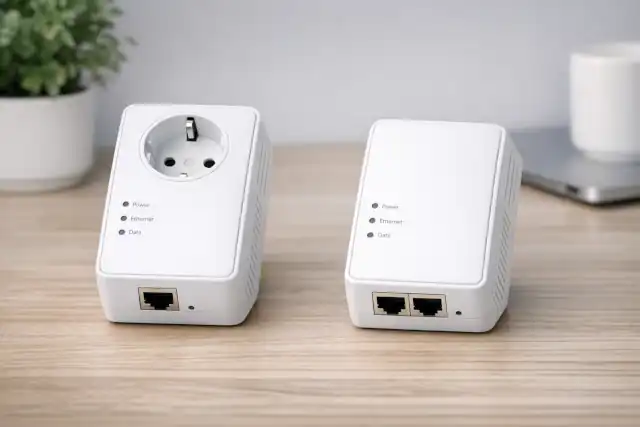
The Quiet Death of the Powerline Adapter
The Quiet Death of the Powerline Adapter
- 60% of MD5 Password Hashes Can Be Cracked in Under an Hour with a Single GPU
- Dirty Frag: Root Access on Every Major Linux Distribution — No Patch, No Warning
- Ubuntu 26.04 LTS (Resolute Raccoon): The Most Ambitious Ubuntu LTS in a Decade
- Proton Mail: Data Transferred to FBI Again!
- How Close Are Quantum Computers to Breaking RSA-2048?
- How to Prevent Ransomware Infection Risks?
- What is the best alternative to Microsoft Office?
The End of the Powerline Era
From a century-old idea to a $2.5 billion market — and now a steady retreat from our walls. Why powerline adapters lost the home network wars, what replaced them, and where they still quietly matter around the world.
There was a time, not long ago, when powerline adapters felt almost miraculous. You plugged one into a wall socket near your router, connected a second one anywhere else in the house, and suddenly that distant bedroom or stubborn basement — choked off from Wi-Fi by concrete walls, wooden floors, and electrical interference — had internet. No drills. No cable runs. No electrician. Just physics, quietly bending to your needs through wires already hidden in the walls.
That era is now drawing to a close for most households. Powerline adapters have retreated from the front shelves of electronics retailers to, at best, a lonely corner display. The dominant vocabulary of home networking has shifted to mesh systems, Wi-Fi 7, and — for those who know to look — MoCA adapters running over coaxial cable. The powerline adapter hasn’t vanished entirely, but its role as a mainstream home networking solution is effectively finished.
Understanding why requires looking beyond the simple narrative of “Wi-Fi got better.” The full story involves a century of electrical infrastructure repurposing, a fundamental mismatch between what power lines are designed to do and what we demanded of them, global market pressures that vary enormously by region, and the relentless economics of a consumer technology landscape that rewards clean, reliable solutions over clever ones. It also requires honesty about what powerline adapters actually are in 2026 — not failures, but technologies that found their true calling in places most consumers never think about.
The story is worth telling in full, because it illuminates something important about how home network technology evolves: not through single dramatic breakthroughs, but through the gradual accumulation of marginal advantages that, taken together, make the old solution feel not merely outdated but actively inferior.
The Wires Were Never Designed for This
Household power lines are unshielded, untwisted, and designed exclusively to carry 50/60 Hz alternating current. When you push high-frequency digital signals (2–86 MHz) through them, they behave like antennas — radiating energy outward and absorbing interference inward. Every vacuum cleaner, hair dryer, motor-driven appliance, and switching charger in the home injects pulse noise directly into the same medium your data is traveling through.
The result is a fundamentally noisy bus. Data packets get corrupted. The adapter retransmits. Latency spikes. The connection that was fine at 9am stumbles at 7pm when someone starts cooking dinner. The problem is not a design flaw in any particular adapter — it is a property of the infrastructure itself.
One silent killer: surge-protecting power strips, used in millions of homes, are specifically engineered to filter out high-frequency signals as “noise.” Plugging a powerline adapter into one causes it to stop working entirely — with no error message, no warning, and no obvious cause. This single fact generates an enormous proportion of user frustration and negative reviews.
Rated Speed Was a Fiction
When powerline adapters advertised speeds of 500, 1200, or even 2000 Mbps, they were quoting theoretical maximums under laboratory conditions — short cable runs, no noise, no interference, no competing devices. Real-world installations in actual homes with actual electrical loads delivered something far more modest: typically 100–300 Mbps under favorable conditions, and considerably less when household loads were high.
This performance gap would not have mattered if the competition stood still. But between 2016 and 2023, Wi-Fi mesh systems improved dramatically. A mid-tier mesh system could now deliver 400–1200 Mbps of wireless throughput with dramatically better latency characteristics, seamless roaming between nodes, and the kind of reliability that powerline simply could not match on noisy home circuits.
The moment the wireless alternative became reliably “good enough” — and then rapidly became substantially better — the case for tolerating powerline’s variability collapsed. Consumers vote with their wallets and their returns, and they voted decisively.
A Shared Bus in an Age of Private Channels
Perhaps the deepest structural problem with powerline technology is its architecture. In a home, all powerline adapters share a single electrical circuit — effectively a bus, where every node competes for the same medium simultaneously. As you add more adapters, or as electrical load increases, performance for everyone degrades. This is the opposite of modern mesh Wi-Fi, where dedicated backhaul channels on 5 GHz or 6 GHz bands carry traffic between nodes without competing with client traffic on the primary band.
Transformer boundaries add another complication. In many homes — and nearly all multi-unit buildings — different circuits are separated by transformers that block powerline signals. An adapter plugged into a circuit that passes through a different phase of the home’s electrical supply may not communicate at all with an adapter on another circuit, creating invisible dead zones that users cannot predict without trial and error.
Modern Wi-Fi 7’s Multi-Link Operation (MLO) — which allows a device to transmit and receive on multiple frequency bands simultaneously — represents the precise architectural opposite of the shared-bus model. The bandwidth gains are compounding; the interference is minimized by design.
“Powerline adapters did not fail because the idea was wrong. They failed because the problem they solved — getting a signal from one room to another — turned out to be solvable in cleaner, faster, more reliable ways that the market inevitably preferred.”
Network Horizon Analysis, March 2026
The story of powerline’s decline is not uniform across the globe. Market data reveals significant regional variation in both the rate of adoption and the nature of the replacement technologies taking over. Understanding these regional differences matters because they reveal that powerline’s retreat is being driven not just by technical inferiority, but by the specific infrastructure, regulatory, and economic conditions of each market.
Europe: Germany, Belgium, and France show persistently higher powerline penetration due to older building stock, thick concrete walls, and the widespread availability of products from manufacturers like Devolo AG. However, fiber-to-the-home buildout and Wi-Fi 6/7 mesh adoption are accelerating the decline even in these holdout markets.
North America: The U.S. and Canada moved away from powerline earlier, driven by the rapid price decline of mesh systems from Google, Amazon, and TP-Link, and the availability of MoCA adapters leveraging the continent’s extensive coaxial cable infrastructure. MoCA is a significant factor that most non-North-American markets simply don’t have access to.
Asia-Pacific: China and Japan represent the most complex picture. Asia-Pacific shows the highest growth potential for powerline in industrial and smart-grid applications — particularly G3-PLC technology deployed in Advanced Metering Infrastructure — even as home consumer adoption stagnates. India’s market remains nascent across all home networking categories, with mobile data often leapfrogging fixed-line solutions entirely.
The global powerline adapter market as a whole is still growing — but a closer reading of the data reveals that this growth is almost entirely concentrated in industrial, commercial, and smart grid segments. The residential home user segment, which once drove the category, is declining in the markets where alternatives are readily available.
Wi-Fi 7 Adoption Index by Region (2025–2026)
- North America 88%
- W. Europe 74%
- Japan / S. Korea 70%
- China 55%*
- SE Asia 42%
- Latin America 30%
- India 18%
- MEA 14%
*China’s 6 GHz band is not allocated for unlicensed Wi-Fi use, limiting full Wi-Fi 7 capability. Source: WBA Industry Report 2025, Network Horizon analysis.
Wi-Fi 7 Shipments
26.3M → 66.5M → 117.9M projected. Source: WBA / ABI Research
| Technology | Real-World Speed | Latency | Reliability | Infrastructure | Setup | Best For | Verdict |
|---|---|---|---|---|---|---|---|
| Powerline AV2 | 100–300 Mbps | 10–50ms (variable) | Poor–Fair | Existing power lines | Very easy | Last resort; no coax, poor Wi-Fi, older buildings | Legacy |
| Wi-Fi Mesh (6/6E) | 400–1,200 Mbps | 3–15ms | Very Good | None required | Easy | Whole-home coverage; rental properties | Mainstream |
| Wi-Fi 7 Mesh | 600–4,000+ Mbps | 1–5ms | Excellent | None required | Easy | High-density smart homes; gaming; AR/VR | Premium Choice |
| MoCA 2.5 | Up to 2,500 Mbps | <5ms | Excellent | Existing coax cable | Moderate | Wired backhaul; gaming; low-latency streaming | Underrated |
| Ethernet (Cat6/6A) | 1,000–10,000 Mbps | <1ms | Best available | New cable runs required | Requires installation | New builds; maximum performance environments | Gold Standard |
| 5G Home Gateway | 100–900 Mbps | 5–30ms | Good (coverage dependent) | 5G signal required | Very easy | Rural / no-fibre areas; temporary setups | Situational |
Declaring powerline communication dead would be both premature and wrong — the technology is not dying, it is migrating. The same physical properties that make powerline adapters frustrating in homes make them indispensable in industrial and infrastructure contexts where those properties are features, not bugs.
Smart grid infrastructure is the clearest example. Advanced Metering Infrastructure (AMI) systems — the backbone of modern electricity billing and demand management — rely on G3-PLC and PRIME standards to transmit meter readings from millions of endpoints across existing power distribution networks. The key insight is that the power company already has wires running to every building it serves. Installing separate communication infrastructure would be vastly more expensive. PLC turns that existing investment into a two-way communication channel at minimal additional cost.
Similarly, smart street lighting networks, building management systems, and solar micro-inverter monitoring all use powerline communication to aggregate data from geographically distributed endpoints without laying new cable. In these applications, the bandwidth requirements are modest — a smart meter sends kilobytes per day, not gigabytes — and the coverage is everything. No other technology offers that combination of universal reach and zero new infrastructure.
Even in homes, powerline has not entirely disappeared. In a small number of specific scenarios — older apartment buildings where neither mesh coverage penetrates effectively nor coaxial wiring exists — a powerline adapter remains the only practical option that does not require a contractor. Some manufacturers have responded by embedding powerline as a fallback backhaul layer in hybrid mesh systems, using it only when dedicated wireless backhaul is insufficient. This hybrid approach is a pragmatic acknowledgment that “last resort” is still a valid use case.
The honest assessment is that powerline technology found its true market, and it was never really the home. The industrial and smart city segments are growing robustly, and G3-PLC deployments in European and Asian smart grid rollouts represent a genuine technology success story — just not the one the consumer electronics industry was originally selling.
Smart Grid / AMI
G3-PLC and PRIME standards power advanced metering across Europe, Asia, and the Americas. Utility-grade; growing robustly.
Smart Street Lighting
Municipal lighting networks use PLC to manage, dim, and monitor millions of streetlights without separate communication cable.
Solar Micro-Inverters
Rooftop solar arrays use PLC to aggregate performance data from individual panels back to a gateway using the AC wiring that’s already there.
Building Automation
HVAC control, access systems, and energy management in commercial buildings leverage PLC where Ethernet installation is disruptive or cost-prohibitive.
Hybrid Home Mesh
TP-Link Deco P9 and similar products embed powerline backhaul as a fallback layer, giving mesh systems a wired path of last resort.
A Technology That Found Its True Calling — Just Not in Your Living Room
The story of powerline adapters is ultimately a story about the gap between a clever idea and a good solution. The idea was clever: electrical wiring is everywhere, copper is copper, and if you can modulate data onto the carrier wave carefully enough, you can use infrastructure that was already paid for. For a window of years — roughly 2005 to 2015 — that cleverness was sufficient, because the alternatives were worse.
What changed was not that powerline got worse. It is essentially the same technology it was a decade ago, with modest improvements in modulation efficiency and speed ratings that rarely materialize in real-world conditions. What changed was everything around it. Mesh Wi-Fi systems dropped in price, rose in performance, and became genuinely reliable. Wi-Fi 6 and now Wi-Fi 7 brought dedicated backhaul bands, multi-link operation, and AI-assisted network management to the mass market. MoCA turned coaxial cable into a Gigabit-class data medium for homes that have it. The gap between “good enough” and “powerline” grew too wide to ignore.
There is a broader lesson here about home networking technology. Consumer tolerance for unreliability is extremely low — perhaps lower than in any other technology category. A fridge that works 85% of the time is unacceptable. So is an internet connection. The variability that powerline adapters introduced — the connection that stuttered when someone vacuumed, the performance that degraded on a cold evening when the heating came on — was always a liability. When reliable alternatives became affordable, adoption shifted decisively and permanently.
Looking forward, the home network landscape of 2026 and beyond is one of accelerating capability. Wi-Fi 7 access point shipments are projected at 117.9 million units in 2026, up from 66.5 million in 2025 — and Wi-Fi 8 (802.11bn) is already moving from specification to early commercial products, with Broadcom having launched a full ecosystem in October 2025. The pace of iteration in wireless networking has never been faster, and each generation makes the case for wired-over-powerline solutions that much weaker.
For the consumer, the message is clear: if you still have powerline adapters in your home, there is almost certainly a better option available to you today at a comparable or lower price. If you have coaxial cable, MoCA 2.5 will outperform your powerline setup by a significant margin. If you don’t, a modern tri-band Wi-Fi 7 mesh system with wireless backhaul will deliver better throughput, lower latency, and dramatically higher reliability than any powerline solution.
The sockets are still in the walls. But the internet — for most of us, in most homes — has found a better way to travel between them.
“Powerline adapters were a hack — an ingenious repurposing of infrastructure never designed for the job. For a window of time, the hack was good enough to matter. The infrastructure built for the job has now caught up. The power lines remain. The adapters, quietly, are leaving.”