What’s the Connection Between Bitcoin’s Flash Crash and Musk’s Sell-off?
What’s the Connection Between Bitcoin’s Flash Crash and Musk’s Sell-off?
What’s the Connection Between Bitcoin’s Flash Crash and Musk’s Sell-off? “Darkest Hour” May Not Have Arrived Yet.
Last Friday, the cryptocurrency market witnessed a dramatic flash crash, with Bitcoin, the largest digital asset by market capitalization, plummeting over $2,000 in just a few minutes.
This event was even more intense than when Silicon Valley Bank suddenly collapsed in March.
Analysts suggest that while news of Elon Musk’s space exploration company SpaceX writing down the value of its Bitcoin holdings to zero acted as a direct catalyst, the underlying cause was a lack of market liquidity, meaning that asset prices would experience severe fluctuations at the slightest hint of trouble.
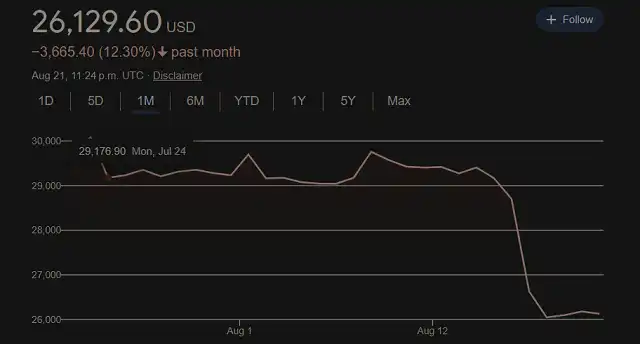
Moreover, concerns about the Federal Reserve continuing to raise interest rates, sustained increases in long-term U.S. Treasury yields, and selling behavior by large participants in the market could have also played catalytic roles.
However, the “darkest hour” for this asset may not have arrived yet. Mark Connors, Head of Research at Canadian fund management company 3iQ, told First Finance News, “Bitcoin’s true decline has only just begun, and this volatility could persist.”
What Happened?
On the 18th, after weeks of relative calm, volatility returned to the Bitcoin market. The price of Bitcoin, which was around $28,600 on the 17th, briefly dropped to a low of $25,200 within a day, marking an 11% decline. In the early hours of the same day, Bitcoin plummeted over $2,000 in just a few minutes.
Some market observers noted that this Bitcoin crash coincided with reports that Musk’s SpaceX had written down the value of its Bitcoin holdings by $373 million in total for the year 2020 and 2021.
Tesla had previously taken similar actions with its Bitcoin holdings. Consequently, this news was seen as the direct trigger for the flash crash.
However, analysts point out that because SpaceX is a private company, the completeness of the financial information reported by the media remains uncertain.
Other cryptocurrencies, including Ethereum, Ripple (XRP), and Binance Coin, were not spared either. Within the 18th, Ethereum also experienced a drop of over 13%, briefly falling below the $1,600 mark.
The intense market turbulence led to widespread liquidations across various exchanges. Data from third-party industry service provider Coinglass indicated that as of midnight on the 19th, a total of 171,000 positions were liquidated within a 24-hour period, amounting to $1.018 billion, surpassing the $800 million liquidation caused during last year’s cryptocurrency exchange FTX’s crisis but trailing the $1.3 billion liquidation triggered by the May 19, 2021, cryptocurrency market crash and the $3 billion liquidation on March 12, 2020.
Gareth Soloway, President and Chief Market Strategist at InTheMoneyStocks.com, commented on social media that the news about SpaceX might have exacerbated selling pressure due to thin trading, amplifying volatility when buyers were scarce.
The Darkest Hour Yet to Come?
While the market generally believes that the Federal Reserve’s interest rate hikes for the remainder of the year have concluded, the latest meeting minutes from the Federal Open Market Committee (FOMC), released on the 17th, stated, “Most participants continued to view the risks to inflation as skewed to the upside and saw the risk that transitory factors could lead to more persistent inflation as having increased.”
Due to concerns that the Fed might maintain interest rates at elevated levels for an extended period, long-term U.S. bond yields have returned to the highest levels in over a decade, reducing the attractiveness of alternative investments.
Moreover, regulatory policies regarding Bitcoin and cryptocurrencies have been issued by entities such as the U.S. Securities and Exchange Commission (SEC), the Financial Crimes Enforcement Network (FinCEN), the Commodity Futures Trading Commission (CFTC), and the National Futures Association (NFA).
“We are not surprised when we see yields gradually rising, up 25 basis points in a month, with the 10-year U.S. bond yield reaching 4.25% – the highest level in a long time. Mortgage rates are higher, and the next challenge for the cryptocurrency market is credit risk default,” added Connors.
On the 18th, Bitcoin briefly rebounded in response to news that the U.S. SEC was considering approving an Ethereum futures ETF. The report indicated that the U.S. SEC intends to greenlight the first ETF based on Ethereum futures.
Several ETFs are expected to go live as early as October, with nearly 12 companies, including Volatility Shares, Bitwise, Roundhill, and ProShares, having already submitted applications.
Analysts suggest that the next support level for Bitcoin, following its drop below $28,500, lies at $25,000. If breached, it could accelerate liquidation.
“Given the limited catalysts to drive Bitcoin higher in the short term, if it falls below $25,000, the bears may gain the upper hand. If the global selloff of risk assets continues, Bitcoin could further decline,” said Josh Gilbert, Market Analyst at investment firm eToro.
In recent years, central banks in many countries have intensified their regulation of digital currencies like Bitcoin.
Institutions such as the European Central Bank and the European Securities and Markets Authority (ESMA) have issued regulatory policies regarding Bitcoin and cryptocurrencies.
The Financial Services Agency (FSA) of Japan has outlined regulatory policies for Bitcoin and cryptocurrencies, including anti-money laundering measures and review requirements for Bitcoin exchanges.
The Financial Services Commission (FSC) in South Korea has also implemented regulations, including limits on Bitcoin trading volume and transaction amounts.