Secret of Intel Arc Gaming GPU Drivers: 45% Performance Boost
Secret of Intel Arc Gaming GPU Drivers: 45% Performance Boost
Secret of Intel Arc Gaming GPU Drivers: 45% Performance Boost.
Where Did the 45% Improvement Come From? Unveiling the Secrets of Intel Arc Gaming GPU Drivers.
As a newcomer to the independent gaming GPU market, Intel has been in the game for just over a year. Initially, there were some shortcomings, be it in product, technology, hardware, or software, but it’s evident that Intel is dead serious about gaming GPUs!
Back in the first quarter of this year, Intel announced that, through continuous optimization, the DX9 gaming performance of the Arc gaming GPUs has improved by an average of up to 43% since their initial launch, with some titles even seeing gains exceeding 60%.
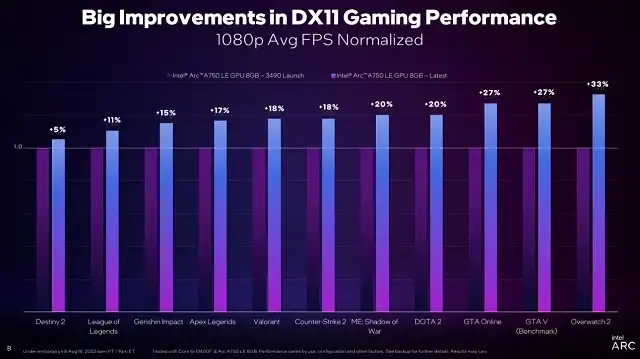
Today, thanks to iterative enhancements across more than 30 driver versions, Intel’s Arc gaming GPUs have achieved an average cumulative improvement of 19% in DX11 gaming performance and a 20% boost in overall smoothness. Notably, games like “Overwatch 2” have witnessed performance leaps of 33% to a staggering 45%.
Furthermore, Intel has extended driver support to as many as 57 games on the day of their release, and the list of games supporting XeSS (Intel’s supersampling technology) has surpassed 70.
In addition to performance optimization, Intel has introduced the all-new PresentMon tool with a significant feature called GPU Busy.
This tool allows developers to measure GPU rendering time and the balance between the CPU and GPU, facilitating game optimization and ensuring players enjoy the best settings and experiences.
It’s worth mentioning that Intel’s Arc GPUs initially faced some challenges in 3DMark benchmark scores and exhibited lower performance in specific games.
This was due to the ideal synchronization between GPU Busy and frame rendering time in benchmark tests, which maximizes overall efficiency.
In contrast, games require targeted and continuous deep-level optimization to deliver improved performance.
Another crucial feature is Overlay, which provides real-time displays of GPU usage, voltage, temperature, 99% frame time, GPU Busy, and other metrics while running games, empowering players to monitor game and hardware statuses effortlessly.
PresentMon is not only comprehensive and powerful but also highly versatile and open.
It supports not only Intel GPUs but also NVIDIA and AMD GPUs and offers full compatibility with games using various API interfaces, including DX9, DX11, DX12, and Vulkan.
To delve into the “secrets” behind the continuous improvement of Intel’s Arc gaming GPUs, Tech Fast once again had a conversation with Intel Fellow and graphics technology expert Tom Peterson, particularly focusing on driver updates.
Tom Peterson pointed out that Intel boasts a substantial software team dedicated to continuously enhancing the performance of Intel Arc GPUs.
They achieve this through the consistent release of driver updates.
On one hand, Intel is continually refining its driver optimization methods and has already made significant strides.
In the past six months alone, around 30 DX12 games have seen varying degrees of improvement, as the Vulkan API behaves similarly to DX12 and Intel’s DX12 drivers have shown impressive performance with Arc GPUs. Consequently, Vulkan games perform exceptionally well on Intel Arc GPUs.
On the other hand, Intel occasionally releases specialized driver versions tailored to new major games.
These versions include adjustments specific to the requirements of those games. To date, 57 new games have received this treatment.
Of course, driver updates aren’t always smooth sailing and can sometimes introduce new bugs while fixing existing ones. Tom Peterson explained that it’s a balancing act.
No one wants new bugs, but the need for continuous iteration to address more critical issues requires finding a good balance. Thus, even if new bugs or issues arise, they are swiftly resolved.
In this round of optimizing DX11 games, Intel has also adopted a steady and methodical approach.
Starting with a few representative DX11 games, they focused on significant improvements and then spent several months optimizing support for a broader range of DX11 games.
Looking ahead, Tom Peterson emphasized that driver updates require ongoing investment.
They need to keep thinking and innovating to continue the positive momentum and adapt flexibly based on progress.
Speaking of new technologies, an important focus of Intel’s driver efforts is shader caching.
They plan to build a new software architecture to store compiled shaders, which will accelerate execution.
Furthermore, Intel’s software team is increasingly collaborating with software developers.
As people become more familiar with and adapt to Intel Arc GPU architecture, they can utilize it more efficiently.
In the long run, this benefits Intel, as wider adoption of Arc GPUs in games and applications fosters a positive feedback loop.
As Arc GPUs gain more recognition from players and developers, it facilitates further optimization and adaptation efforts.
It’s this dedicated, ongoing work that has earned Intel Arc GPUs recognition and favor from a growing number of manufacturers, including Acer, Sparkle, Matrox, and ASRock.
These brands have joined Intel’s GPU camp and introduced a diverse range of products with varied pricing, catering to the needs of different user segments.
Tom Petersen expressed his satisfaction with this cooperation, emphasizing that GPU manufacturers have their decision-making processes. He’s delighted to see their partnership with Intel bearing fruit in today’s achievements.
Providing high-quality products to partners, improving market recognition through outstanding product performance, and helping partners create more demand in the consumer market is what Intel is working on.
Lastly, regarding changes in the GPU market, Tom Peterson believes that most products in the current GPU market have seen significant price increases compared to previous generations.
As a new entrant, Intel is striving to bring balance to the GPU market, but this will take time. Consumers need time to gain a deeper understanding of and trust in Intel’s products.
He particularly emphasized that Intel will continue to cultivate the GPU market, earn the trust of more gamers, and win consumers’ favor through excellent product performance and exceptional value for money.