ARM Unveils Cortex-M52: AI Acceleration for Affordable IoT Devices
ARM Unveils Cortex-M52: AI Acceleration for Affordable IoT Devices
- Why Enterprise RAID Rebuilding Succeeds Where Consumer Arrays Fail?
- Linus Torvalds Rejects MMC Subsystem Updates for Linux 7.0: “Complete Garbage”
- The Man Who Maintained Sudo for 30 Years Now Struggles to Fund the Work That Powers Millions of Servers
- How Close Are Quantum Computers to Breaking RSA-2048?
- Why Windows 10 Users Are Flocking to Zorin OS 18 Instead of Linux Mint?
- How to Prevent Ransomware Infection Risks?
- What is the best alternative to Microsoft Office?
ARM Unveils Cortex-M52: AI Acceleration for Affordable IoT Devices.
ARM Cortex-M52 Chip to Launch Next Year Bringing AI Acceleration to Low-Power IoT Devices.
While artificial intelligence algorithms seem omnipresent, processing on the most popular platforms requires powerful server GPUs to deliver generative services to customers.
ARM is introducing a new dedicated chip design that, starting next year, will provide AI acceleration capabilities even in the most cost-effective IoT devices.
According to the company, the ARM Cortex-M52 is the smallest and most cost-effective processor designed for AI acceleration applications.
As ARM claims, this latest design from the UK-based fab-less company is poised to offer “enhanced” AI capabilities for Internet of Things (IoT) devices without the need for a separate computing unit.
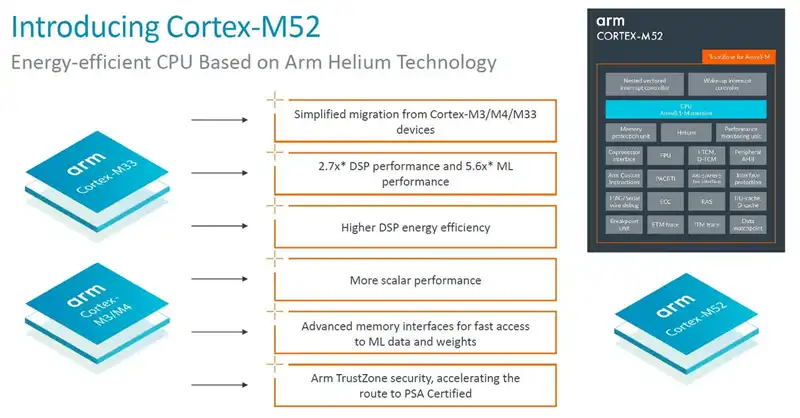
Paul Williamson, Senior Vice President and General Manager of IoT Business at ARM, emphasized that to fully harness the potential of AI in the IoT domain, machine learning optimized processing must be introduced into “minimal, lowest-power” terminal devices. Williamson pointed out that although AI is ubiquitous, smarter and more powerful IoT devices are needed to extract “intelligence” from the vast amount of data flowing through digital devices.
The Cortex-M52 chip design incorporates ARM’s Helium technology, adding 150 new scalar and vector instructions to the ARMv8.1-M Cortex-M series (including Cortex-M55 and Cortex-M85). Compared to the previous generation Cortex-M, Helium instructions can improve the performance of machine learning algorithms by 5.6 times and enhance the performance of digital signal processing (DSP) workloads by 2.7 times.
As ARM explains, security remains a crucial aspect. Cortex-M52 implements the latest security extensions of ARMv8.1-M (PACBTI, ARM TrustZone). The new chip design also promotes a “modernized development process,” and according to ARM, developers can access a unified toolchain for the Cortex-M platform and fully support AI workflows.
Before Cortex-M52, developers had to combine CPU, DSP, and NPU units with three different software toolkits to achieve the ML and DSP performance offered by the new design. ARM states that now only one toolchain is needed. Cortex-M52 is fully compatible with software written for Cortex-M55 and Cortex-M85, and the new chip will also undergo silicon pre-development through the ARM Virtual Hardware Cloud platform.
Williamson states that Cortex-M52 technology can be integrated into very low-cost IoT products through licensing, with chips costing 1-2 dollars potentially making up a significant portion of production volume. He adds that the chip can also be integrated into “slightly more feature-rich” IoT devices.