ASRock’s H610M COMBO II: The Motherboard With Both DDR4 and DDR5 Slots
ASRock’s H610M COMBO II: The Motherboard With Both DDR4 and DDR5 Slots
- Why Enterprise RAID Rebuilding Succeeds Where Consumer Arrays Fail?
- Linus Torvalds Rejects MMC Subsystem Updates for Linux 7.0: “Complete Garbage”
- The Man Who Maintained Sudo for 30 Years Now Struggles to Fund the Work That Powers Millions of Servers
- How Close Are Quantum Computers to Breaking RSA-2048?
- Why Windows 10 Users Are Flocking to Zorin OS 18 Instead of Linux Mint?
- How to Prevent Ransomware Infection Risks?
- What is the best alternative to Microsoft Office?
ASRock’s H610M COMBO II: The Motherboard With Both DDR4 and DDR5 Slots
A compact Micro-ATX board for Intel LGA1700 quietly arrives with a startling trick: three DIMM slots spanning two generations of RAM, in the middle of a global memory price crisis.
ASRock has never been afraid to build the motherboard nobody asked for — and then watch the market catch up. On March 14, 2026, the Taiwanese manufacturer quietly listed the H610M COMBO II in select regions, the second entry in its unconventional “COMBO” series of LGA1700 boards designed to accept both DDR4 and DDR5 memory modules. The launch generated little fanfare from ASRock itself, but the tech press took notice almost immediately.
The timing is far from accidental. The global RAM market in early 2026 is under severe stress. DDR5 shortages driven by AI infrastructure demand have pushed 32 GB DDR5 kits above $350 in the United States, while DDR4 — technically last-gen but still perfectly capable — has become scarce as manufacturers pivot production lines toward more profitable LPDDR5X and HBM. The H610M COMBO II offers builders a third path: choose whichever memory generation you can actually find and afford, then upgrade later.
“Use whatever memory you can find or afford — DDR4 or DDR5 — and retain upgrade flexibility for the future.”
The design philosophy behind ASRock’s COMBO seriesWhat Is the H610M COMBO II?
The H610M COMBO II is a Micro-ATX motherboard built on Intel’s entry-level H610 chipset, supporting 12th, 13th, and 14th generation Intel Core processors (Alder Lake, Raptor Lake, and Raptor Lake Refresh) on the LGA1700 socket. It is the follow-up to the original H610M COMBO announced at CES 2026, which used a larger 24.4 × 24.4 cm PCB with six DIMM slots.
The COMBO II trims things down considerably. Its PCB measures 22 × 20.3 cm and features just three DIMM slots in total: two DDR5 and one DDR4. This makes it a more practical board for the configurations most builders actually need: a 16 GB or 32 GB single-memory-type setup, not a maxed-out workstation configuration.
| Chipset | Intel H610 |
| Socket | LGA1700 (Intel 12th / 13th / 14th Gen) |
| Form Factor | Micro-ATX (22 × 20.3 cm) |
| Memory Slots | 2 × DDR5 + 1 × DDR4 (COMBO design) |
| DDR5 Speed | Up to 5600 MT/s (14th Gen) / 4800 MT/s (12–13th Gen) |
| DDR4 Speed | Up to 3200 MT/s |
| Max Memory | 96 GB DDR5 or 32 GB DDR4 |
| PCIe | 1 × PCIe 5.0 x16, 1 × PCIe 3.0 x1 |
| Storage | 1 × M.2 (PCIe Gen3 x4), 4 × SATA III |
| VRM | 6+1+1 Phase Power Design |
| Display Outputs | D-Sub (VGA), HDMI 2.1 (4K/60Hz), DisplayPort 1.4 (8K) |
| Networking | Realtek RTL8111H Gigabit LAN |
| Audio | Realtek ALC897 7.1 HD |
| USB (Rear) | 4 × USB 3.2 Gen1, 6 × USB 2.0, 1 × PS/2 |
| Availability | Select regions only; pricing TBD |
The Hybrid Memory Design: How It Works
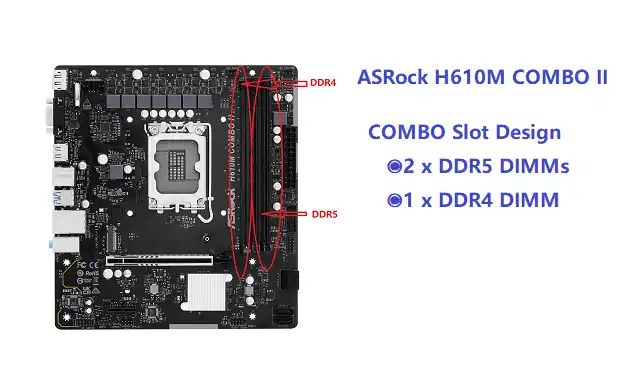
The defining feature of the COMBO II is its three-slot “COMBO” memory configuration. Two slots are standard DDR5 DIMMs; the third, positioned closest to the CPU socket, is a DDR4 DIMM slot. The physical keying of DDR4 and DDR5 slots differs — the notch positions are incompatible — so accidental misinstallation is essentially impossible.
(DDR4)
(DDR5)
(DDR5)
Only one memory type may be installed at a time. DDR5 supports dual-channel across its two slots; DDR4 is single-channel with one slot only.
This design is made possible by a feature unique to Intel’s 12th–14th generation Core CPUs: their memory controllers can natively handle both DDR4 and DDR5 signaling. When Intel launched Alder Lake in late 2021, it was the first mainstream desktop platform to offer this dual-standard support, originally intended to ease the industry’s transition to DDR5. Most motherboard vendors responded by making separate DDR4 and DDR5 board variants. ASRock is taking the more ambitious approach of a single board supporting both — at the cost of considerable PCB engineering complexity.
Routing two different memory standards on one PCB requires separate signal trace paths, separate power delivery planes (DDR4 runs at 1.2V; DDR5 at 1.1V with integrated voltage regulators on the modules themselves), and validation across every speed grade of each standard. It is engineering work most manufacturers consider economically unjustifiable. ASRock, which previously built similar hybrid boards during the DDR-to-DDR2 and DDR3-to-DDR4 transitions, has a long institutional memory for exactly these situations.
Can You Use DDR4 and DDR5 at the Same Time?
No — and this is the single most important thing to understand about the COMBO design. The H610M COMBO II does not support mixed DDR4 and DDR5 operation at the same time. You must choose one memory standard per build: either populate the one DDR4 slot, or populate the two DDR5 slots. Installing both types simultaneously will prevent the system from booting.
This is a fundamental hardware constraint, not a firmware limitation that could be patched away. DDR4 and DDR5 run at different voltages, use different command/address protocols, and are served by entirely separate memory controller logic inside the CPU. Intel’s hybrid memory controller selects its operating mode during system initialization based on which slots are populated — it cannot service both buses at once.
What the board enables is a future migration path without replacing the motherboard: build today with DDR4 you already own or can source cheaply, then swap in DDR5 sticks when prices normalize. The CPU and board remain unchanged. Only the memory modules need to change.
Why Build This in 2026?
To understand the H610M COMBO II’s rationale, you need to understand the current state of the memory market. DDR5’s consumer adoption has been accelerated not by demand, but by AI infrastructure’s voracious appetite for high-bandwidth memory. Manufacturers including Micron and Samsung have redirected significant fab capacity toward HBM and LPDDR5X, squeezing consumer DDR5 supply. Meanwhile, DDR4 production is being wound down, making large-capacity DDR4 kits increasingly scarce in many regions.
The result is a market where builders in different regions face wildly different conditions: DDR5 may be expensive and available in one country, while DDR4 is cheap but running out in another. A board that accepts either standard becomes genuinely practical in ways that would have seemed unnecessary as recently as 2024.
The Rest of the Board: Honest Entry-Level
Away from its headline feature, the H610M COMBO II is a no-frills entry-level board with realistic ambitions. The 6+1+1 phase VRM is adequate for 65W non-K Intel processors but will strain under high-TDP configurations. Storage is limited to a single M.2 Gen3 x4 slot — no Gen4 — plus four SATA ports. The inclusion of a PCIe 5.0 x16 slot is a notable bright spot for an H610 board, ensuring full bandwidth compatibility with current discrete GPUs.
Display output coverage is surprisingly broad: VGA (D-Sub) for legacy monitors, HDMI 2.1 for 4K/60Hz, and DisplayPort 1.4 with DSC for 8K or 5K resolutions. Networking uses a Realtek RTL8111H Gigabit LAN controller with no onboard Wi-Fi. Audio is handled by the Realtek ALC897 7.1-channel HD codec. USB connectivity on the rear I/O is functional but not generous: four USB 3.2 Gen1 and six USB 2.0 ports, plus a PS/2 legacy port.
Verdict: A Pragmatic Answer to an Unprecedented Problem
The H610M COMBO II is not a performance showcase. Its H610 chipset prevents overclocking, its VRM is modest, and a single M.2 slot will frustrate anyone building a storage-intensive rig. But performance was never the point. ASRock built this board to solve a specific and currently very real problem: how do you build a cost-effective PC when neither DDR4 nor DDR5 is reliably available at a sane price?
The answer — a board that accepts either — is inelegant by engineering standards and difficult to manufacture at scale, which is presumably why the COMBO II is confirmed only for select regional markets with no announced pricing. But for a builder who has DDR4 sitting in a drawer, or who lives in a market where one standard is dramatically more affordable than the other, it is exactly the right product at exactly the right time.
Whether other manufacturers follow suit depends on how long the current memory market dislocation persists. If DDR5 prices normalize by late 2026, hybrid boards like the COMBO II may be remembered as an interesting footnote. If the shortage deepens, expect imitation to be the sincerest form of flattery.
Key Takeaways
The ASRock H610M COMBO II is an Intel LGA1700 Micro-ATX motherboard with two DDR5 slots and one DDR4 slot — a configuration unique in the consumer market. DDR4 and DDR5 cannot run simultaneously; builders select one per build. The board exists as a direct response to 2025–2026 RAM market disruptions, offering maximum flexibility when sourcing memory. Outside its hybrid memory design, it is a capable but strictly entry-level platform suited to 65W Intel 12th–14th Gen processors and everyday computing workloads.