Austria’s Military Ditches Microsoft Office: A Neutral Nation’s Quest for Digital Sovereignty
Austria’s Military Ditches Microsoft Office: A Neutral Nation’s Quest for Digital Sovereignty
- Why Enterprise RAID Rebuilding Succeeds Where Consumer Arrays Fail?
- Linus Torvalds Rejects MMC Subsystem Updates for Linux 7.0: “Complete Garbage”
- The Man Who Maintained Sudo for 30 Years Now Struggles to Fund the Work That Powers Millions of Servers
- How Close Are Quantum Computers to Breaking RSA-2048?
- Why Windows 10 Users Are Flocking to Zorin OS 18 Instead of Linux Mint?
- How to Prevent Ransomware Infection Risks?
- What is the best alternative to Microsoft Office?
Austria’s Military Ditches Microsoft Office: A Neutral Nation’s Quest for Digital Sovereignty
How a pro-Western European country chose data control over convenience—and what it means for the future of European digital independence
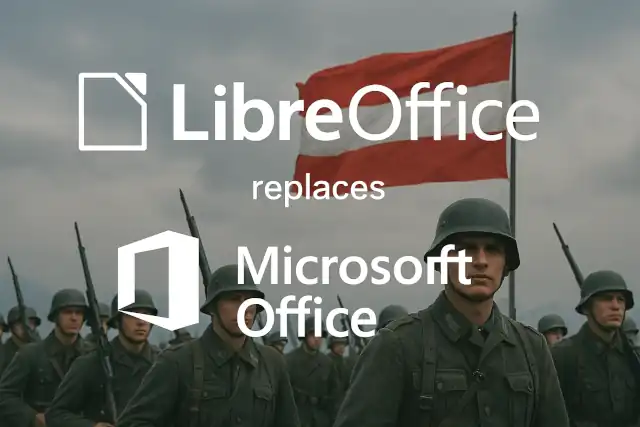
In September 2025, the Austrian Armed Forces (Bundesheer) completed a remarkable transformation: removing Microsoft Office from all 16,000 military computers and replacing it with LibreOffice, an open-source alternative.
This wasn’t a budget-cutting measure or a technology experiment—it was a calculated assertion of digital sovereignty by a traditionally pro-Western nation that has grown increasingly wary of foreign control over sensitive military data.
Why German State Governments Are Abandoning Microsoft Office for Open-Source Solutions
The Decision: 2021
Austria’s military made the decisive move in 2021, though planning had begun a year earlier. The catalyst wasn’t an immediate crisis but rather a long-term strategic concern: Microsoft’s aggressive push toward mandatory cloud services. Austrian military IT officials, led by Michael Hillebrand, head of the ICT department, recognized that this shift would force sensitive defense data onto external servers potentially accessible by foreign entities, including US intelligence agencies under laws like the Foreign Intelligence Surveillance Act (FISA) and the CLOUD Act.
“The real goal is digital sovereignty: keeping sensitive military data on our own servers, not on external cloud services that foreign entities can access,” Hillebrand explained. The transition took four years to implement fully, with careful attention to training, testing, and gradual rollout—completing the migration by September 2025.
Austria’s decision is particularly noteworthy given its close security cooperation with Western nations. Though constitutionally neutral and not a NATO member, Austria maintains active partnerships with NATO through the Partnership for Peace program and participates in Western defense initiatives and intelligence sharing as an EU member state. This makes the Austrian military’s deliberate choice to eliminate American software from its core IT infrastructure all the more significant—a signal that even traditionally pro-Western European nations are prioritizing data autonomy over vendor convenience.
Can LibreOffice Replace Microsoft Office? A Comprehensive Comparison
A Continental Movement
Austria is far from alone. Across Europe, a remarkable wave of digital independence is sweeping through government institutions, driven by concerns over data privacy, geopolitical vulnerability, and the desire to control national digital infrastructure.
Germany: The Pioneer
Germany’s Schleswig-Holstein state has emerged as Europe’s boldest open-source adopter. In April 2024, it announced plans to migrate 30,000 government computers—serving civil servants, police, and the judiciary—from Microsoft’s entire ecosystem to Linux and LibreOffice by the end of 2025. Minister-President Daniel Günther emphasized that the move was about achieving “complete digital sovereignty” for the state.
By September 2025, Schleswig-Holstein had largely completed this transition, becoming the first major European jurisdiction to entirely eliminate Microsoft Teams, Outlook, Word, Excel, and Windows from public offices. The state replaced these with LibreOffice for productivity, Linux for operating systems, and Open-Xchange for email and collaboration—all hosted on German-controlled cloud infrastructure.
The motivation extends beyond cost savings. “We must ensure that the state controls the IT systems it uses and continues to independently manage the data of citizens and businesses,” the government’s April 2025 policy statement declared. “It is essential to reduce current dependencies and pursue the path toward digital sovereignty.”
Denmark: National-Level Commitment
In June 2025, Denmark took the movement to the national level. Digital Minister Caroline Stage Olsen announced that the Danish Ministry of Digital Affairs would transition half its staff to Linux and LibreOffice by August 2025, with complete implementation by autumn. Denmark’s two largest cities, Copenhagen and Aarhus, quickly followed suit.
“We must never make ourselves so dependent on so few that we can no longer act freely,” Olsen stated. “Too much public digital infrastructure is currently tied up with very few foreign suppliers. This makes us vulnerable.”
The Danish decision was partly catalyzed by geopolitical concerns, including reports that Microsoft had allegedly locked the International Criminal Court’s Chief Prosecutor out of his email accounts following sanctions—a stark reminder of the vulnerability created by dependence on foreign software providers.
France, Italy, and Beyond
France has long pursued digital sovereignty, with 11 French ministries installing LibreOffice on 500,000 workstations. The National Gendarmerie successfully transitioned 37,000 desktops to Linux between 2004 and 2013, saving millions in licensing fees while gaining greater operational independence. In June 2025, the city of Lyon announced it would abandon Microsoft products entirely in favor of open-source alternatives, with €2 million in government funding supporting the development of local digital infrastructure.
Italy’s Ministry of Defence standardized on LibreOffice and the OpenDocument Format across 150,000 PCs between 2015 and 2016. The city of Toulouse saved approximately €1.8 million over three years by migrating 90% of its desktops to LibreOffice, while Barcelona has invested heavily in open-source software as part of its broader digital strategy.
Windows Software Alternatives in Linux OS
Why Now? The Geopolitical Context
Several factors have converged to accelerate Europe’s digital independence movement:
Extraterritorial US Laws: American legislation like the CLOUD Act gives US authorities potential access to data held by American companies, regardless of where that data is physically stored. For European governments handling sensitive citizen information or military intelligence, this represents an unacceptable sovereignty risk.
Rising Cybersecurity Concerns: With global cybercrime causing an estimated $6.2 trillion in economic damage in 2023, governments are increasingly skeptical of proprietary software whose source code they cannot audit. Open-source alternatives allow full transparency and independent security verification.
The Microsoft Pricing Problem: Microsoft’s enterprise contracts have become notorious for opaque pricing, unpredictable increases, and forced hardware upgrades. Schleswig-Holstein alone expects to save tens of millions of euros through its open-source adoption.
China’s Example: China’s development of HarmonyOS, which overtook iOS in China’s mobile market by 2024, demonstrated how geopolitical tensions can accelerate domestic technology development. While China built new platforms, European governments are leveraging existing open-source ecosystems to achieve similar independence.
Legal Framework: The Interoperable Europe Act, which came into force in 2024, now legally requires EU public sector bodies to prioritize open-source solutions and ensure interoperability across borders. This provides institutional support for what was previously voluntary.
What is the best alternative to Microsoft Office?
Contributing Back to the Commons
What distinguishes Austria’s approach is its commitment to strengthening the open-source ecosystem. Rather than simply consuming free software, the Austrian military has actively contributed to LibreOffice development, funding and creating new features. To date, Austria has contributed the equivalent of five years of development time, improving list formatting, metadata removal, and advanced presentation capabilities.
This represents a sustainable model: governments invest in tools they control, improvements benefit everyone, and local IT expertise develops—creating jobs while reducing foreign dependency.
The Munich Lesson
Not all European open-source migrations have succeeded. Munich’s celebrated LiMux project, initiated in 2003 to migrate 12,600 desktops to Linux, ultimately saved €11.7 million but was reversed in 2017 following political pressure, user complaints, and the costs of maintaining parallel systems.
The lesson was clear: technological capability alone isn’t enough. Success requires sustained political commitment, comprehensive user training, robust technical support, and careful management of the transition process. Denmark’s phased approach, with contingency plans for rapid reversion to Microsoft if critical workflows are disrupted, reflects this hard-won wisdom.
France’s National Gendarmerie, by contrast, has run Linux successfully for over 15 years, demonstrating that with proper implementation, long-term success is achievable.
Why Are US Allies Also Abandoning American Software?
What This Means for US-European Relations
Austria’s decision, alongside similar moves across Europe, signals a subtle but significant shift in the transatlantic technology relationship. These are not anti-American gestures—Austria remains firmly within the Western democratic sphere as an EU member and NATO partner. Rather, these decisions are pragmatic responses to structural vulnerabilities created by dependence on any single foreign provider.
For American technology companies, the message is unmistakable: European governments will no longer automatically accept vendor lock-in, opaque pricing, or data practices that compromise sovereignty. Microsoft and other vendors may need to offer more flexible, transparent arrangements—including truly sovereign cloud options that eliminate extraterritorial legal exposure.
For policymakers on both sides of the Atlantic, this movement highlights the tension between economic integration and digital sovereignty. As France’s digital ambassador Henri Verdier noted, strengthening European digital commons isn’t about rejecting American technology entirely—it’s about ensuring Europe has genuine alternatives and maintains control over critical infrastructure.
The Road Ahead
The European digital sovereignty movement shows no signs of slowing. With successful implementations in Schleswig-Holstein, Denmark, and Austria providing roadmaps for others, and with legal frameworks like the Interoperable Europe Act providing institutional support, more governments are likely to follow.
Switzerland has committed $231 million to build a national cloud service. An EU-Linux petition has gained significant traction, calling for continent-wide adoption of open-source operating systems. The movement is expanding beyond government: businesses, educational institutions, and civil society organizations are increasingly exploring open-source alternatives.
The question is no longer whether European digital sovereignty will advance, but how far and how fast. Austria’s military migration—completed quietly but effectively—may prove to be not an outlier but a harbinger of a fundamental restructuring of Europe’s digital infrastructure.
For Austria, a small neutral nation navigating between larger powers, the choice was clear: true sovereignty in the 21st century requires control over one’s digital destiny. As geopolitical tensions rise and technology becomes ever more central to statecraft, other nations—whether neutral, NATO members, or otherwise—are reaching the same conclusion.
The Austrian military’s successful migration demonstrates that digital sovereignty isn’t just rhetoric—it’s an achievable goal that delivers both security and economic benefits. As Europe charts its course in an increasingly multipolar digital world, the decisions made in 2021 are shaping the continent’s technological future for decades to come.