Can Synchronous Reluctance Motors End Our Dependence on Chinese Rare Earths?
Can Synchronous Reluctance Motors End Our Dependence on Chinese Rare Earths?
- Why Enterprise RAID Rebuilding Succeeds Where Consumer Arrays Fail?
- Linus Torvalds Rejects MMC Subsystem Updates for Linux 7.0: “Complete Garbage”
- The Man Who Maintained Sudo for 30 Years Now Struggles to Fund the Work That Powers Millions of Servers
- How Close Are Quantum Computers to Breaking RSA-2048?
- Why Windows 10 Users Are Flocking to Zorin OS 18 Instead of Linux Mint?
- How to Prevent Ransomware Infection Risks?
- What is the best alternative to Microsoft Office?
Can Synchronous Reluctance Motors End Our Dependence on Chinese Rare Earths?
Synchronous Reluctance Motors: A Pathway to Reduce Rare Earth Dependence on China
Breaking Free from Rare Earth Constraints
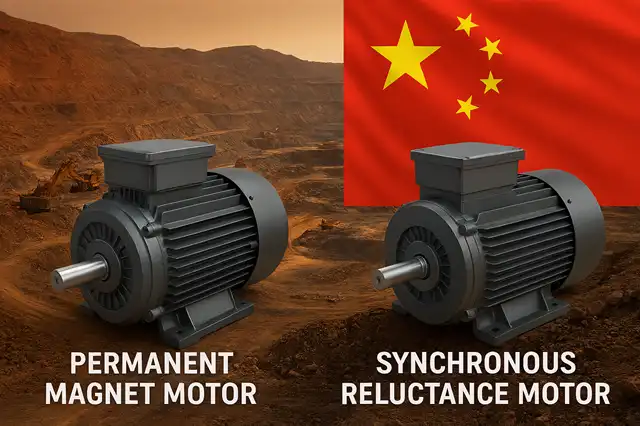
The global electric vehicle and industrial motor industry faces a strategic vulnerability: heavy dependence on rare earth permanent magnets, predominantly controlled by China.
Synchronous reluctance motors (SynRMs) are emerging as a compelling alternative that could help manufacturers reduce their reliance on these critical materials while maintaining competitive performance.
China currently controls approximately 70% of global rare earth mining and over 90% of rare earth processing capacity.
The rare earth elements neodymium, dysprosium, and praseodymium are essential for manufacturing the powerful permanent magnets used in conventional electric motors.
This concentration of supply creates geopolitical risks and price volatility that manufacturers are increasingly seeking to avoid.
Synchronous reluctance motors operate on an entirely different principle. Instead of using permanent magnets to create magnetic fields, SynRMs utilize the magnetic reluctance of specially designed rotor structures.
The rotor contains layers of magnetic steel and air barriers arranged to create paths of varying magnetic resistance.
When the stator generates a rotating magnetic field, the rotor aligns itself with the path of least reluctance, producing torque without any permanent magnets.
Technical Advantages and Market Adoption
Several major manufacturers have already committed to SynRM technology.
- BMW’s fifth-generation electric drivetrain, introduced in models like the iX3 and i4, employs synchronous reluctance motors without rare earth magnets.
- Renault has similarly invested in rare-earth-free motor technology for its electric vehicles.
- Industrial motor manufacturer ABB has been a longtime advocate, offering SynRM solutions for industrial applications since 2011.
- Japan Astemo announced on October 27 that it has developed a new rare earth-freeSynRM motor
The technology offers several strategic advantages beyond rare earth independence. SynRMs eliminate concerns about magnet demagnetization at high temperatures, a significant issue in permanent magnet motors.
They also provide better fault tolerance, as there are no magnets to create uncontrolled back-EMF during failures.
Manufacturing costs can be lower once production scales, as the rotor construction, while geometrically complex, uses only standard electrical steel.
However, challenges remain:
- SynRMs typically require larger physical dimensions to achieve equivalent torque compared to permanent magnet motors, making packaging more difficult in space-constrained applications.
- They also depend heavily on sophisticated control algorithms and power electronics to maintain efficiency.
- The motor controller must continuously optimize current angles and magnitudes to achieve maximum torque per ampere, requiring more computational resources than simpler permanent magnet motor control.
Performance Characteristics and Future Outlook
Modern SynRMs achieve power densities approaching 85-90% of equivalent permanent magnet motors, a significant improvement from earlier generations. Efficiency at rated load typically reaches 93-96%, competitive with many permanent magnet designs. The technology performs particularly well in constant-torque applications and benefits from field-weakening capability that can extend the constant-power operating range.
The strategic importance of rare-earth-free motor technology continues to grow as electric vehicle production scales globally. Government initiatives in Europe and North America specifically encourage development of motors that reduce critical material dependencies. Research institutions are actively developing advanced rotor geometries, improved magnetic materials, and more efficient control strategies to further close the performance gap with permanent magnet motors.
While synchronous reluctance motors may not completely replace permanent magnet motors in all applications, they represent a viable alternative that can significantly reduce industry dependence on rare earth supply chains. As the technology matures and manufacturers optimize designs for specific use cases, SynRMs are likely to capture an increasing share of the electric motor market, particularly in applications where supply chain resilience is valued alongside pure performance metrics.
Detailed Comparison: Permanent Magnet Motors vs. Synchronous Reluctance Motors
| Characteristic | Permanent Magnet Synchronous Motor (PMSM) | Synchronous Reluctance Motor (SynRM) |
|---|---|---|
| Magnetic Material | Requires rare earth magnets (NdFeB, SmCo) | No permanent magnets; uses electrical steel only |
| Rare Earth Dependence | High – dependent on neodymium, dysprosium | None – completely rare-earth-free |
| Supply Chain Risk | Significant geopolitical vulnerability | Reduced risk; materials widely available |
| Power Density | Excellent (100% baseline) | Good (85-90% of PMSM) |
| Torque Density | High – compact design possible | Moderate – requires larger volume for same torque |
| Efficiency at Rated Load | 94-97% | 93-96% |
| Efficiency at Partial Load | Excellent | Good to very good (controller-dependent) |
| Peak Efficiency Range | Broad operating range | Narrower, more dependent on control optimization |
| Rotor Construction | Simple – magnets mounted on/in rotor | Complex – multiple flux barriers and steel layers |
| Manufacturing Cost | Higher (expensive rare earth materials) | Potentially lower at scale (standard materials) |
| Manufacturing Complexity | Moderate (magnet handling challenges) | Higher (precise lamination geometries required) |
| Temperature Sensitivity | Magnets can demagnetize at high temperatures | Not temperature-sensitive (no magnets) |
| Maximum Operating Temperature | Limited by magnet grade (150-200°C typical) | Higher capability (limited by insulation only) |
| Control Complexity | Moderate – simpler field-oriented control | High – requires sophisticated optimization |
| Back-EMF at High Speed | High – can complicate control and safety | Lower – better fault tolerance |
| Field Weakening Capability | Limited by magnet flux | Good – purely controlled by stator current |
| Constant Power Speed Range | Moderate | Wide range possible |
| Acoustic Noise | Low to moderate | Moderate to high (torque ripple) |
| Torque Ripple | Low with proper design | Higher – requires careful design and control |
| Starting Torque | Excellent | Good (requires position sensing) |
| Overload Capability | Good | Good to excellent |
| Fault Tolerance | Lower – magnet flux always present | Higher – no uncontrolled fields |
| Recycling/End-of-Life | Complex – rare earth recovery needed | Simpler – standard steel recycling |
| Environmental Impact | Higher (rare earth mining impact) | Lower (no rare earth mining required) |
| Best Applications | High-performance EVs, compact drives, servo systems | Industrial drives, cost-sensitive EVs, high-temperature environments |
This comparison demonstrates that while permanent magnet motors currently hold advantages in power density and compactness, synchronous reluctance motors offer a strategically important alternative that eliminates rare earth dependence while delivering competitive performance in many applications.
The choice between technologies increasingly depends on specific application requirements, supply chain priorities, and long-term strategic considerations rather than pure technical performance alone.