China Officially Replaces Microsoft Office with Domestic WPS Format in Government Documents
China Officially Replaces Microsoft Office with Domestic WPS Format in Government Documents
- Why Enterprise RAID Rebuilding Succeeds Where Consumer Arrays Fail?
- Linus Torvalds Rejects MMC Subsystem Updates for Linux 7.0: “Complete Garbage”
- The Man Who Maintained Sudo for 30 Years Now Struggles to Fund the Work That Powers Millions of Servers
- How Close Are Quantum Computers to Breaking RSA-2048?
- Why Windows 10 Users Are Flocking to Zorin OS 18 Instead of Linux Mint?
- How to Prevent Ransomware Infection Risks?
- What is the best alternative to Microsoft Office?
China Officially Replaces Microsoft Office with Domestic WPS Format in Government Documents
October 2025 marks a historic shift in China’s digital sovereignty push as government agencies formally abandon Microsoft file formats
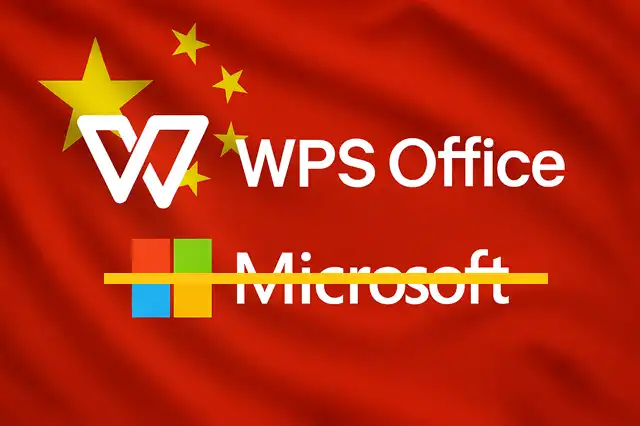
In a significant move toward technological self-reliance, the Chinese government has officially begun replacing Microsoft Office’s Word and Excel formats with the domestic WPS file format as of October 2025.
This transition, years in the making, represents a definitive break from Western office software standards in China’s government operations.
The Official Turning Point
The watershed moment came on October 9, 2025, when China’s Ministry of Commerce issued Announcement No. 61. For the first time, all attached documents were distributed exclusively in the domestic WPS format, completely abandoning the previously standard Word and PDF formats.
This marks the first instance of a major Chinese government agency explicitly rejecting Microsoft document formats in important policy files, signaling a formal shift toward domestically-produced file standards across government office systems.
A Gradual Transition Years in the Making
While October 2025 represents the official implementation, this transformation has been building momentum for several years through a carefully orchestrated three-phase approach:
Phase 1: Policy Trial Period (2020 onwards)
Since 2020, China’s Ministry of Commerce and other government departments began gradually increasing the proportion of WPS format usage while steadily reducing reliance on Word documents. This experimental phase allowed agencies to test compatibility and workflow adjustments without disrupting critical government operations.
Phase 2: Clear Promotion Stage (2022)
The transition accelerated dramatically in September 2022 when the State-owned Assets Supervision and Administration Commission (SASAC) under China’s State Council issued a directive requiring all central state-owned enterprises to complete the replacement of foreign office software with domestic alternatives by 2027. WPS emerged as the primary designated software in this mandate, effectively setting a firm deadline for the transition.
During this period, local governments across China also took action. Between 2019 and 2023, provincial and municipal authorities progressively incorporated WPS into their procurement standards, creating a dual-track push combining both policy directives and technical infrastructure development.
Phase 3: Full Implementation (October 2025)
The October 2025 announcement by the Ministry of Commerce represents the culmination of these efforts. By completely abandoning Microsoft formats in official documentation, the government has made “WPS format officialization” a reality, establishing a new baseline for document standards across Chinese government agencies.
Implications and Context
This shift reflects China’s broader strategy of reducing dependence on foreign technology platforms, particularly in critical government infrastructure. The move ensures that sensitive government documents are created, stored, and transmitted using domestically-controlled software and file formats.
WPS Office, developed by Chinese company Kingsoft, has been positioning itself as a national alternative to Microsoft Office for years. The software supports multiple file formats and has been widely adopted in educational institutions and businesses throughout China.
For international organizations and foreign businesses operating in China, this transition may require adjustments to document exchange protocols and compatibility considerations when communicating with Chinese government agencies. The October 2025 implementation suggests that similar transitions may extend to other government departments in the coming months and years, further cementing WPS as the de facto standard for official Chinese government documentation.
Does Chinese government still use Microsoft Windows?
Based on recent developments, no, the Chinese government is actively moving away from Windows.
In December 2023, China’s government officially banned the use of Windows, Intel, and AMD processors in government computers.
Chinese government agencies are now required to use domestically developed Linux-based operating systems, while approved CPUs generally use ARM architectures or Chinese-made x86 chips.
The Domestic Alternatives
China has developed several homegrown operating systems to replace Windows:
-
Kylin/NeoKylin – Developed by the National University of Defense Technology, Kylin and NeoKylin together have 90% market share in China’s government sector
-
UOS (Unity Operating System) – Built on Debian Linux by UnionTech, UOS has become one of the most prominent domestic options and is widely deployed in government offices and state-owned enterprises
-
OpenKylin – Released in 2022 as an open-source OS designed to have the look and feel of Microsoft Windows
-
HarmonyOS – Huawei debuted its first in-house PC operating system for personal computers in 2025, offering an alternative to Windows for government and enterprise clients
Timeline of the Transition
This shift has been years in the making. As Microsoft prepares to end support for Windows 10 in October 2025, China sees this as a strategic opportunity to accelerate its transition away from foreign technology dependence.
The government has been promoting this through procurement policies favoring domestic software and substantial investments in local operating system development.
So while Microsoft once offered a special “Windows 10 China Government Edition” with enhanced security controls, the Chinese government has now moved decisively toward complete independence from Windows across all government systems.
What is the best alternative to Microsoft Office?