China’s Free Kimi K2 Thinking AI Rivals Top American Models?
China’s Free Kimi K2 Thinking AI Rivals Top American Models?
- Why Enterprise RAID Rebuilding Succeeds Where Consumer Arrays Fail?
- Linus Torvalds Rejects MMC Subsystem Updates for Linux 7.0: “Complete Garbage”
- The Man Who Maintained Sudo for 30 Years Now Struggles to Fund the Work That Powers Millions of Servers
- How Close Are Quantum Computers to Breaking RSA-2048?
- Why Windows 10 Users Are Flocking to Zorin OS 18 Instead of Linux Mint?
- How to Prevent Ransomware Infection Risks?
- What is the best alternative to Microsoft Office?
China’s Free Kimi K2 Thinking AI Rivals Top American Models?
A new artificial intelligence model from China is turning heads in the tech world, not just for its impressive capabilities, but for its price tag: zero dollars.
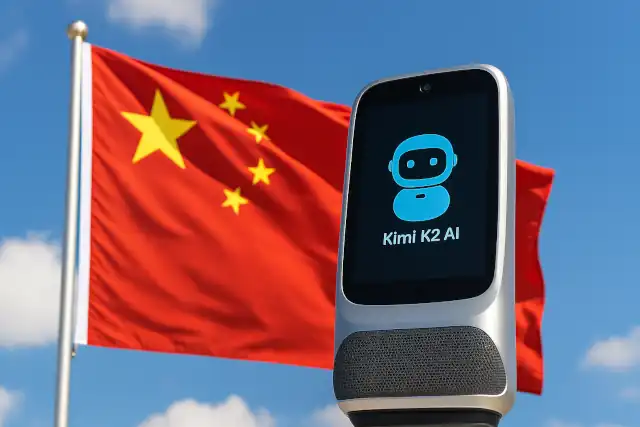
Kimi K2 Thinking, developed by Chinese AI startup Moonshot AI, has emerged as a serious competitor to America’s leading AI models like OpenAI’s o1 and Anthropic’s Claude.
Early benchmarks and user reports suggest the model performs exceptionally well on complex reasoning tasks, challenging the assumption that cutting-edge AI innovation remains solely in Western hands.
Why China Is Phasing Out Foreign AI Chips Despite Their Higher Compute Power?
What Makes Kimi K2 Different
Kimi K2 Thinking specializes in what’s called “chain-of-thought” reasoning—breaking down complex problems into logical steps before arriving at an answer. This approach mirrors how OpenAI’s o1 model works, spending more time “thinking” through problems in mathematics, coding, and scientific reasoning.
According to preliminary testing by Chinese AI researchers and developers, Kimi K2 demonstrates strong performance on mathematical problem-solving, code generation, and analytical tasks. Some early comparisons place it competitively alongside GPT-4-level reasoning, though comprehensive independent benchmarks are still emerging.
How China’s Financial Controls Are Winning the Ransomware War
The Free Access Advantage
Perhaps most striking is Moonshot AI’s decision to offer Kimi K2 Thinking with generous free access to users. While American AI companies have increasingly moved toward subscription models—OpenAI’s ChatGPT Plus costs $20 monthly, Anthropic’s Claude Pro similarly priced—Kimi K2 provides substantial free usage.
This pricing strategy reflects a broader pattern in China’s tech sector: rapid user acquisition through free or low-cost services, building massive user bases before monetizing. It’s the same playbook that helped Chinese apps like TikTok and Temu gain global footholds.
Does China Have Domestic Software Substitutes Amid US Export Ban Risks?
China’s AI Ambitions
Kimi K2’s emergence fits into China’s broader push for AI self-sufficiency. After U.S. export restrictions limited China’s access to advanced semiconductors from NVIDIA and other American chipmakers, Chinese companies have doubled down on algorithmic efficiency and model optimization.
Moonshot AI, founded by former Tsingent researchers, has focused on building competitive models that can run efficiently on available hardware. The company’s earlier Kimi Chat model gained popularity in China for its ability to process extremely long contexts—handling entire books or lengthy documents in a single conversation.
UBIOS: China’s Alternative to UEFI and the New Era of Firmware Standards
Questions of Performance and Access
Western AI researchers have noted that while Kimi K2 shows promising capabilities, comprehensive third-party evaluations are still limited. Performance on standardized benchmarks, handling of edge cases, and reliability across diverse tasks require further independent testing.
Additionally, access restrictions cut both ways. Just as U.S. export controls limit Chinese access to advanced chips, Chinese AI services often have limited availability outside China or require Chinese phone numbers for registration, creating barriers for Western users wanting to test these tools directly.
Why US Export Restrictions Haven’t Slowed China’s AI Development?
What This Means for the AI Race
Kimi K2 Thinking’s arrival signals that the global AI competition is intensifying. Rather than a unipolar landscape dominated by American companies, we’re seeing a multipolar AI ecosystem emerge:
- American companies (OpenAI, Anthropic, Google) continue pushing frontier capabilities with massive computational resources
- Chinese firms (Moonshot AI, Baidu, Alibaba) are optimizing for efficiency and rapid deployment
- European players (Mistral AI) focus on open-source approaches and regulatory compliance
For Western users and businesses, this competition could drive innovation and potentially lower costs. However, it also raises questions about data privacy, content moderation standards, and the geopolitical implications of depending on AI infrastructure from different nations.
China Officially Replaces Microsoft Office with Domestic WPS Format in Government Documents
The Bottom Line
Whether Kimi K2 Thinking truly “surpasses” American AI depends on which metrics matter most. In raw benchmark scores on certain tasks? Possibly competitive. In accessibility and cost? Clearly advantageous for users. In trustworthiness, transparency, and alignment with Western values? More complicated.
What’s undeniable is that China’s AI capabilities are advancing rapidly, and companies like Moonshot AI are producing models that deserve serious attention. The era of assuming AI leadership belongs exclusively to Silicon Valley appears to be ending.
For consumers and businesses in the West, the message is clear: the AI landscape is becoming more diverse, more competitive, and potentially more affordable. The question now is whether and how these Chinese alternatives will become accessible to Western users—and whether Western users will be comfortable using them.