Domain Hijacking:The Silent Theft of Your Online Identity
Domain Hijacking: The Silent Theft of Your Online Identity
- Why Enterprise RAID Rebuilding Succeeds Where Consumer Arrays Fail?
- Linus Torvalds Rejects MMC Subsystem Updates for Linux 7.0: “Complete Garbage”
- The Man Who Maintained Sudo for 30 Years Now Struggles to Fund the Work That Powers Millions of Servers
- How Close Are Quantum Computers to Breaking RSA-2048?
- Why Windows 10 Users Are Flocking to Zorin OS 18 Instead of Linux Mint?
- How to Prevent Ransomware Infection Risks?
- What is the best alternative to Microsoft Office?
Domain Hijacking:
The Silent Theft of Your Online Identity
Attackers don’t need to hack your servers. By targeting the registrar that holds your domain name, they can redirect your entire online presence — email, website, and all — without ever touching your infrastructure.
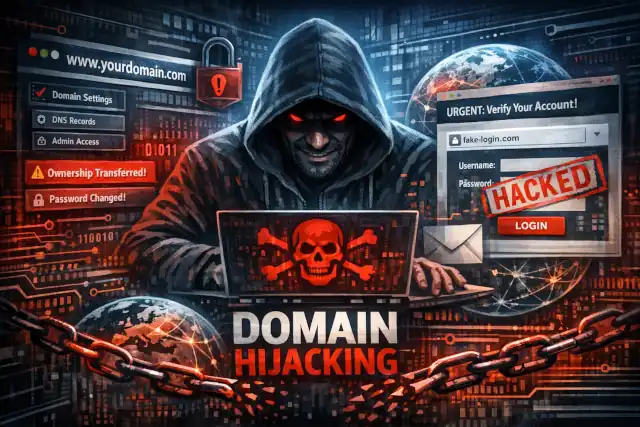
Domain hijacking is one of the most disruptive forms of cyberattack precisely because it bypasses the defenses most organizations invest in. Firewalls, endpoint protection, and intrusion detection systems are rendered irrelevant when an attacker can walk through the front door of your domain registrar and simply point your website elsewhere. The result: every visitor who types your URL is silently redirected — to a page you did not build, controlled by someone you did not authorise.
Unlike domain expiration — where a forgotten renewal notice leads to a lapsed registration — hijacking involves an active adversary gaining control of a live registrar account. Once inside, the attacker can modify DNS records to redirect traffic to their own servers, transfer the domain to a different registrar entirely, or both. The original owner may not discover the compromise until visitors begin reporting that something is wrong.
How Attackers Get In
The most common entry point is spear-phishing — a targeted deception email designed to trick an individual into surrendering their registrar login credentials. Unlike broad phishing campaigns, spear-phishing is tailored to appear credible to a specific recipient, dramatically increasing its success rate. Attackers research their targets, craft convincing pretexts, and send emails that closely mimic legitimate communications from the registrar, a reseller, or an internal IT team.
A second major vector is credential stuffing — the automated use of username-and-password combinations harvested from unrelated data breaches. Because many people reuse passwords across services, credentials leaked from one platform are systematically tested against registrar login portals. If the account lacks multi-factor authentication, a single matching credential is enough to grant full access.
It is also worth noting the risk of SIM swapping, a technique frequently overlooked in coverage of domain hijacking. By convincing a mobile carrier to transfer a target’s phone number to a SIM they control, an attacker can intercept SMS-based one-time passwords — effectively defeating the most common form of two-factor authentication deployed by registrars. This elevates the importance of hardware-based, phishing-resistant MFA over SMS codes.
What Attackers Do With Access
- Modify DNS records to redirect web traffic and email to attacker-controlled servers
- Transfer the domain to another registrar, making recovery significantly more complex
- Intercept email by altering MX records, enabling credential harvesting and business email compromise
- Serve malware by pointing the domain to infrastructure hosting malicious payloads
- Conduct phishing using the trusted domain name to deceive users into submitting sensitive information
The Potential Consequences
The impacts of a successful domain hijack extend far beyond website downtime. Because a domain name anchors not just a website but an entire communications infrastructure, losing control of it can cascade into:
- Loss of ownership or control of the domain itself
- Takeover of corporate email systems via MX record modification
- Malware distribution to all users who visit the domain while it is compromised
- Severe reputational damage, particularly for media, financial, and government entities
- Legal and regulatory exposure if user data is intercepted during the period of compromise
The Syrian Electronic Army, August 2013
One of the most instructive real-world examples of domain hijacking at scale occurred on August 27, 2013, when the Syrian Electronic Army (SEA) — a pro-Assad hacktivist group — compromised the domain registrar Melbourne IT through a spear-phishing email sent to a U.S.-based reseller of the company. Using the stolen reseller credentials, the group accessed Melbourne IT’s administrative control panel and altered the DNS records of several high-profile domains managed through that reseller account.
The New York Times website was inaccessible to readers for over four hours. Visitors who could reach the site were redirected to a page displaying the message “Hacked by SEA.” The SEA also altered name server records for Twitter’s image-serving domain (twimg.com) and its URL-shortening service (t.co), causing sporadic disruptions to image loading and link routing across the platform. Huffington Post UK’s DNS records were similarly modified.
The SEA’s goal was primarily political defacement — demonstrating reach and sending a message to Western media — rather than malware distribution. However, a Cloudflare investigation found that the server to which NYTimes.com was being redirected did appear to host malware, meaning visitors during the period of compromise may have been exposed.
Recovery required coordinated action across multiple organisations. Cloudflare CEO Matthew Prince described how technical teams from Cloudflare, OpenDNS, and Google DNS joined a conference call to begin correcting cached records for users of their recursive DNS services. Verisign, which manages the .com TLD registry, rolled back the authoritative name server changes and applied a registry lock to NYTimes.com. Melbourne IT restored the correct DNS settings and locked the compromised account.
Critically, Twitter’s primary domain — twitter.com — was spared because it already had a registry lock in place. Domains on the same compromised reseller account that had registry locks active were not affected. This single security measure proved decisive.
The Registrar–Registry Distinction
Understanding domain hijacking requires clarity on two easily confused terms. A registrar is the company through which an organisation purchases and manages its domain names (examples: GoDaddy, Namecheap, Melbourne IT). A registry is the authoritative operator of a top-level domain (TLD) — for instance, Verisign operates the .com and .net TLDs. When a registrar makes changes to DNS records, those changes propagate up to the relevant registry.
This distinction matters for security. A registry lock — one of the most effective countermeasures against domain hijacking — must be applied at the registry level, not merely within the registrar’s interface. It prevents any modification to authoritative name server records without an out-of-band verification process, making unauthorised changes extremely difficult even with full registrar account access.
How to Protect Your Domains
No single measure eliminates the risk of domain hijacking, but a layered approach dramatically reduces it. The following controls are ordered broadly by impact:
Phishing-Resistant MFA
Use FIDO2-based authentication or hardware security keys (e.g. YubiKey) on registrar accounts. Avoid SMS-based OTP, which is vulnerable to SIM-swapping attacks.
Registry Lock
Enable registry locks for your most critical domains. This requires out-of-band verification before any authoritative DNS change can take effect, neutralising stolen credential attacks.
Role-Based Access Control
If your registrar supports RBAC, restrict which accounts can modify DNS records or initiate transfers. Limit blast radius in the event of a credential compromise.
Domain Monitoring
Configure alerts for any changes to DNS records, WHOIS data, or registrar account settings. Detection does not prevent an attack, but faster response limits damage.
Registrar Selection
Evaluate registrars on their security posture — not just price. Prioritise those offering registry locks, audit logs, and multi-factor authentication as standard.
Supply Chain Awareness
The 2013 SEA attack exploited a reseller, not Melbourne IT directly. Audit the security practices of any third party with access to your registrar account.
The original document reviewed for this article characterised the SEA attack primarily as a “malware propagation” campaign and attributed the response to a generic list of organisations including Google, Cloudflare, OpenDNS, and Verisign. The factual record shows the attack was primarily political defacement; malware was incidental. The collaborative response detail is accurate, but arose specifically from the NYTimes.com incident rather than a pre-planned arrangement. The document also omitted SIM-swapping as an attack vector, and slightly blurred the registrar/registry distinction. All other claims — attack vectors, impacts, and mitigation recommendations — are accurate and well-supported.
The Broader Lesson
Domain hijacking is a supply chain problem as much as it is a security one. The organisations targeted in the 2013 SEA attack had invested significantly in their own security postures. Their employees had been trained on phishing awareness. Their servers were not breached. Yet all of that investment was undermined by the security practices of a third-party reseller they had never audited.
For any organisation for whom an online domain is a critical asset — which is to say, nearly every organisation operating today — the registrar relationship deserves the same security scrutiny applied to internal systems. The domain name is not merely a web address. It is the anchor of email delivery, brand identity, and digital trust. Losing control of it, even temporarily, can have consequences that outlast the outage itself.