Gallium: The semiconductor industry accounting for about 80% of the total consumption
Gallium: The semiconductor industry accounting for about 80% of the total consumption
Gallium: The semiconductor industry accounting for about 80% of the total consumption.
Background and Overview:
Gallium, symbol Ga, belongs to Group IIIA of the fourth period.
It was discovered in 1875 by P.E.L.de Boisbaudran, a French scientist, during the spectroscopic analysis of an extract obtained from sphalerite.
In honor of the discoverer’s homeland, it was named gallium, derived from the ancient name for France, Gallia.
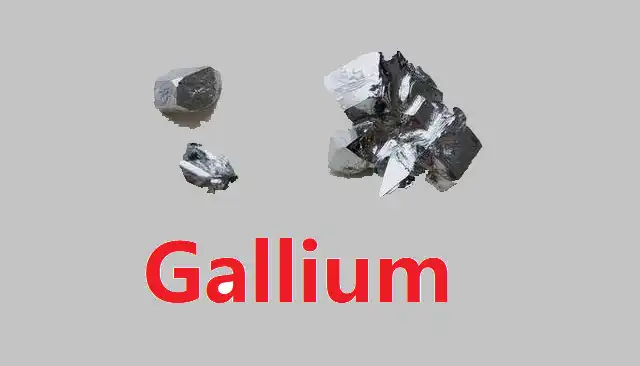
Gallium is a rare and dispersed element that is often found in trace amounts in minerals such as bauxite and sphalerite. In its solid state, it appears as a bluish-gray color with a melting point of 29.78°C and a boiling point of 2403°C.
It has a relative density of 5.907 and resembles zinc in appearance, while its liquid state appears silvery-white and is similar to mercury.
Gallium is one of the three metals (mercury, cesium, and gallium) that are liquid near room temperature (21-30°C).
Its solid form has a complex structure, and pure liquid gallium exhibits significant supercooling tendencies, capable of being supercooled to -120°C without crystallization for several days in an ice bath. It is soft in texture and brittle in nature, and it remains stable in air.
When heated, gallium can dissolve in acids and alkalis, react vigorously with boiling water, and exhibit slight reactivity with water at room temperature, while at high temperatures, it can interact with most metals. The solid-to-liquid phase transition of gallium results in a 3.1% expansion rate, making it suitable for storage in plastic containers.
Gallium is commonly used as a raw material for optical glass, vacuum tubes, and semiconductors. Its wide liquid temperature range makes it suitable for manufacturing high-temperature thermometers. Adding gallium to aluminum allows the production of heat-treatable alloys.
Gallium-gold alloys are used in decorative and dental applications, as well as catalysts in organic synthesis.
Several gallium compounds, such as arsenides, antimonides, and phosphides, exhibit semiconductor properties and are used in solid-state devices such as electrical and laser devices, microwave generators, and field-emission light-emitting devices. Gallium can be obtained by smelting the enriched material obtained after zinc extraction from zinc ores.
Global Distribution of Resources
Metallic gallium is mainly distributed in countries such as China, Canada, Germany, France, Japan, Kazakhstan, Australia, and Russia. In 2008, the global reserves of gallium were estimated to be around 180,000 metric tons.
The reserves excluding China of gallium were approximately 40,000 to 50,000 metric tons, while reserves in China were around 130,000 to 140,000 metric tons, accounting for approximately 75% of the world’s total.
In 2010, a unique and large gallium deposit associated with coal was discovered in China Inner Mongolia. It was estimated to contain reserves of 857,000 metric tons of gallium.
This discovery significantly changed the global reserves of metallic gallium, with China’s gallium reserves accounting for over 95% of the world’s total.
Applications
Gallium is commonly used as a raw material for optical glass, vacuum tubes, and semiconductors. Its wide liquid temperature range (melting point of 29.8°C and boiling point of 2403°C) makes it suitable for manufacturing high-temperature thermometers.
When gallium is added to aluminum, it can create heat-treatable alloys. Gallium-gold alloys are used in decorative applications, dental applications, and as catalysts in organic synthesis.
Several gallium compounds, such as arsenides, antimonides, and phosphides, exhibit semiconductor properties and are used in solid-state devices such as electrical appliances, lasers, microwave generators, and field-emission light-emitting devices.
Gallium can be obtained from the enriched material remaining after zinc extraction from zinc ores.
The applications of metallic gallium are closely related to the development of low-carbon economy, green energy, and other aspects advocated by today’s world economy. It is also closely linked to many high-tech industries of modern technology.
Due to the importance of metallic gallium, an increasing number of companies are dedicated to the development of gallium products.
Currently, the consumption areas of metallic gallium include semiconductors and optoelectronic materials, solar cells, magnetic materials, petrochemicals, medical devices, and new alloys.
Among them, the semiconductor industry is the largest consumer of gallium, accounting for approximately 80% of the total consumption.
With the rapid development of the gallium industry, especially in the semiconductor and solar cell industries, and the promotion of the LED industry development plan by the Chinese government, the metallic gallium market will face greater opportunities and challenges.
According to EU predictions, global consumption of metallic gallium will quadruple in the next 10 to 20 years.
How to get Metal Gallium?
1) Extracted from by-products of aluminum smelting industry
Gallium metal At present, about 90% of the gallium metal in the world is obtained from the by-products of the aluminum smelting industry.
Since the geochemical properties of gallium and elemental aluminum are very similar, most gallium in nature exists in bauxite in an associated form.
In the process of dissolving and extracting aluminum from bauxite, gallium is dissolved together with aluminum, and enters the solution together with sodium aluminate in the form of sodium gallate, and metal gallium can be obtained from this sodium aluminate solution.
The technological conditions of dissolving bauxite with hydrochloric acid to extract gallium from it were studied.
Gallium-containing bauxite is ground to 200 mesh, roasted at 500°C for 3 hours, and then leached for 12 hours with 6mol/L hydrochloric acid solution at a liquid-solid volume-to-mass ratio of 2.5:1. Gallium is in the form of GaCl-4 complex ions Into the solution, the leaching rate is greater than 94%.
2) Gallium is usually extracted from the leaching solution by precipitation-electrolysis,
Extraction method, resin adsorption method, etc. It is reported in the literature that CO2 is passed into the leaching solution containing Na2CO3120~376g/L, NaOH13~65g/L, Al2O36~32g/L, Ga0.01~0.1g/L, and the temperature is maintained in the range of 65~98℃, stirring for 2.5 After ~7h, gallium and aluminum precipitated in the form of amorphous hydrate.
Extraction of metal gallium and zinc from hydrometallurgy zinc slag The leaching slag is the first by-product of hydrometallurgy zinc smelting.
Since it is rich in scattered metals such as gallium, indium, and germanium, it has great economic value for comprehensive treatment.
It is reported in the literature that gallium in zinc leaching slag can be effectively enriched by reduction roasting-magnetic separation process.
The method is to roast the zinc leaching residue in a rotary kiln at 1100°C for 15 minutes, so that valuable elements such as Zn and Pb in the residue can be volatilized and precipitated, and the residue should not produce a liquid phase as much as possible to avoid the occurrence of valuable elements such as gallium in the residue.
A multi-component complex compound is formed, and then the volatile residue is separated and enriched by magnetic separation to enrich Fe and Ga.
Studies have shown that the volatilization rate of zinc in zinc leaching slag reaches 98.42%.
The concentrate obtained by magnetic separation of volatile residues contains 90.16% iron and 2164g/t gallium, and the recoveries of iron and gallium are 87.78% and 92.42% respectively.
Kiln slag or roasted slag is acid leached, and gallium enters the leaching solution.
Gallium can be enriched from the leaching solution by extraction, resin adsorption, etc. It is reported in the literature that Ga3+ can be effectively extracted in hydrochloric acid system by using 2-octylphenoxyacetic acid (CA-12 for short) as the extractant.
The organic phase is a kerosene solution of CA-12, the concentration of CA-12 is 4.6×10⁻³mol/L, the volume ratio of the organic phase to the aqueous phase is 1:1, pH=4.2, room temperature, extraction time 30min, extraction of gallium The rate can reach 100%. In addition to CA-12, using 2-ethylhexylphosphonic acid-mono-2-ethylhexyl ester, organophosphorus compounds, Cyanex925, etc. as extraction agents can effectively extract Ga3+ from the leachate.
3) Extract gallium from corundum slag
Corundum slag is a low-silicon ferroalloy obtained when brown corundum is refined from bauxite. Its main components are: ΣFe68.8%, Si9.21%, Al2O311.61%, Ga0.034%.
It is reported in the literature that corundum slag is used as raw material, leached with sulfuric acid, then neutralized and precipitated to remove iron, then leached with alkali, and gallium metal is extracted by electrolysis.
0.25kg of gallium metal can be extracted from each ton of slag, and 2.8t of ferrous sulfate, 100kg of Al(OH), 370kg of Na2CO3, and 43kg of iron oxide red can be obtained at the same time. The literature introduces a device for producing metal gallium from corundum slag.
The device consists of a leaching tower, a rotary extraction tower, a stripping tower, an impurity-removing extraction tower, and an evaporation tank.
Put the corundum slag crushed to 40-60 mesh into the leaching tower, leaching with 23% hydrochloric acid solution at 60°C, and extract the leaching solution with 1:1 tributyl phosphate and toluene solution to obtain an organic phase containing gallium, and then in Extract with water in the stripping tower, then extract the gallium-containing aqueous phase twice with ether in the impurity removal extraction tower to obtain the gallium-containing ether organic phase, remove the ether by evaporation to obtain the gallium-containing aqueous phase, and the mass concentration of gallium at this time is greater than 0.1g /L. After adding NaOH to remove iron, metal gallium can be obtained through precipitation and electrolysis.
4) Extract metal gallium from ores
It has been reported in the literature that metal gallium can be extracted by direct leaching with sulfuric acid using composite ores containing gallium and germanium as raw materials.
The composite ore contains Ga0.037%, Ge0.0965%, Fe16.9%, Zn1.52%, Si34.5%. After the ore is ground, it is leached in three stages to obtain a leaching solution rich in valuable metals Ga, Ge, and Cu.
The leaching solution is replaced by iron to remove copper, H2S is added to precipitate germanium, after solvent extraction to remove iron, ammonia water is added to precipitate gallium in the form of Ga(OH)3. Gallium metal can be obtained by further dissolving Ga(OH)3 precipitation, purification and electrolysis.
Among them, in the three-stage leaching process, the first stage adopts 40% sulfuric acid solution, and the second stage adopts 100-120g/L sulfuric acid solution or 0.5-7mol/L H2SO4 and 0.15mol/L Na2S2O3 mixed solution that is continuously fed into SO2, The third section is leached with 325-350g/L H2SO4 and a certain amount of CaF2 solution.
After 3-step leaching, the extraction rates of Ga and Ge in the ore reached 98% and 78%-80%, respectively. The addition of CaF2 can promote the leaching of Ga and Ge.
Studies have shown that Ga and Ge can be directly extracted from low-grade composite ores using sulfuric acid and SO2 or sulfuric acid and sodium thiosulfate.
It is reported in the literature that in the gallium-containing solution, an Al2O3-containing mineral such as bauxite that has been roasted and activated at a temperature of 500-800 ° C is added as a gallium extraction agent, and the similar properties of aluminum and gallium are used.
The action of high temperature can realize the extraction of gallium, and then dissolve Al and Ga with soda ash or sodium hydroxide solution to obtain a sodium metaaluminate solution containing gallium, or dissolve Al and Ga with acid, and then precipitate Al and Ga with ammonia water Precipitate, and then treat the precipitate with sodium hydroxide solution to obtain gallium-containing sodium metaaluminate solution.
The solution can be treated with general electrolytic method to obtain gallium metal. When extracting gallium with Al, it is necessary to add extraction processing aids such as ammonium sulfate or calcium sulfate.
5) Extract gallium metal from vanadium slag
Vanadium slag is the residue obtained after vanadium extraction from vanadium-titanium magnetite (mass fraction of Ga is about 0.004%) by atomization.
Gallium in slag can be enriched to 0.01% to 0.03%, which is a good raw material for gallium extraction.
It has been reported in the literature that adding a roasting agent containing chloride salt, carbon powder, and sodium carbonate to the gallium-containing vanadium slag material, and performing high-temperature chlorination roasting can separate V and Ga in the vanadium slag, and obtain Ga with a mass fraction of more than 0.18%.
Concentrates, the extraction rate of gallium is over 80%. The enrichment can be leached, purified, and electrolyzed to obtain metal gallium with a purity of more than 99.9%. The chlorine salt in the roasting agent used can be NaCl, CaCl2 or NH4Cl.
The proportion of roasting agent is added according to 10%~60% of the weight of the material, including 5%~40% of chloride salt, 3%~20% of carbon powder (or petroleum coke), 5%~20% of sodium carbonate, and the chlorination roasting temperature 800~1300℃.