Glass Hard Drives Are Coming to Data Centers: 360TB Capacity with a 13.8 Billion-Year Lifespan
Glass Hard Drives Are Coming to Data Centers: 360TB Capacity with a 13.8 Billion-Year Lifespan
- Why Enterprise RAID Rebuilding Succeeds Where Consumer Arrays Fail?
- Linus Torvalds Rejects MMC Subsystem Updates for Linux 7.0: “Complete Garbage”
- The Man Who Maintained Sudo for 30 Years Now Struggles to Fund the Work That Powers Millions of Servers
- How Close Are Quantum Computers to Breaking RSA-2048?
- Why Windows 10 Users Are Flocking to Zorin OS 18 Instead of Linux Mint?
- How to Prevent Ransomware Infection Risks?
- What is the best alternative to Microsoft Office?
Glass Hard Drives Are Coming to Data Centers: 360TB Capacity with a 13.8 Billion-Year Lifespan
Revolutionary 5D optical storage technology promises to transform cold data archiving with unprecedented capacity and durability
In a breakthrough that could revolutionize long-term data storage, UK-based SPhotonix is advancing its 5D crystal storage technology toward commercial deployment, with plans to pilot glass-based cold storage systems in data centers within the next two years.
Why You Should Choose CMR Over SMR Hard Drives Without Multiple Backups: A Technical Analysis
The Technology Behind Glass Storage
The innovative system uses femtosecond laser pulses to etch microscopic voxels (3D pixels) into fused quartz glass. By leveraging the birefringence properties of these voxels combined with their x, y, and z spatial coordinates, the technology achieves five-dimensional data encoding—a significant leap beyond traditional two-dimensional storage methods.
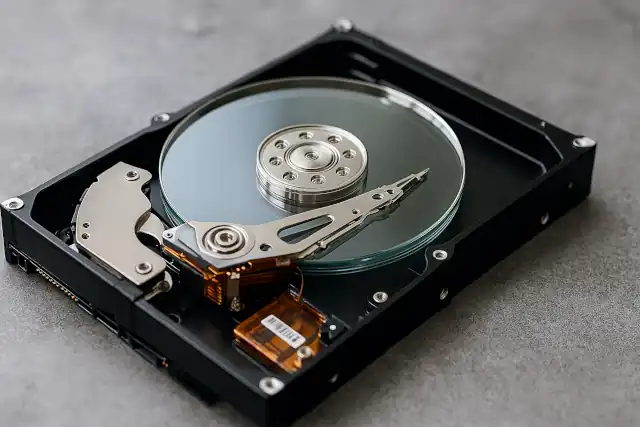
The storage medium itself—quartz crystal—shares similarities with fiber optic cable materials, offering exceptional durability. A single 5-inch glass disc can store up to 360TB of data, with SPhotonix estimating that data stored in glass voxels could remain stable for approximately 13.8 billion years at temperatures up to 190°C (374°F).
This longevity dramatically surpasses conventional storage media: standard optical discs last only 5-100 years, M-DISC technology claims a 1,000-year lifespan, while magnetic and electronic storage media offer even less stability than quartz crystal.
The 40TB Barrier: Why Hard Drives Hit a Wall and What Comes Next
Performance Specifications and Development Timeline
Current performance metrics show write speeds of 4MB/s and read speeds of 30MB/s. SPhotonix has set ambitious targets to increase both read and write speeds to 500MB/s within 3-4 years, positioning the technology to compete with archival tape and optical disc backup systems.
Within the next 18 months, the company plans to release field-deployable reading devices. Currently, data retrieval must be completed through the company’s laboratory facilities, but this limitation will be eliminated as the technology matures.
Toshiba Pioneers 12-Platter Hard Drive: 40TB Model Set for 2027 Launch
Target Market: Cold Data Storage
The 5D storage crystal technology specifically targets “cold data storage” scenarios—applications where data retrieval times of 10 seconds or longer are acceptable. This represents a massive market opportunity, as an estimated 60-80% of globally stored data falls into the cold data category.
However, the technology is not designed for all storage needs. “Hot data” applications requiring sub-5-millisecond response times—such as financial trading systems—remain the domain of solid-state drives (SSDs). Similarly, scenarios requiring 20-millisecond to 1-second response times, including streaming media and active document storage, are not suitable for glass-based storage.
Why HDDs Won’t Be Replaced by SSDs: The Economics of Mass Storage
Historical Context: Evolution of Optical Data Storage
SPhotonix’s 5D storage technology represents the latest chapter in optical data storage innovation:
- 1980s-1990s: Compact Discs (CDs) and DVDs introduced consumer optical storage with capacities from 700MB to 4.7GB
- 2000s: Blu-ray technology pushed optical storage to 25-100GB per disc
- 2009: M-DISC developed for archival purposes, claiming 1,000-year data retention
- 2013: University of Southampton researchers demonstrated early 5D optical data storage in quartz glass
- 2018: Microsoft’s Project Silica explored glass-based storage in partnership with Warner Bros., storing the entire “Superman” movie on a glass plate
- 2020s: Various research institutions advanced femtosecond laser writing techniques for ultra-high-density storage
- 2024-2025: SPhotonix moves 5D crystal storage toward commercial viability with plans for data center deployment
Why Your SSD Might Be Slower Than Expected?
Industry Implications
The emergence of practical glass-based storage addresses a critical challenge facing the digital economy: the exponential growth of data that must be preserved long-term but rarely accessed. From regulatory compliance archives to scientific datasets and cultural preservation, the demand for ultra-stable, high-capacity cold storage continues to escalate.
If SPhotonix successfully deploys its technology at scale, glass storage could offer data centers a compelling alternative to traditional tape libraries and optical archives, with dramatically superior density, longevity, and—eventually—competitive performance characteristics.
The technology’s environmental credentials also merit attention. With data projected to persist for billions of years without degradation or energy-intensive refreshing cycles, glass storage could significantly reduce the carbon footprint of long-term data preservation.
As data centers worldwide grapple with soaring storage demands and sustainability pressures, the prospect of room-temperature storage media lasting longer than the age of the universe itself presents an intriguing solution to one of the digital age’s most persistent challenges.