Google Files Lawsuit Against Fraudsters Using DMCA Notices to Attack Competitors
Google Files Lawsuit Against Fraudsters Using DMCA Notices to Attack Competitors
- Why Enterprise RAID Rebuilding Succeeds Where Consumer Arrays Fail?
- Linus Torvalds Rejects MMC Subsystem Updates for Linux 7.0: “Complete Garbage”
- The Man Who Maintained Sudo for 30 Years Now Struggles to Fund the Work That Powers Millions of Servers
- How Close Are Quantum Computers to Breaking RSA-2048?
- Why Windows 10 Users Are Flocking to Zorin OS 18 Instead of Linux Mint?
- How to Prevent Ransomware Infection Risks?
- What is the best alternative to Microsoft Office?
Google Files Lawsuit Against Fraudsters Using DMCA Notices to Attack Competitors
On Monday of this week, Google filed a lawsuit in California accusing two individuals of using 65 Google accounts to send false DMCA infringement notices to Google, targeting as many as 620,000 URLs.
Google alleges that these individuals exploited the copyright notice and removal system to disrupt the trade of competitors, causing harm to the search engine and its customers.
While all removal notices that do not comply with DMCA regulations are typically considered invalid, there is a significant distinction between mistakenly sent notices and those sent purely out of malice.
False DMCA removal notices are not a new occurrence, but in recent years, organized groups have increasingly used malicious DMCA notices as a business tool.
As consequences for most offenders are close to zero, this may encourage them to send more notices. Through the lawsuit filed on Monday in a California court, Google seems to be sending a message of “enough is enough.”
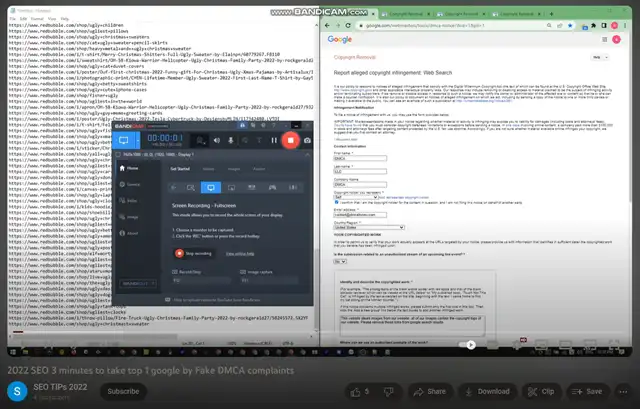
(screenshot from youtube)
Defendants Exploiting DMCA Enforcement Measures
Google’s lawsuit targets Nguyen Van Duc and Pham Van Thien, both said to be residents of Vietnam and purported leaders among 20 unnamed defendants. Google claims that these defendants systematically abused accounts to “submit a massive number” of false copyright removal requests, with the aim of removing competitors’ website URLs from Google search results.
“The defendants weaponized the notice and removal procedures of copyright law, not for the intended purpose of swiftly removing infringing content, but to use false accusations to remove legitimate content of their competitors. The defendants’ illegal fraudulent actions harm consumers, third-party businesses, and Google’s interests, stifle competition, and could tarnish Google’s trusted brand.”
Reportedly, in the past few years, Nguyen, Pham, and those collaborating with them created at least 65 Google accounts, sending confirmed false notices for 117,000 URLs and an additional 500,000 URLs suspected of fraud through Google.
“The defendants appear to be associated with websites selling printed T-shirts, and their illicit actions are aimed at removing third-party competing sellers from Google search results. The defendants maliciously exploit Google’s policies and procedures established under the Digital Millennium Copyright Act to disrupt and harm competitors.”
Google’s move aims to halt infringement and hold defendants accountable
Google continues to emphasize its role as a major intermediary, processing notices under the Digital Millennium Copyright Act for 600 million URLs annually, highlighting that the act requires Google to remove or disable allegedly infringing content. Google points out that failure to act promptly after receiving legally compliant DMCA notices could result in losing safe harbor protection.
Since Google typically relies on the accuracy of statements in DMCA notices, fraudulent notices could lead to the incorrect removal of content, damaging the company’s search engine advertising business and the businesses that Google’s customers seek to attract. In this case, the defendants utilized Google’s system and DMCA removal procedures to weaken the strength of their competitors.
False names, false statements
False statements in notices sent to Google could also cause harm to other parties. The defendants used false names, claiming to represent major companies such as Amazon, Twitter, and NBC News, as well as sports teams like the Philadelphia Eagles, Los Angeles Lakers, and San Diego Padres.
In similar false notices, they also claimed to represent prominent figures such as Elon Musk, Taylor Swift, LeVar Burton, and Kanye West.
The complaint notes that some notices were submitted under the names of companies that do not exist in the United States, and the addresses of these companies could lead to innocent households and businesses. Google states that despite these claims, the defendants can be found in Vietnam, where they proudly promote their “search engine optimization” plans, including through YouTube.
Fake SEO, Fake DMCA
“Bad actors like the defendants use this strategy to attack and fraudulently suppress the websites and products of competitors in Google search results, making consumers more likely to purchase the same or similar products from the bad actors or their affiliated companies,” the complaint continues.
“These bad actors know that fraudulent removal requests often have the same effect as legitimate removal requests; if a removal request contains all the elements required by section 512(c)(3)(A), it is likely to trigger removal by Google. Unfortunately, to ensure compliance with the Digital Millennium Copyright Act, Google’s system removes a significant number of URLs locked by the defendants before Google and/or the website owner can clarify the situation and take appropriate action to restore the URLs.”
A particularly damaging batch of fraudulent notices targeted more than 35,000 URLs operated by a Google customer spending tens of millions of dollars annually on Google search advertising. The result was a significant drop in traffic during the fake holiday season, leading to a loss of $5 million for the customer and its sellers, and a loss of $2 million to $3 million for Google.
Holding the defendants accountable
Those intentionally making false statements in DMCA notices may be liable for damages, costs, and attorney fees. In this case, the defendants’ actions caused economic losses to Google, including lost advertising revenue, damage to business relationships, and significant resources invested in investigating their unlawful conduct.
Under section 512(f) of the U.S. Code, Google requests that the defendants pay attorney fees and compensate for losses, with the specific amount to be determined during the trial.
The complaint also states that each time the defendants created dozens of Google accounts, they entered into enforceable agreements with Google. While Google claims to have “fulfilled” all the obligations specified in these contracts, the defendants’ actions amount to a violation of their contractual obligations to Google and intentional interference with the contractual relationship between Google and its advertising customers.
Google states that it is entitled to request the defendants to pay for all general, special, and actual losses that Google has “suffered or will suffer” due to fraudulent notices.
Google also requests the court to issue an order prohibiting the defendants (and anyone cooperating with them) from submitting any fraudulent removal notices and/or creating any Gmail accounts. Google also seeks to prohibit the defendants from using any of its products or services to advertise their websites or products.
Click here to view the complaint (PDF)