Google Reduces Its Dependence on ARM: Android Accelerates Transition to RISC-V
Google Reduces Its Dependence on ARM: Android Accelerates Transition to RISC-V
- Why Enterprise RAID Rebuilding Succeeds Where Consumer Arrays Fail?
- Linus Torvalds Rejects MMC Subsystem Updates for Linux 7.0: “Complete Garbage”
- The Man Who Maintained Sudo for 30 Years Now Struggles to Fund the Work That Powers Millions of Servers
- How Close Are Quantum Computers to Breaking RSA-2048?
- Why Windows 10 Users Are Flocking to Zorin OS 18 Instead of Linux Mint?
- How to Prevent Ransomware Infection Risks?
- What is the best alternative to Microsoft Office?
Google Reduces Its Dependence on ARM: Android Accelerates Transition to RISC-V
Sometimes, ARM might be wondering what it did wrong.
On October 30, just before the new RISC-V Summit, Google announced the latest developments in Android and RISC-V on its open-source blog, stating that Android now provides comprehensive support for the RISC-V architecture. Developers can now build, run, and test Android’s support for RISC-V on their devices.

This isn’t the first time Google has “taken a swipe at ARM.” Almost a year ago, Google officially announced at the RISC-V Summit that Android would gradually support the RISC-V instruction set architecture and treat RISC-V as an equally important primary platform alongside ARM.
Google’s intention is not hard to fathom; it aims to support RISC-V, and one of the significant reasons is to avoid ARM potentially controlling the future of the Android ecosystem.
Qualcomm shares a similar mindset. Over the past couple of years, Qualcomm’s relationship with ARM has been tense, from being a major partner to legal battles, and from in-house CPU core development to direct competition in business models. Qualcomm has made it clear that it’s dissatisfied with ARM.
Just this month, Qualcomm, in partnership with Google, announced that it would soon launch RISC-V chips supporting the Wear OS system (based on Android). Earlier, Qualcomm, along with NXP, Bosch, Infineon, and Nordic, established a RISC-V chip company.
In contrast, ARM, which went public in September, has experienced a rollercoaster ride in market value. It surged by 25% to $65.2 billion on its first day of trading, only to fall below its IPO price in less than a month. Its latest market value is $49.11 billion, nearly approaching its historical low.
The divergence of major customers and partners, coupled with the rise of RISC-V, seems to signify that ARM may no longer have a bright future.
One step closer to Android phones using RISC-V chips
Android is an open-source operating system, but many people may not know that ARM, the underlying chip architecture for Android phones, has always been closed source. In contrast, RISC-V is a completely open-source instruction set architecture.
RISC-V is an instruction set architecture, much like the ARM architecture widely used in smartphone chips or the x86 architecture commonly used in PCs. Specifically, RISC-V is more similar to ARM, as both are based on the Reduced Instruction Set Computing (RISC) principles.
In November of last year, Google announced that the Android system was accepting RISC-V patches, and Lars Bergstrom, the Director of Android Engineering, even stated that RISC-V should be treated as a primary platform for Android. He also unveiled a detailed architecture migration roadmap at the RISC-V Summit.
This is just a small step for Google but a significant one for the entire RISC-V ecosystem, as it signifies the beginning of RISC-V’s entry into the core of the smartphone ecosystem alongside ARM.
The latest development is that Google has already implemented fairly comprehensive support for RISC-V on Android, essentially achieving all the functionalities of the Android Open Source Project (AOSP). Developers can now start adapting and developing software for the RISC-V architecture.
Google’s next focus in transitioning Android from ARM to RISC-V architecture is on the software ecosystem.
Google mentions that although the Android system already supports building, testing, and running on RISC-V chips, it’s not yet fully optimized. For instance, optimization work on Android Runtime (ART) is ongoing, and external projects and compilers still need further optimization. However, Google believes that Android is well-prepared for this transition.
The challenge lies in not just porting the Android system; Google is seeking collaboration from the Android community and RISE (RISC-V Software Ecosystem). The former means that Google is already encouraging Android community software developers to try and adapt to RISC-V. The latter is a joint project aimed at accelerating the development of the RISC-V software ecosystem, with members including Google, Intel, Qualcomm, NVIDIA, Red Hat, Samsung, and SiFive, among other significant tech companies.
For the sake of the RISC-V software ecosystem, we will see Google and Qualcomm collaborate to release the first RISC-V Snapdragon chip for Wear OS smartwatches. The benefit is that it doesn’t require a high-demanding app ecosystem, and it also has support for Google’s app suite.
However, readers may wonder why Google and Qualcomm are making these efforts to transition the Android ecosystem from ARM to RISC-V.
SoftBank and ARM’s Quest for More Profit Intensifies
In 1990, in Cambridge, the UK, three companies, Acorn Computers (the precursor of ARM), Apple, and VLSI (the precursor of NXP), jointly founded a company called Advanced RISC Machine, which is now known as ARM, the world’s largest chip IP company.
ARM, founded 33 years ago, has sold over 250 billion ARM chips worldwide, making its way into almost every smartphone and numerous smart computing devices. The success of ARM is closely tied to its unique business model.
As we know, ARM’s revenue comes primarily from chip design companies, including Qualcomm, MediaTek, Apple, Huawei’s HiSilicon, and others, primarily through IP licensing fees and royalties.
In ARM’s fee structure, every generation of ARM architecture requires a separate IP licensing fee. For example, if you pay for ARM v8 architecture, you will have to pay again when using ARM v9 or v9.2. Additionally, chip design companies pay a low percentage of royalties based on the chip’s price. This is somewhat similar to Qualcomm charging patent fees based on the price of the phone.
Of course, there are various levels of licensing, with early contributors like Apple having more autonomy in CPU architecture design. They receive basic architectural licenses and have more freedom to design their own cores. To make a rough analogy, it’s like giving Apple a “blank slate” and letting them do the rest.
However, this business model doesn’t bring in high annual revenue for ARM. In the 2022 fiscal year, ARM’s revenue was only $2.7 billion (with a profit of $1.68 billion), which is significantly lower compared to Qualcomm’s $44.2 billion and TSMC’s $75.88 billion. At the acquisition price of $32 billion by the SoftBank Group, it would take almost two decades to start “making money.”
Furthermore, ARM’s current revenue and profit levels are also built on a strategy of exploiting its ecosystem. Last year, ARM took Qualcomm to court over Qualcomm’s acquisition of Nuvia. ARM believed that Qualcomm’s acquisition didn’t grant it custom ARM architecture licensing and that Qualcomm had violated its IP licensing agreement.
Under SoftBank’s leadership, ARM introduced new licensing and fee structures. These include requiring SoCs that use ARM’s off-the-shelf CPU to bundle with ARM’s off-the-shelf GPU, NPU, and ISP, among other conditions. Additionally, royalties are no longer calculated based on the “low” chip prices but are collected based on a percentage of the end-product’s price.
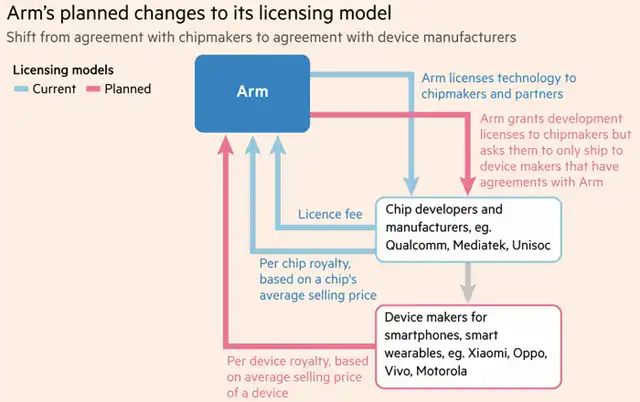 Old and new fee structures. Image courtesy of the Financial Times
Previously, the industry opposed NVIDIA’s acquisition of ARM, fearing that NVIDIA would have too much power. However, it’s clear that without NVIDIA, SoftBank, seeking financial returns, is willing to disregard the ecosystem’s interests.
On the other hand, RISC-V
offers a more open and flexible instruction set architecture that is not controlled by a single nation or commercial entity. Any company, and even individuals, can design chips freely based on the RISC-V architecture. Chip guru Jim Keller has also pointed out that RISC-V has fewer historical burdens and “junk” compared to ARM. It is cleaner, much like ARM was in its early days.
This directly influenced Jim Keller, one of the authors of the x86-64 instruction set, Apple A-series chip designer, AMD Zen architect, and creator of Tesla’s self-driving chip, to join a RISC-V chip startup after leaving Intel.
Additionally, semiconductor research firm SemiAnalysis revealed that Apple is transitioning its embedded chip’s core instruction set from ARM to RISC-V architecture. Apple’s later job postings have also corroborated this.
RISC-V will inevitably succeed, but what about ARM?
As we’ve previously noted, the rise of RISC-V is a victory for open-source architecture.
For many commercial companies, the value of the RISC-V architecture lies not in being free but in being open-source and freely modifiable, no longer controlled by commercial giants like Intel (x86) and ARM (ARM).
Furthermore, as RISC-V has developed to this point, even companies without architectural design capabilities or chip designs can find corresponding solutions and even mature products. This, to some extent, mitigates the fragmentation issue associated with open source.
For example, Jim Keller’s Tenstorrent offers five different RISC-V CPU core IPs that any chip design company can purchase.
But what about ARM?
The accumulation of ecosystems over the past few decades means that ARM cannot simply “collapse.” Qualcomm recently released its in-house-designed Oryon CPU based on ARM architecture. NVIDIA and AMD are rumored to be developing PC chips based on ARM architecture. It’s hard to imagine that Apple will abandon its recently completed “unified” architecture based on ARM in favor of RISC-V in the short term.
However, no empire lasts forever, and ARM is driving away one of its biggest customers and partners. More companies are dissatisfied with ARM’s dominance and short-sightedness. Otherwise, how could the list of members in the RISC-V Alliance be filled with names of ARM’s customers and partners?