Google Testing IP Privacy Protection in Chrome 119
Google Testing IP Privacy Protection in Chrome 119
- Why Enterprise RAID Rebuilding Succeeds Where Consumer Arrays Fail?
- Linus Torvalds Rejects MMC Subsystem Updates for Linux 7.0: “Complete Garbage”
- The Man Who Maintained Sudo for 30 Years Now Struggles to Fund the Work That Powers Millions of Servers
- How Close Are Quantum Computers to Breaking RSA-2048?
- Why Windows 10 Users Are Flocking to Zorin OS 18 Instead of Linux Mint?
- How to Prevent Ransomware Infection Risks?
- What is the best alternative to Microsoft Office?
Google Testing IP Privacy Protection in Chrome 119
Google to Test IP Privacy Protection Feature in Chrome Starting from Chrome 119
News On October 23, Google is developing a new feature for the Chrome browser to help users protect their IP address privacy.
According to reports, this IP protection feature aims to prevent websites from tracking user actions.
Google will begin testing this feature from Chrome version 119 and continue until version 125.
It’s worth noting that this feature is optional, and users can decide whether to enable it themselves.
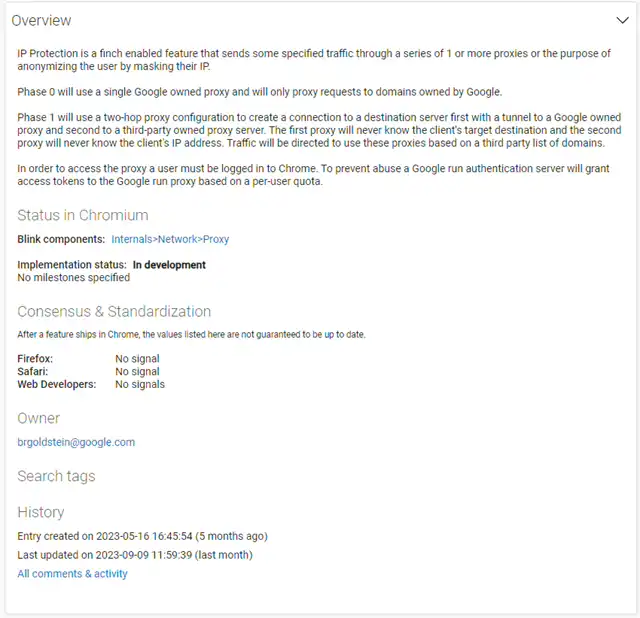
Google will conduct the testing using its own proxy servers, with the initial phase targeting users in the United States and covering 33% of experimental Chrome versions.
Interoperability and Compatibility
IP protection will alter the stability of client IP addresses but won’t significantly impact existing websites. In this experiment, the only affected domains are those owned by Google, including certain third-party loaded domains. For these requests, the client will no longer require a stable IP address. Currently, other domains remain unaffected.
Data will be routed through proxies using CONNECT and CONNECT-UDP technologies and will be fully encrypted through the TLS protocol. To minimize risks, an encryption token is required during the initial visit, and this token is generated by Google’s authentication server during the Chrome login process, tied to the user’s Google account.