India’s Software Industry and the US Ban on Chinese Automotive Software
India’s Software Industry and the US Ban on Chinese Automotive Software
- Why Enterprise RAID Rebuilding Succeeds Where Consumer Arrays Fail?
- Linus Torvalds Rejects MMC Subsystem Updates for Linux 7.0: “Complete Garbage”
- The Man Who Maintained Sudo for 30 Years Now Struggles to Fund the Work That Powers Millions of Servers
- How Close Are Quantum Computers to Breaking RSA-2048?
- Why Windows 10 Users Are Flocking to Zorin OS 18 Instead of Linux Mint?
- How to Prevent Ransomware Infection Risks?
- What is the best alternative to Microsoft Office?
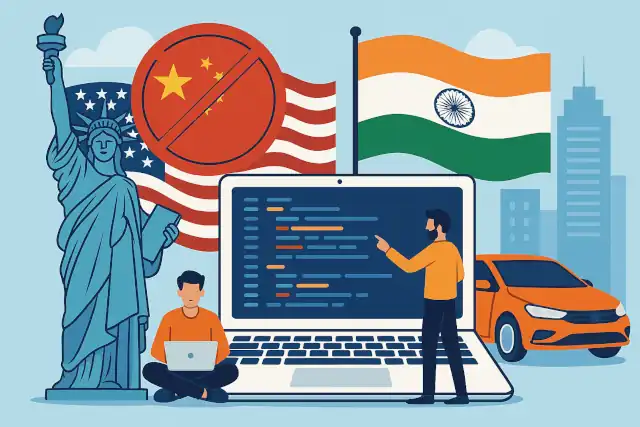
India’s Software Industry and the US Ban on Chinese Automotive Software
Analysis | March 2026
Washington’s sweeping ban on Chinese-made automotive software marks one of the most consequential supply chain ruptures in the history of the connected vehicle industry.
For the US automotive sector, it is a costly forced migration. For India’s software industry, it may represent a once-in-a-decade opportunity — but capitalizing on it will require more than simply filling a gap left behind by China.
What the US Ban Actually Requires
The US Department of Commerce’s Bureau of Industry and Security (BIS) finalized its connected vehicle rule in January 2025. The regulation prohibits the use of software integrated into Vehicle Connectivity Systems (VCS) and Automated Driving Systems (ADS) that was designed, developed, manufactured, or supplied by entities linked to China or Russia. Software compliance applies to model year 2027 vehicles, while hardware restrictions kick in for model year 2030.
The rule’s reach is wide. It covers application software, middleware, and system software — the core layers of modern automotive digital architecture. Firmware and open-source software are excluded, but the covered categories form the essential intelligence of any connected car: the telematics that transmits data, the connectivity stack that links vehicles to networks, and the automated driving logic that increasingly defines how cars behave on the road.
A legacy software exemption offers a limited runway: Chinese-developed software frozen in place before March 17, 2026 may remain in use, as long as it is not maintained or updated by any Chinese-linked entity after that date. In practice, software that cannot be updated is software on borrowed time — unsuitable for vehicles that require ongoing security patches and feature improvements.
The industry’s challenge is stark. Years of integration with Chinese suppliers — many of whom are reluctant to share proprietary source code — has created supply chains that automakers do not fully understand or control. Replacing deeply embedded software across global vehicle programs is not a task measured in months.
The Vacuum China Leaves Behind
China’s dominance in automotive software did not happen by accident. Chinese technology companies built cost-competitive, sophisticated capabilities across telematics, connectivity modules, sensor fusion, and ADAS software. Their integration into global automotive supply chains was deep, deliberate, and — until recently — welcomed.
The BIS rule now forces automakers and Tier 1 suppliers to find alternatives. The US itself has strong automotive software players, particularly in ADAS and autonomous driving, where companies like Mobileye, Luminar, and Waymo have deep expertise. European engineering firms bring proven embedded systems capabilities. But the sheer volume of software work that needs to be reshored, audited, rewritten, or replaced creates demand that no single geography can absorb alone.
This is where India enters the picture with a credible case.
India’s Automotive Software Sector: Quietly Building for a Moment Like This
India’s automotive software industry has been growing steadily beneath the radar of most geopolitical observers. According to market data, India accounted for approximately 3.4% of the global automotive software market in 2024 and is projected to grow at a compound annual growth rate of over 20% through 2030, reaching nearly $2.9 billion. While still modest in absolute terms, this trajectory reflects a sector that has been accumulating genuine technical depth.
Several Indian companies are now recognized players in the global automotive software space. KPIT Technologies has positioned itself as a specialist in software-defined vehicles and ADAS systems, with partnerships that include Mercedes-Benz. Tata Elxsi brings embedded systems engineering and automotive design capabilities developed over two decades of working with European and American OEMs. Tata Technologies, an offshoot of the Tata Motors engineering culture, supports product engineering for global automotive clients. Tech Mahindra has built an automotive vertical spanning connected vehicle platforms, cybersecurity, and over-the-air update systems.
Beyond these established names, a new generation of Indian ADAS startups has emerged — companies like Minus Zero, Swaayatt Robots, Flux Auto, and Ati Motors — that have developed AI-native autonomous systems calibrated for the challenging, high-density traffic conditions of Indian roads. These systems, designed to handle apparent chaos, may prove unusually transferable to demanding global applications.
India’s government has added institutional momentum to this commercial activity. The Semicon India Programme, backed by roughly $9 billion in financial support, is funding domestic semiconductor manufacturing — including 28-nanometer process technology suitable for automotive and ADAS chips. The Automotive Research Association of India is developing a dedicated ADAS testing facility near Pune. The Ministry of Road Transport and Highways has mandated ADAS features in new passenger vehicles, creating a domestic proving ground for technologies aimed at global markets.
The Opportunity: Real, But Not Automatic
The case for India benefiting from the US ban rests on several compounding factors. First, Indian software engineers are fluent in the programming languages and development frameworks used across automotive embedded systems — C, C++, Python, and increasingly Rust for safety-critical applications. Second, Indian IT services firms have long-standing relationships with US and European automakers through broader digital transformation contracts, giving them established access and trust. Third, India’s labor costs remain significantly lower than alternatives in Western Europe or North America, a factor that will matter to automakers facing enormous compliance costs.
The ban effectively reconfigures the global automotive software supply chain. Work that Chinese engineers in Shanghai or Shenzhen were doing — writing telematics middleware, developing connectivity stack software, maintaining ADAS calibration code — now needs to move somewhere that does not carry the geopolitical risk that triggered the BIS rule. India, which has maintained a firmly non-adversarial posture toward the United States and has itself restricted Chinese technology products in recent years, presents a clean geopolitical profile alongside proven technical capability.
The scale of the work is substantial. Analysts describe the rule as requiring automotive manufacturers to conduct an audit of every software component across multiple supplier tiers, produce Software Bills of Materials (SBOMs) documenting the origin of each element, and restructure supplier relationships built over years. Indian IT and engineering services firms — accustomed to managing large, complex, multi-year software transformation programs — are well suited to this kind of systematic, documentation-heavy work.
Headwinds and Honest Cautions
The opportunity is genuine, but India’s automotive software sector faces real obstacles that temper any simple optimism.
Automotive software development is safety-critical work governed by exacting international standards — ISO 26262 for functional safety, ISO/SAE 21434 for cybersecurity, and AUTOSAR for software architecture. Meeting these standards requires not just capable engineers, but organizations with certified processes, validated toolchains, and the institutional culture to sustain rigorous quality across millions of lines of code. Building this capability takes years, and China’s dominance in automotive software was partly a function of having made these investments early and at scale.
India’s established automotive IT players — KPIT, Tata Elxsi, Tata Technologies — have done this work and carry the relevant certifications. But the broader Indian IT services industry, which is more experienced in enterprise application development and business process outsourcing than in embedded safety-critical systems, cannot simply pivot into automotive software overnight. The skills are different, the tooling is specialized, and the stakes are higher.
There is also the challenge of timing. The BIS software compliance deadline applies to model year 2027 vehicles — meaning automakers need compliant software in production within roughly 18 to 24 months of now. In automotive development timelines, that is exceptionally tight. Companies cannot wait for India’s automotive software sector to scale up organically; they need partners who are ready today. This reality favors India’s existing specialized players over the broader IT sector.
Finally, it is worth noting that the current landscape of India’s large IT firms — TCS, Infosys, Wipro, HCL — while globally influential, have faced a subdued period in automotive manufacturing contracts specifically, with analysts noting weakness in this vertical heading into 2026. The automotive software opportunity is real, but it is more likely to benefit India’s specialized engineering services companies than the IT sector as a whole in the near term.
The Bigger Strategic Picture
Beyond the immediate commercial opportunity, the US ban represents a signal about the direction of global technology governance. The United States is drawing a line between trusted and untrusted technology origins for critical infrastructure — and connected vehicles, with their sensors, GPS systems, telematics, and increasingly autonomous capabilities, are now firmly in that critical infrastructure category.
India has an opportunity to position itself not merely as a lower-cost alternative to Chinese software labor, but as a genuinely trusted technology partner in the US automotive supply chain. This is a different and more durable competitive position. It requires investing in the certifications, processes, and institutional credibility that make Indian automotive software companies not just capable, but unambiguously safe from a regulatory standpoint.
India’s government appears to understand this framing. The domestic ADAS mandate, the semiconductor investment program, and the development of testing infrastructure are not just industrial policy — they are signals to global OEMs that India is serious about becoming a tier-one automotive technology nation, not just a low-cost services hub.
Conclusion
The US ban on Chinese automotive software does create real opportunity for India’s software industry. The demand for compliant, trusted, technically capable automotive software partners is large and growing urgently. India has the engineering talent, the geopolitical credibility, the established relationships with global automakers, and a growing ecosystem of specialized companies to make a meaningful claim on this work.
But the opportunity will not be captured passively. It will go to the Indian companies that have already done the hard work of mastering safety-critical automotive software standards, that have invested in the toolchains and certifications that global OEMs require, and that can demonstrate readiness now — not in five years. For those companies, the US-China decoupling in automotive technology may be the most significant tailwind of the decade.
Sources: BIS Final Rule (January 2025); Mayer Brown, Arnold & Porter, Gibson Dunn legal analyses; Grand View Research India Automotive Software Market; Canalys India ADAS Mandate Report; TechSpot, Plaxidity X industry analyses.