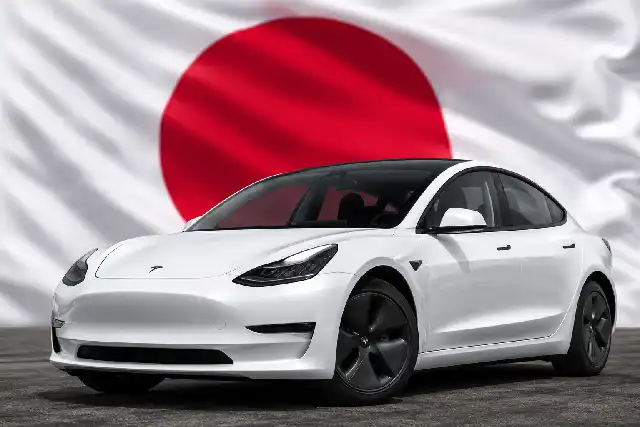
Is Tesla’s Model 3 Really US$22,000 in Japan?
- 60% of MD5 Password Hashes Can Be Cracked in Under an Hour with a Single GPU
- Dirty Frag: Root Access on Every Major Linux Distribution — No Patch, No Warning
- Ubuntu 26.04 LTS (Resolute Raccoon): The Most Ambitious Ubuntu LTS in a Decade
- Proton Mail: Data Transferred to FBI Again!
- How Close Are Quantum Computers to Breaking RSA-2048?
- How to Prevent Ransomware Infection Risks?
- What is the best alternative to Microsoft Office?
Is Tesla’s Model 3 Really US$22,000 in Japan?
Stack Japan’s national EV subsidy, Tokyo’s local incentive, and three years of free Supercharging — and a Model 3 lands at roughly ¥3,243,000. Here’s the verified math behind the headline.
Tesla has been aggressively pursuing the Japanese market with a combination of competitive pricing, interest-free financing, and substantial EV subsidy eligibility. When Japan’s national Clean Energy Vehicle (CEV) subsidy is combined with Tokyo’s local incentive and three years of free Supercharging, the effective purchase price of a Model 3 RWD drops to approximately ¥3,243,000 — around US$22,000 at current exchange rates.
That figure is verified. Here’s exactly how it’s calculated, what it means for the Japanese car market, and why Tesla’s momentum in a historically resistant market is now accelerating sharply.
The Base Prices
Tesla Japan’s current list prices (tax included) are ¥5,313,000 for the Model 3 RWD and ¥5,587,000 for the Model Y RWD. These figures are confirmed and have not changed recently as part of any new “discount package” — Tesla’s recent moves in Japan have focused on incentives and financing rather than list price cuts.
National and Local Subsidies
Japan’s national CEV (Clean Energy Vehicle) subsidy stands at ¥1,270,000 for qualifying Tesla models — this is among the highest available to imported vehicles and applies to both the Model 3 and Model Y. After this subsidy, the Model 3 RWD’s effective price drops to approximately ¥4,043,000 and the Model Y RWD to ¥4,317,000.
Tokyo residents can additionally claim a metropolitan subsidy. Under the current framework, Tesla qualifies for a manufacturer-tier subsidy of ¥400,000, with a maximum of ¥800,000 depending on eligibility. The Tokyo Metropolitan Government announced in June 2026 it would raise the maximum available local subsidy ceiling by ¥300,000, potentially increasing future savings further.
Stacking All Incentives: Model 3 Breakdown
| Component | Amount (¥) | Notes |
|---|---|---|
| List price (incl. tax) | ¥5,313,000 | Model 3 RWD |
| National CEV subsidy | − ¥1,270,000 | Available nationwide |
| Tokyo local subsidy (max) | − ¥800,000 | Tokyo residents only; varies by eligibility |
| Best-case effective price | ≈ ¥3,243,000 | ~$22,000 USD at ¥147/$1 (June 2026) |
Free Supercharging for three years (available on orders placed between April 1 and July 31, 2026) is estimated to save approximately ¥291,000 compared to fueling a gasoline equivalent over the same period. Including this benefit, the all-in ownership cost advantage over a comparable gas car becomes even more compelling.
“Japan remains one of the world’s most challenging markets for EV adoption, with hybrids dominating sales and battery-electric vehicles still a small share of new registrations.”
How Does This Compare to Mainstream Japanese Cars?
Context matters here. The Toyota Corolla Hybrid starts at around ¥2,380,000 in Japan, while the Honda Civic starts near ¥3,500,000. At ¥3,243,000 after maximum subsidies, the Model 3 crosses into territory previously occupied by premium mid-size sedans rather than mass-market compacts — but it’s no longer in the luxury bracket it once occupied in Japan.
The comparison underscores how dramatically subsidy stacking has shifted Tesla’s value proposition in the Japanese market. The 0% financing offer (available through March 2026 on earlier orders) pushed monthly payments to levels competitive with Japanese domestic brand hybrids.
Tesla’s Momentum in Japan
The strategy appears to be working. Tesla registrations surged approximately 182% year-over-year in May 2026, with nearly 2,000 vehicles delivered in the month alone and year-to-date sales up more than 150% compared to the same period in 2025. Japan, once considered impenetrable for foreign EVs given the dominance of Toyota and Honda hybrids, is beginning to show genuine openings for battery-electric alternatives.
Bottom Line
The real best-case figure — after Japan’s national subsidy plus maximum Tokyo local subsidy — lands closer to ¥3,243,000 (approximately $22,000 USD) at current exchange rates. Add in three years of free Supercharging and zero-percent financing, and the overall cost-of-ownership argument becomes genuinely strong.
What is unambiguously true is that Tesla has engineered a moment where its entry-level EV sits within striking distance of premium Japanese domestic models on price — a positioning that would have seemed far-fetched just two years ago.