Is Your Smartphone Safe During a Solar Storm?
Is Your Smartphone Safe During a Solar Storm?
- Why Enterprise RAID Rebuilding Succeeds Where Consumer Arrays Fail?
- Linus Torvalds Rejects MMC Subsystem Updates for Linux 7.0: “Complete Garbage”
- The Man Who Maintained Sudo for 30 Years Now Struggles to Fund the Work That Powers Millions of Servers
- How Close Are Quantum Computers to Breaking RSA-2048?
- Why Windows 10 Users Are Flocking to Zorin OS 18 Instead of Linux Mint?
- How to Prevent Ransomware Infection Risks?
- What is the best alternative to Microsoft Office?
Is Your Smartphone Safe During a Solar Storm?
Solar Storms and Technology: From Aviation Crisis to Consumer Electronics
Airbus Grounds 6,000 Aircraft Following Solar Radiation Vulnerability Discovery
November 28, 2025 — European aircraft manufacturer Airbus has initiated one of its largest-ever recalls, affecting approximately 6,000 A320-family aircraft worldwide after discovering that intense solar radiation can corrupt critical flight control systems. The unprecedented action comes after a JetBlue Airways flight experienced an uncommanded altitude loss on October 30, injuring at least 15 passengers and forcing an emergency landing in Tampa, Florida.
The issue stems from a vulnerability in the aircraft’s Elevator and Aileron Computer (ELAC), which manages aircraft pitch through pilot inputs. According to Airbus’s investigation, exposure to solar flares could lead to corrupted data that might result in uncommanded elevator movements, potentially exceeding the aircraft’s structural capabilities in worst-case scenarios.
The European Union Aviation Safety Agency issued an Emergency Airworthiness Directive late Friday, making the software fix mandatory before affected aircraft can carry passengers again. Most planes can be repaired in approximately two hours, though around 1,000 older jets will require hardware modifications leading to prolonged groundings.
Major carriers are racing to complete the updates. American Airlines, the world’s largest A320 operator, confirmed that 340 of its 480 A320 aircraft require the fix, while Delta Air Lines expects fewer than 50 aircraft to be impacted. The timing is particularly challenging as airlines face peak holiday travel periods in the United States and other regions.
Google Quick Share and AirDrop Integration: Breaking Down the Walls Between Android and iPhone
Beyond Aviation: How Solar Storms Affect Consumer Electronics
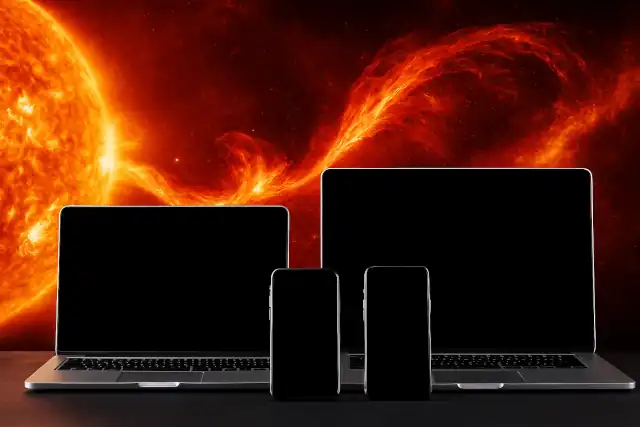
While the Airbus incident represents an extraordinary case, it raises broader questions about solar storm impacts on everyday technology. The sun recently entered its solar maximum phase in October 2024, a period of heightened solar activity occurring approximately every 11 years.
Why Can’t Criminals “Ghost Tap” Your iPhone or Android Wallet?
Direct Threats to Phones and Computers
The biggest threats to consumer electronics from solar flares include software glitches, data corruption, and hardware damage, though typical solar flares and geomagnetic storms are not strong enough to have noticeable effects on everyday electronics.
The energetic particles from solar flares can reach Earth and create small electrical currents that interfere with devices, especially those with sensitive chips. This can cause what experts call a “single event upset” (SEU), where a small error occurs in a microchip’s data processing. However, modern electronics are generally designed with some resistance to such interference.
Consumer wireless networks rely on different radio frequencies than those most affected by solar storms, and GPS features on phones typically use a mix of pure GPS and cellular tower-based location tracking, providing redundancy during solar events.
Google Maps’ Battery Saver Mode: Why It’s Currently Exclusive to Pixel 10
May 2024 Solar Storm: A Wake-Up Call
The May 2024 geomagnetic storm, classified as G5 on NOAA’s 1-to-5 scale, demonstrated the real-world impact on technology. The storm was strong enough to knock out GPS equipment that farmers rely on to cultivate their land and plan harvests, requiring centimeter-level precision for tractor guidance systems.
During the May storm, GPS communications were disrupted sufficiently to throw off automated agricultural machinery in the middle of planting season. The event also produced auroras visible as far south as Mexico and Florida, the strongest in over 500 years.
iOS 27 Prioritizes Performance as Apple Pumps the Brakes on Features
Infrastructure at Risk: Power Grids and Satellites
The most significant danger from severe solar storms involves large-scale infrastructure rather than individual devices. Geomagnetically induced currents can exceed 100 amperes, flowing into electrical components connected to the grid such as relays, transformers, and sensors, potentially causing internal component damage and large-scale power outages.
Satellites can suffer physical damage from particles, including supercharged “killer electrons,” hurtling directly into key hardware components or zapping entire machines into dysfunction. Satellites orbiting around 22,000 miles from Earth, including telecommunications and Earth-observing systems, are particularly vulnerable.
The 1989 Quebec blackout serves as a sobering example: a massive solar storm on March 13 caused a nine-hour electricity blackout across eastern Canada. Even more dramatically, the 1859 Carrington Event—the largest recorded geomagnetic storm—caused telegraph systems worldwide to fail catastrophically, with operators reporting electrical shocks and telegraph paper catching fire.
How Bypass Charging Keeps Gaming Phones Cool and Fast?
The Historical Context and Future Risks
Scientists studying Antarctic ice core samples have identified even more powerful events in Earth’s history. Around 774 CE, the Miyake Event produced the largest and fastest rise in carbon-14 ever recorded, with ice core samples showing that large-scale geomagnetic storms occur at an average rate of once every 500 years.
A National Academy of Sciences report estimates that a truly disastrous solar storm could cost as much as $2 trillion during its first year alone, accounting not just for equipment replacement but also the economic impact of prolonged outages lasting potentially months.
Lost iPhone “Found” Notification Scam: How to Avoid Falling for Fake Apple Alerts
Preparing for the Next Big Storm
Despite the alarming scenarios, experts emphasize that most solar activity poses minimal risk to consumer electronics. If users notice their devices or software experiencing problems, it is most likely unrelated to solar flares.
However, preparations are advisable for extreme events:
- Monitor solar activity reports from NOAA and other agencies
- Unplug electronics during periods of potentially dangerous solar activity
- Create data backups on external hard drives that remain unplugged
- Keep extra batteries or hand-powered chargers for small devices
- Maintain at least a half-tank of gas in vehicles, as gas stations require electricity for pumps
NOAA officials have stated that impact to cell phones should be minimal unless there are broad disruptions to the power grid. The agency actively monitors solar activity using satellites as part of an early warning system, though scientists note the challenge of the short response window—solar flares traveling at the speed of light reach Earth’s atmosphere in just eight minutes.
World’s First LPDDR6 Memory Debuts: Samsung Unveils Next-Generation Solution for Android Devices
Conclusion
The Airbus A320 recall represents an unprecedented intersection of space weather and modern aviation technology, highlighting vulnerabilities in increasingly computerized systems. While the immediate crisis affects thousands of aircraft and millions of passengers, it serves as a broader reminder of our technological dependence and exposure to solar phenomena.
For most consumers, everyday solar activity poses negligible risk to phones, computers, and personal devices. The real concern lies in extreme events that could damage power grids, satellites, and critical infrastructure—the backbone supporting all modern electronics. As we navigate the current solar maximum period, continued investment in early warning systems, hardened infrastructure, and contingency planning remains essential to protecting our interconnected technological world from the sun’s occasional fury.
With the sun’s 11-year cycle now at its peak, aviation authorities, power utilities, and technology companies worldwide are reassessing their vulnerability to space weather—a threat that grows more consequential as our civilization becomes ever more dependent on sophisticated electronics.