Japan’s Osaka Expo Electric Bus Scandal: How BYD Was Pushed Out and EVMJ Got In
Japan’s Osaka Expo Electric Bus Scandal: How BYD Was Pushed Out and EVMJ Got In
- Why Enterprise RAID Rebuilding Succeeds Where Consumer Arrays Fail?
- Linus Torvalds Rejects MMC Subsystem Updates for Linux 7.0: “Complete Garbage”
- The Man Who Maintained Sudo for 30 Years Now Struggles to Fund the Work That Powers Millions of Servers
- How Close Are Quantum Computers to Breaking RSA-2048?
- Why Windows 10 Users Are Flocking to Zorin OS 18 Instead of Linux Mint?
- How to Prevent Ransomware Infection Risks?
- What is the best alternative to Microsoft Office?
Japan’s Osaka Expo Electric Bus Scandal: How BYD Was Pushed Out and EVMJ Got In
February 27, 2026
What was meant to be a showcase of Japan’s green transportation future has become one of the country’s most embarrassing public safety scandals.
EV Motors Japan (EVMJ), the Kitakyushu-based startup that supplied electric buses for Expo 2025 in Osaka, is now at the center of a widening crisis involving widespread vehicle defects, allegations of falsified safety reports, a mass recall, and — as of this week — the resignation of its founding president.
How BYD Was Pushed Out — and EVMJ Got In
Before examining EVMJ itself, it is essential to understand how it won the Expo contract in the first place — and why the far more qualified BYD was excluded.
Around 2022, Osaka City Bus (a subsidiary of Osaka Metro) had already selected the BYD K8 as the large EV bus for Expo use, following comparative trials with Chinese manufacturer Alphabus. Staff had completed internal evaluation and were ready to proceed. However, when the procurement proposal was escalated to the parent company, Osaka Metro executives directed staff to also evaluate buses offered by “a company called EV Motors Japan.” The BYD selection was quietly shelved, and without further open competition, EVMJ secured the contract for 100 buses — later increased to 150.
Around the same time, other established Chinese manufacturers — including Farizon Auto (a commercial vehicle subsidiary of Geely) — were also in contact with the Expo organization but were told that “the Expo wanted Japanese-made EV buses.” Both BYD and Farizon were effectively disqualified on that basis. The irony, which the public would only learn later, is that EVMJ’s buses were not Japanese-made either — not a single unit had been assembled in Japan.
Industry sources and investigative journalists have pointed to the strong influence of then-Minister of Economy, Trade and Industry Yasutoshi Nishimura, who reportedly pushed hard for “domestically produced” EV buses at the Expo. Under that political pressure, EVMJ — which loudly advertised its plans for a domestic assembly factory in Kitakyushu — was positioned as the “Japanese” answer, even though its Kitakyushu factory would not produce a single vehicle before, during, or after the Expo.
The three Chinese OEM manufacturers that EVMJ sourced from — Wisdom, Yancheng (Hengtian), and VAMO (AIMO, a CRRC subsidiary) — are all comparatively small, inexperienced firms. Crucially, all three manufacture exclusively for export: none of their vehicles are approved for sale in China’s domestic market under the Ministry of Industry and Information Technology (MIIT) standards. All three told investigators it was their first time manufacturing buses for the Japanese market. By contrast, BYD had supplied approximately 500 buses to Japanese operators over the preceding decade, with a strong reliability record across nearly 30 operators surveyed nationwide.
A Startup With a Questionable Rise
Founded on April 1, 2019, EV Motors Japan is not a manufacturer. The company’s business model is to import electric buses produced by three Chinese OEM manufacturers — Wisdom (a Fujian-based bus maker), Hengtian, and Aizhonghe (AIMO, a subsidiary of state-owned railway giant CRRC) — and sell them to Japanese transit operators.
Despite having almost no domestic sales record at the time, EVMJ won a landmark contract in 2022 to supply 100 electric buses for the Osaka-Kansai Expo, a number that was later increased to 150. The Expo’s official website promoted these as “state-of-the-art electric buses” ferrying visitors on routes inside and outside the Expo site. Major Japanese operators including Hankyu Bus, Iyotetsu Bus, Fujikyu Bus, and Tokyu Bus subsequently adopted EVMJ buses, and by early 2025, the company had more than 300 buses in operation across the country.
What few buyers knew — or were told — was that the buses were entirely Chinese-made, assembled in China and imported as finished products. EVMJ had completed a “final assembly” factory in Kitakyushu in late 2023, with plans to transition to domestic assembly, but as of early 2026, the facility had not produced a single bus.
A Pattern of Failures From the Start
Problems emerged almost immediately after the Expo opened on April 13, 2025. Bus drivers at Osaka Metro reported a litany of defects: rain leaking through the roof and from tire housings, automatic doors failing to open or close, air conditioning breakdowns, screws and inspection covers falling off during operation, and buses stalling mid-route — including on inclines and in the middle of intersections — requiring tow trucks.
In April 2025, four EVMJ electric school buses delivered to Chikugo City, Fukuoka Prefecture — promoted as Japan’s first EV school buses — broke down repeatedly even during pre-launch testing. Within two weeks of entering service, all four were taken offline. After repairs, they returned to service in early June, only to malfunction again on the very first day. The Chikugo City contract was cancelled on October 1, and the school buses were replaced with diesel vehicles.
Parents of schoolchildren voiced alarm in local media, and the story spread nationally. Still, EVMJ continued to insist publicly that its vehicles had no fundamental defects.
The September 1 Accident and the Cover-Up Allegation
The crisis reached a breaking point on September 1, 2025, when an EVMJ E1 mini-bus — manufactured by Aizhonghe (AIMO) — suffered a complete steering failure while operating in central Osaka. Despite the driver’s repeated attempts to steer, the vehicle did not respond and collided with a median strip.
In a move that drew immediate public outrage, EVMJ’s internal inquiry concluded that the cause was not a vehicle defect but the driver’s inattentive driving — a finding that contradicted both the driver’s own account and the onboard camera footage. Industry insiders later alleged that this pattern of falsified reporting was systematic: internal inspection checklists held by EVMJ’s own engineers showed defects, while the reports submitted to clients and the authorities claimed everything was in order.
An industry source explained at the time: “We’ve compared the completed inspection checklists held by EVMJ inspectors with the inspection reports submitted to Osaka Metro. The discrepancies are clear. It’s highly likely that the Ministry would also be told there are no issues.”
Government Intervention and Damning Inspection Results
On September 5, Japan’s Ministry of Land, Infrastructure, Transport and Tourism (MLIT) ordered a nationwide comprehensive inspection of all 317 EVMJ electric buses, covering both Expo shuttle buses and vehicles operated by city and regional transit operators across the country. EVMJ dispatched inspectors from Hokkaido to Okinawa, completing the checks in approximately one week beginning September 9.
On October 17, Land Minister announced the results: 113 of 317 vehicles — more than 35% — had defects. Many buses had multiple problems, with some showing more than ten separate faults. A key issue was improper brake hose routing near the front wheel assembly, where contact with steering components could cause wear and eventual failure.
Three days later, on October 20, MLIT conducted an unannounced on-site inspection at EVMJ’s Kitakyushu headquarters under the authority of the Road Transport Vehicle Act. This surprise visit was triggered by the discovery that defects existed in vehicles beyond the original 113, and that EVMJ’s prior declarations that “all faults had been fully repaired” were found to be false.
Recall and Suspension of Operations
On November 28, 2025, EVMJ submitted a recall application to MLIT covering 190 electric buses sourced from its three Chinese manufacturers: Wisdom, Yancheng (Hengtian), and AIMO (the CRRC subsidiary). These vehicles had been distributed to bus operators throughout Japan.
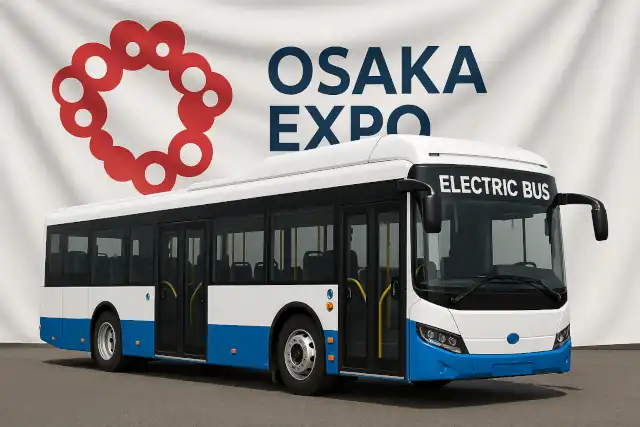
On December 23, 2025, Osaka Metro announced it would immediately suspend all EVMJ buses from service in the interest of passenger safety. The buses — still bearing the distinctive red, white, and blue livery of the Expo 2025 — were withdrawn from routes and placed in storage. A large number are now parked at a facility in Izumiotsu City, Osaka Prefecture, where rows of grounded buses have become a symbol of the scandal, widely described in Japanese media as an “electric bus graveyard.”
CEO Resigns; Leadership Overhaul
On February 20, 2026, EVMJ issued a formal statement accepting responsibility for the ongoing safety failures and management deficiencies. Founder and president Hiroyuki Sato, 69, announced he would step down effective February 28, remaining with the company in a technical advisory role. Vice President Hidenori Sumi is set to take over as representative director on March 1.
The company stated that all vehicles had completed inspection and repair work by the end of January 2026, and outlined a series of corrective measures including quality management reforms and a stated intent to pursue domestic production. The timeline for resuming normal operations remains unclear.
Broader Implications
The scandal has raised a number of larger questions. A central concern is that the buses were widely perceived — and at times actively presented — as domestically produced Japanese electric vehicles, when they were in fact entirely manufactured in China. Former Minister of Economy, Trade and Industry Yasutoshi Nishimura commented in April 2025 that officials had been reassured the buses were not Chinese-made.
The incident has also fed debate about supply chain transparency in the electric vehicle sector, the adequacy of Japan’s vehicle safety certification process for imported buses, and — in some quarters — whether remotely connected vehicle systems could pose national security risks. The Ministry has stated it will determine next steps based on inspection outcomes, but a clear path to the resumption of service has not yet been established.
Industry experts caution against drawing overly simplistic conclusions. In the context of a globalized supply chain, the failures involve not just the question of where the buses were manufactured, but how responsibilities were divided — and neglected — across design, assembly, quality assurance, and customer management. When those connections break down, the consequences, as this case shows, can extend from a World Expo showcase to a national safety crisis.
Sources: EV Motors Japan official statements; Japan Ministry of Land, Infrastructure, Transport and Tourism; 36Kr Japan (investigative reporting by automotive journalist Kumiko Kato); EVsmart Blog; Kuruma News; Yahoo! Japan News