Linux Kernel 6.6 Officially Released
Linux Kernel 6.6 Officially Released: Introduces EEVDF Scheduler, Shadow Stack and More
- Why Enterprise RAID Rebuilding Succeeds Where Consumer Arrays Fail?
- Linus Torvalds Rejects MMC Subsystem Updates for Linux 7.0: “Complete Garbage”
- The Man Who Maintained Sudo for 30 Years Now Struggles to Fund the Work That Powers Millions of Servers
- How Close Are Quantum Computers to Breaking RSA-2048?
- Why Windows 10 Users Are Flocking to Zorin OS 18 Instead of Linux Mint?
- How to Prevent Ransomware Infection Risks?
- What is the best alternative to Microsoft Office?
Linux Kernel 6.6 Officially Released: Introduces EEVDF Scheduler, Shadow Stack and More
On October 30th, in an announcement made by Linus Torvalds, Linux Kernel 6.6 has been officially released, bringing several new features and driver updates.
In the release notes for version 6.6, Linus Torvalds stated:
“The past week has been very calm, and I have no excuses to delay the release of version 6.6 any further, so it’s time to release it.”
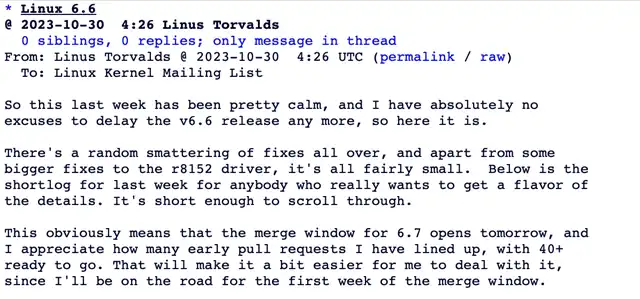
Apart from some significant fixes to the r8152 driver, everything else consists of minor improvements and fixes.
Linux Kernel 6.6 Officially Released: Introduces EEVDF Scheduler, Shadow Stack, and More
IT Home has discovered that Linux Kernel 6.6 primarily introduces the EEVDF scheduler, implements support for the Shadow Stack, adds user-space API required for Mesa NVK Vulkan driver to the Nouveau DRM driver, and continues to support upcoming Intel and AMD platforms.
Furthermore, Linux Kernel 6.6 also supports changing the charging mode, fan, and eGPU settings for ASUS devices, provides additional keyboard backlight control for Lenovo IdeaPad devices, and supports new Mellanox driver devices and other peripherals.
You can find the source code for Linux Kernel 6.6 on IT Home’s website at this link.
What are the key features of Linux Kernel 6.6?
Linux Kernel 6.6 was recently released and includes several new features and improvements.
Here are some of the key features:
- Robust Laptop Compatibility: The kernel introduces the “HP-BIOSCFG” driver, which allows users to customize their system settings directly from the Linux environment on HP laptops released in 2018 and later. Lenovo laptops, particularly the IdeaPad series, have also received improved support, including better keyboard backlight control. ASUS’s ROG Flow X16 (2023) series benefits from the kernel’s capability to activate tablet mode .
- Advanced Networking Capabilities: The kernel has broadened hardware support and embraces diverse networking hardware .
- AMD-Centric Innovations: The Linux Kernel 6.6 introduces a novel feature for AMD, namely the “FreeSync Panel Replay” technology. It also includes AMD Dynamic Boost Control.
- Enhanced Security Measures: The release of Linux Kernel 6.6 marks a significant step forward in bolstering system security. One of the standout features is integrating Intel’s Shadow Stack technology, which defends against a specific type of cyber threat known as return-oriented programming (ROP) attacks.
Please note that this is not an exhaustive list of all the features and improvements in Linux Kernel 6.6.