Mac or Linux? Choosing the Right Home for OpenClaw
Mac or Linux? Choosing the Right Home for OpenClaw
- Why Enterprise RAID Rebuilding Succeeds Where Consumer Arrays Fail?
- Linus Torvalds Rejects MMC Subsystem Updates for Linux 7.0: “Complete Garbage”
- The Man Who Maintained Sudo for 30 Years Now Struggles to Fund the Work That Powers Millions of Servers
- How Close Are Quantum Computers to Breaking RSA-2048?
- Why Windows 10 Users Are Flocking to Zorin OS 18 Instead of Linux Mint?
- How to Prevent Ransomware Infection Risks?
- What is the best alternative to Microsoft Office?
Platform Guide · March 2026
Mac or Linux? Choosing the Right Home for OpenClaw
Both platforms run the viral AI agent without friction — but the right answer depends entirely on what you actually need it to do.
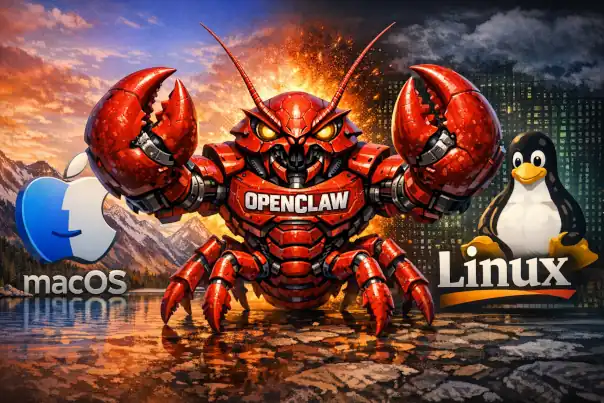
Since OpenClaw went viral in late January 2026 — after a journey through the names Clawdbot and Moltbot — the internet has been locked in a surprisingly heated debate about where to run it. Every Reddit thread, every YouTube setup video, and every tech blog seems to end with the same conclusion: just get a Mac Mini. But is that actually the right call for everyone? The answer is more nuanced than the hype suggests.
OpenClaw is an open-source AI agent gateway that stays alive 24/7, listens for messages across apps like WhatsApp, Telegram, Slack, and iMessage, and executes actions on your behalf — reading emails, managing calendars, running shell commands. Because it lives on hardware you control, the platform you choose shapes everything from uptime to security to how much you’ll spend.
What OpenClaw Actually Needs
Before picking a platform, it helps to understand the real requirements. OpenClaw needs Node.js 22 or later — earlier versions cause install failures or gateway crashes. Beyond that, the hardware demands depend heavily on how you use it.
If you’re routing requests to cloud AI providers like Anthropic or OpenAI, the agent itself is lightweight: 8 GB of RAM is sufficient for most setups. If you want to run local language models through Ollama alongside OpenClaw, you’ll want 16 GB or more — and this is where hardware architecture starts to matter.
Both macOS and Linux are supported natively. The daemon installer uses launchd on macOS and systemd on Linux, giving both platforms automatic startup on boot, crash recovery, and persistent background operation after a single setup command.
The Case for macOS (Mac Mini M4)
The Mac Mini M4 has become the community’s default recommendation, and there are real reasons for that consensus — not just hype.
iMessage Integration
This is the single biggest practical advantage macOS holds over Linux. OpenClaw’s native integrations with iMessage, Apple Notes, and Apple Reminders simply do not exist on Linux. If your household runs on iPhones and you want to talk to your agent through the Messages app, macOS is the only path that doesn’t involve workarounds.
Power Efficiency
Apple Silicon idles at under 10 watts. A Mac Mini M4 running OpenClaw around the clock draws roughly $1–3 per month in electricity. For an always-on agent, that’s a meaningful long-term advantage over many x86 alternatives.
Unified Memory for Local Models
If you plan to run local LLMs via Ollama, the M4’s unified memory architecture — where CPU and GPU share the same pool — provides notably better inference throughput than discrete GPU setups at the same price point. The 16 GB base model handles 7B parameter models cleanly; the 24 GB and 32 GB configurations open up larger models.
Simplicity
macOS handles updates, security, sleep/wake cycles, and headless operation gracefully. For users who don’t want to manage a Linux server, that reduced maintenance overhead is a real quality-of-life benefit.
“macOS is perhaps the best choice for installing OpenClaw. It was largely built for the Apple ecosystem, and it shows — with integrations with apps such as Notes, Reminders, and iMessage.”
— BitLaunch OpenClaw Installation Guide, March 2026
The Downsides of Mac
The Mac Mini M4’s weaknesses are real. The base model ships with 16 GB of soldered RAM — you cannot upgrade it later. The 24 GB configuration costs $999; the 32 GB model is $1,199. You are paying the Apple premium for a chassis and an OS. For cloud-API OpenClaw users, that hardware is vastly overpowered. And an HDMI dummy plug ($8–10) is recommended for stable headless operation, since macOS can break screen-recording permissions without a display attached.
The Case for Linux
Linux is where OpenClaw’s server DNA lives. The official documentation recommends Linux as “the most predictable option” for server hosting, and that reflects how the project was originally built.
Cost and Hardware Flexibility
A mini PC running Linux can be configured with 32–96 GB of upgradeable DDR5 RAM for $749–$1,000 — often less than an equivalent Mac. Unlike soldered Apple Silicon memory, you can expand it as your needs grow. For users who want to run heavy local models or multiple simultaneous channels, this matters.
Full Control and Customization
Linux gives you granular control over every layer of the stack — firewall rules, user permissions, containerization with Docker, automated backup scripts, and network isolation. Experienced users often prefer this transparency, especially given OpenClaw’s documented security concerns. Distributions like Ubuntu 22.04+ and Debian 11+ are fully supported and have the largest community of OpenClaw users on the server side.
VPS Option
Linux also unlocks the VPS deployment path. Hosting OpenClaw on DigitalOcean, Hetzner, or Contabo costs roughly $5–20 per month with no upfront hardware cost, built-in redundancy, and remote accessibility without additional tunneling tools. For users who don’t want to maintain physical hardware, this is often the most pragmatic starting point.
The Downsides of Linux
No iMessage. If your primary messaging ecosystem is Apple’s, Linux cannot match macOS here without significant workarounds. Linux also demands more hands-on administration — system updates, service monitoring, and security hardening are your responsibility. For non-technical users, the learning curve is steeper.
Side-by-Side Comparison
| Factor | macOS (Mac Mini M4) | Linux (Mini PC / VPS) |
|---|---|---|
| iMessage support | ✔ Native | ✘ Not available |
| WhatsApp / Telegram / Slack | ✔ Full support | ✔ Full support |
| Daemon (auto-start) | ✔ launchd | ✔ systemd |
| Idle power draw | ~5–10W | 10–30W (varies) |
| RAM upgradeable | ✘ Soldered | ✔ Yes (mini PC) |
| Local LLM performance | Excellent (unified memory) | Good (GPU dependent) |
| Upfront cost (16 GB equiv.) | $599–$999 | $0 (VPS) / $749+ (mini PC) |
| Maintenance burden | Low (macOS handles updates) | Medium–High |
| Docker / containerization | ✔ (via Docker Desktop) | ✔ Native |
| Server / remote deployment | Not ideal | ✔ Ideal (VPS) |
| Setup difficulty | Easy | Easy–Medium |
| Node.js 22+ required | ✔ Both | ✔ Both |
Who Should Choose What
Choose macOS if…
- You are in the Apple ecosystem and want iMessage integration
- You want low power draw for an always-on device
- You plan to run local LLMs (Ollama) and want efficient inference
- You prefer low-maintenance “set it and forget it” operation
- Budget is not the primary constraint
Choose Linux if…
- You use WhatsApp, Telegram, Slack, or Discord as your main channel
- You want maximum hardware flexibility and upgradeable RAM
- You’re comfortable managing a server or VPS
- You want the lowest possible cost — especially via a $5/month VPS
- You need advanced security controls and network isolation