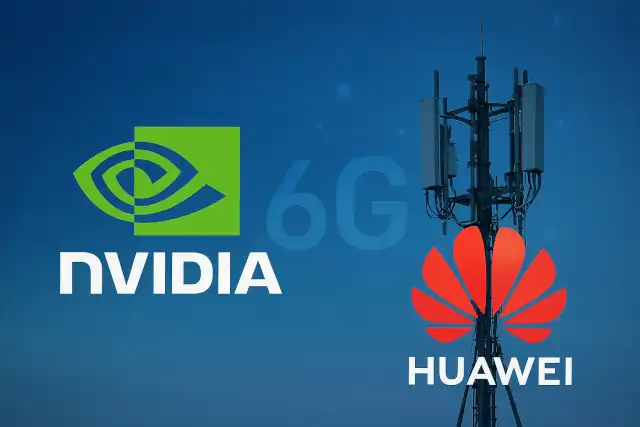
NVIDIA Declares War on Huawei for 6G Dominance
NVIDIA Declares War on Huawei for 6G Dominance
- Why Enterprise RAID Rebuilding Succeeds Where Consumer Arrays Fail?
- Linus Torvalds Rejects MMC Subsystem Updates for Linux 7.0: “Complete Garbage”
- The Man Who Maintained Sudo for 30 Years Now Struggles to Fund the Work That Powers Millions of Servers
- How Close Are Quantum Computers to Breaking RSA-2048?
- Why Windows 10 Users Are Flocking to Zorin OS 18 Instead of Linux Mint?
- How to Prevent Ransomware Infection Risks?
- What is the best alternative to Microsoft Office?
NVIDIA Declares War on Huawei for 6G Dominance
A Tech Battle Reshaping the Future of Global Communications
October 30, 2025
The global race for 6G supremacy has escalated into a full-scale technological confrontation, with NVIDIA launching an aggressive offensive against Huawei’s growing influence in next-generation wireless communications.
What began as a competition over AI chips has now evolved into a strategic battle that will determine who controls the infrastructure of tomorrow’s connected world.
Can NVIDIA Dominate 6G Infrastructure Through Its Partnership with Nokia?
The Opening Salvo: NVIDIA’s $1 Billion Gambit
In a dramatic move announced just days ago at the GTC Washington conference, NVIDIA unveiled a comprehensive 6G strategy centered on its new Arc Aerial RAN Computer platform and a landmark $1 billion investment in Nokia.
The partnership with Nokia, Europe’s telecommunications giant, represents NVIDIA’s most significant thrust into the wireless infrastructure market—a domain where Huawei has long held considerable influence.
The timing of NVIDIA’s announcement is no coincidence. The company is positioning itself as the champion of Western telecommunications independence, with CEO Jensen Huang declaring that “wireless technology around the world, largely today, is deployed on foreign technologies… that has to stop.” The message is clear: NVIDIA intends to challenge Huawei’s position not just in China, but globally.
Beyond 5G: How Terahertz Waves Will Power the Next Generation of 6G Wireless Networks
Huawei: The Formidable Adversary
NVIDIA’s aggressive posture stems from genuine concern about Huawei’s technological capabilities. Despite years of U.S. sanctions and export restrictions, Huawei has emerged as what NVIDIA executives describe as a “formidable” and “very advanced” competitor in the AI-RAN (AI-native Radio Access Network) space.
Ronnie Vasishta, NVIDIA’s Head of Telecom Business, acknowledged in June 2025 that Huawei’s submissions to the 3GPP standards body for 6G were “very, very detailed” and “very forward-looking.” The Chinese giant proposed a revolutionary air interface that could potentially double spectral efficiency—a breakthrough that would give it a significant edge in the 6G race.
What makes Huawei particularly dangerous to NVIDIA’s ambitions is its unique position as the only company developing both advanced RAN technology and competitive AI processors. Huawei’s Ascend GPU series, particularly the upcoming 910D chip, has been designed specifically to challenge NVIDIA’s dominance in AI computing. The company has also developed CANN (Compute Architecture for Neural Networks), a software platform intended to rival NVIDIA’s CUDA ecosystem.
In September 2025, Huawei unveiled its Atlas 950 and Atlas 960 SuperPoD systems, claiming they would be the “most powerful” AI computing clusters in the world. Rotating Chairman Eric Xu boldly predicted these systems would deliver 6.7 times more computing power than NVIDIA’s comparable offerings, signaling Huawei’s determination to compete across the entire AI-RAN stack.
Why Are 6G Smartphone Antennas So Incredibly Complex?
The Strategic Battlefield: AI-RAN and 6G
The contest between NVIDIA and Huawei centers on AI-RAN, a revolutionary approach that integrates artificial intelligence directly into radio access networks. This technology promises to dramatically improve spectral efficiency, enable real-time network optimization, and support the massive connectivity demands of 6G networks.
NVIDIA’s strategy revolves around making its CUDA platform and GPU architecture the de facto standard for AI-RAN deployments worldwide. The company has spent years cultivating a rich developer ecosystem around CUDA, creating what many describe as a protective “moat” around its business. Once developers commit to CUDA, switching to alternatives becomes extremely difficult—a strategic advantage NVIDIA hopes will translate into 6G dominance.
The newly announced Arc Aerial RAN Computer represents NVIDIA’s hardware answer to this challenge. Combined with the company’s recently open-sourced Aerial software suite, NVIDIA is offering a complete, “made-in-America” AI-native wireless stack designed to compete directly with Huawei’s integrated solutions.
Huawei, meanwhile, is leveraging its traditional strengths: massive scale, advanced networking expertise, and strong government support. The company has publicly admitted its individual chips can’t match NVIDIA’s raw performance, but it’s compensating through system-level optimization and brute force—deploying five times as many processors to achieve superior overall computing power.
https://pbxscience.com/wp-admin/post.php?post=13281&action=edit
The Geopolitical Dimension
This technological rivalry cannot be separated from broader geopolitical tensions. NVIDIA’s partnership with Nokia and collaboration with U.S. telecom leaders like T-Mobile, Cisco, and Booz Allen explicitly frames the 6G race as a matter of national security and economic sovereignty. The Trump administration has positioned AI dominance as central to American competitiveness, with NVIDIA serving as a key partner in this strategy.
U.S. export restrictions have sought to cut China off from NVIDIA’s most advanced AI chips, including the flagship B200 and even the H100. However, these measures have had the unintended consequence of accelerating Chinese innovation. Huawei’s rapid progress in developing competitive alternatives—despite being blacklisted since 2019—demonstrates the limits of technology denial strategies.
The competition has intensified in recent months. China’s internet regulator reportedly banned local companies from purchasing NVIDIA’s RTX Pro 6000 chips, while Beijing accused NVIDIA of anti-monopoly violations. These moves signal China’s determination to build a self-sufficient semiconductor ecosystem with Huawei at its center.
Market Stakes: A $200 Billion Prize
The financial stakes are enormous. According to analyst firm Omdia, the AI-RAN market is expected to exceed a cumulative $200 billion by 2030. This represents not just incremental growth, but a fundamental transformation of the telecommunications infrastructure that underpins the global economy.
NVIDIA sees 6G as a generational platform shift—an opportunity to extend its AI dominance from data centers into the edge computing and wireless communications domains. Success would cement NVIDIA’s position as the essential provider of AI infrastructure across multiple industries.
For Huawei, 6G leadership represents both commercial opportunity and strategic necessity. After being largely excluded from Western 5G markets, the company is betting that technological superiority in 6G—particularly in markets where it can compete—will allow it to reclaim global influence and power China’s digital infrastructure goals.
The Competitive Landscape
While NVIDIA has focused on building alliances with Western telecommunications companies, Huawei has pursued a different path. The company leads the 5G RAN market and has deployed over 300 Atlas 900 AI clusters to customers across telecommunications, manufacturing, and other industries. Its integrated approach—controlling everything from chips to network equipment to software platforms—gives it unique advantages in optimization and cost efficiency.
However, Huawei faces a critical weakness: convincing software developers outside China to prioritize CANN over CUDA. NVIDIA’s vast developer ecosystem represents a powerful network effect that will be difficult to overcome in Western markets. Vasishta emphasized this advantage, noting that “the ecosystem of developers for NVIDIA is very, very rich, and we should continue to enrich that ecosystem, because that’s the way we can grow.”
NVIDIA has countered Huawei’s integrated approach by open-sourcing its Aerial software suite and introducing the compact DGX Spark AI supercomputer for 6G research. These moves aim to democratize access to NVIDIA’s technology and accelerate AI-RAN innovation among a broad base of researchers and developers.
Looking Ahead: An Uncertain Future
As 2025 draws to a close, the NVIDIA-Huawei rivalry shows no signs of abating. Both companies are investing heavily in next-generation technologies, from NVIDIA’s forthcoming Vera Rubin architecture to Huawei’s planned three-year campaign to erode NVIDIA’s AI chip dominance.
The competition will likely intensify as 6G standardization work progresses through 2026 and 2027. Key battlegrounds will include:
-
Standards Setting: Both companies are actively participating in 3GPP and other standards bodies, seeking to embed their technologies into official 6G specifications.
-
Ecosystem Building: NVIDIA’s developer-focused strategy versus Huawei’s vertically integrated approach will be tested as early 6G deployments begin.
-
Performance Benchmarks: As real-world testing progresses, the claims and counterclaims about computing power, spectral efficiency, and total cost of ownership will face market validation.
-
Geopolitical Alignment: The extent to which countries align with U.S. or Chinese technology ecosystems will significantly influence market access and adoption patterns.
Conclusion: A Battle That Defines the Digital Future
The NVIDIA-Huawei confrontation over 6G represents more than a corporate rivalry—it’s a contest that will shape the fundamental infrastructure of the digital age. The winner won’t just dominate a lucrative market; they’ll influence how billions of devices connect, how AI services are delivered, and ultimately, whose technological ecosystem powers the global economy.
NVIDIA’s declaration of war through massive investments, strategic partnerships, and “America First” positioning has transformed what might have been a gradual competitive evolution into an urgent technological arms race. Huawei, battle-hardened by years of sanctions and restrictions, has proven it cannot be counted out.
As both companies marshal their resources for the battles ahead, one thing is certain: the future of 6G—and with it, the future of global connectivity—will be determined by whichever company can most effectively combine technological innovation, ecosystem strength, and strategic positioning. The war for 6G dominance has begun, and the entire world will feel its impact.