OpenELA Officially Releases Enterprise Linux Source Code
OpenELA Officially Releases Enterprise Linux Source Code, Encourages Third-Party Development of RHEL-Compatible Distributions
- Why Enterprise RAID Rebuilding Succeeds Where Consumer Arrays Fail?
- Linus Torvalds Rejects MMC Subsystem Updates for Linux 7.0: “Complete Garbage”
- The Man Who Maintained Sudo for 30 Years Now Struggles to Fund the Work That Powers Millions of Servers
- How Close Are Quantum Computers to Breaking RSA-2048?
- Why Windows 10 Users Are Flocking to Zorin OS 18 Instead of Linux Mint?
- How to Prevent Ransomware Infection Risks?
- What is the best alternative to Microsoft Office?
OpenELA Officially Releases Enterprise Linux Source Code, Encourages Third-Party Development of RHEL-Compatible Distributions
Following Red Hat’s announcement that it would no longer publicly release the source code for Red Hat Enterprise Linux (RHEL), companies such as Oracle, SUSE, and CIQ, operating in the Linux field, have come together to establish the Open Enterprise Linux Association (OpenELA).
OpenELA, in a recent blog post, announced the official release of “open and free” Enterprise Linux (EL) source code. They have also established a technical steering committee to encourage the development of Linux versions compatible with RHEL by third-party developers.

OpenELA Officially Releases Enterprise Linux Source Code, Encourages Third-Party Development of RHEL-Compatible Distributions
IT Home discovered that OpenELA stated its commitment to ensuring the continuous availability of EL source code to the community, with initial emphasis on EL8 and EL9, and software packages for EL7 are also set to be released soon.
Wim Coekaerts, Oracle Linux Development Lead, said, “When we established OpenELA earlier this year, we made some commitments to the open-source developer community, and now we are delivering on those commitments. We are very excited to reach these significant milestones and look forward to seeing an ecosystem develop around OpenELA.”
For those interested, you can find the project’s website at the following link: [Link Here]
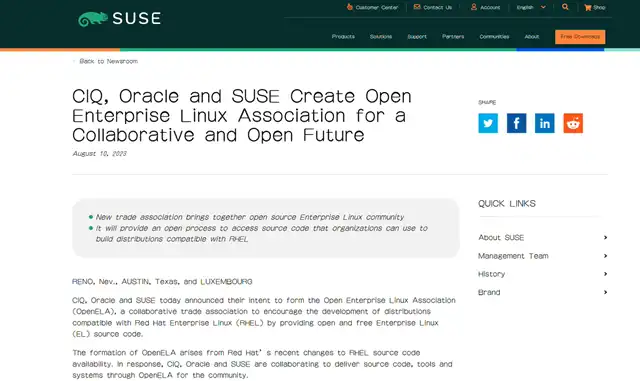
Oracle, SUSE, and CIQ Establish Open Enterprise Linux Association to Develop RHEL-Compatible Distribution
August 11th – Following Red Hat’s announcement in June that they would no longer publicly release the Red Hat Enterprise Linux (RHEL) source code, three key players in the Linux sphere, Oracle, SUSE, and CIQ, made a joint statement yesterday. They declared the formation of the Open Enterprise Linux Association (OpenELA), which aims to provide “open and free” Enterprise Linux (EL) source code to encourage the development of Linux versions compatible with RHEL by third parties.
Related news:
Oracle, SUSE, and CIQ Establish Open Enterprise Linux Association to Develop RHEL-Compatible Distribution
Earlier, it was reported that Red Hat decided to cease providing the RHEL source code publicly in June this year, making the CentOS Stream source code, a testing version of RHEL, the only one available for public access.
Red Hat had previously stated that they would provide RHEL source code directly to their commercial customers and partners through the Red Hat Customer Portal.
Red Hat’s move has generated significant outrage in the industry, with many questioning the company’s actions for potential violations of various open-source licenses, including the GPL.
However, Mike McGrath, Vice President responsible for Red Hat’s Core Platform Engineering, explained that “Red Hat has invested a lot of time and effort in developing and maintaining RHEL and shares its contributions with projects like Fedora, CentOS Stream, or the Linux Kernel. Thus, Red Hat complies with its own open-source licenses.”
Nonetheless, the industry has evidently held a different view. Previously, SUSE announced an investment of over $10 million to develop a Linux distribution compatible with RHEL.
Now, Oracle, SUSE, and CIQ have gone a step further by establishing the Open Enterprise Linux Association (OpenELA), with its primary objective being the development of a distribution compatible with RHEL Enterprise Edition.
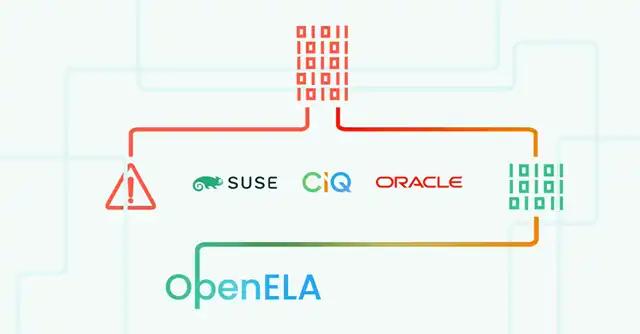
OpenELA states on its official website, “Open source and the community are in OpenELA’s DNA. OpenELA’s project is oriented towards the maximum benefit of the open-source community and all downstream derivative versions, encouraging a broader community participation. We welcome all contributors to join the OpenELA project.”
OpenELA plans to provide a series of toolkits to developers in the latter half of this year to collaborate in the development of RHEL-compatible distributions, with an initial focus on RHEL 8 and RHEL 9.
However, it is currently unclear whether the source code provided by OpenELA will be identical to that of RHEL.