Quantum Computers Will Break Today’s Encryption And Hackers Are Already Preparing
Quantum Computers Will Break Today’s Encryption And Hackers Are Already Preparing
- Why Enterprise RAID Rebuilding Succeeds Where Consumer Arrays Fail?
- Linus Torvalds Rejects MMC Subsystem Updates for Linux 7.0: “Complete Garbage”
- The Man Who Maintained Sudo for 30 Years Now Struggles to Fund the Work That Powers Millions of Servers
- How Close Are Quantum Computers to Breaking RSA-2048?
- Why Windows 10 Users Are Flocking to Zorin OS 18 Instead of Linux Mint?
- How to Prevent Ransomware Infection Risks?
- What is the best alternative to Microsoft Office?
Quantum Computers Will Break Today’s Encryption And Hackers Are Already Preparing
The Terrifying New Threat of Quantum Computing: “Steal the Data Now, Decrypt It Later”
A new era of cybersecurity challenges emerges as attackers stockpile encrypted data today, waiting for quantum computers powerful enough to break it tomorrow
The cybersecurity landscape is facing an unprecedented transformation. Quantum computers—machines that harness the strange properties of quantum mechanics to perform calculations exponentially faster than conventional computers—threaten to render today’s encryption methods obsolete.
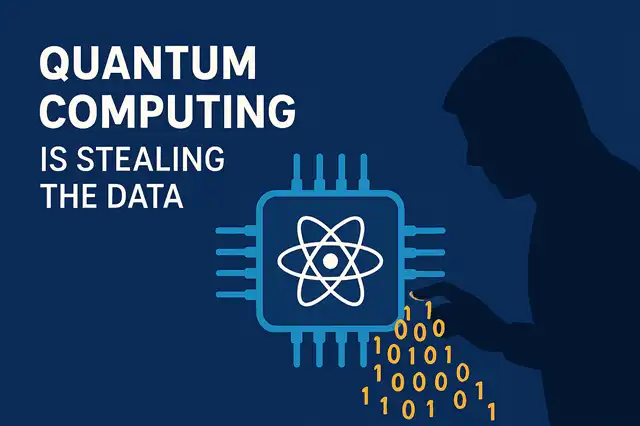
But the most alarming aspect of this looming threat isn’t just that quantum computers will be able to crack current encryption; it’s that attackers are already executing a chilling strategy: stealing encrypted data now and storing it until quantum computers become powerful enough to decrypt it.
This approach, known as “Harvest Now, Decrypt Later,” represents a fundamental shift in how we must think about data security.
The End of “Thousands of Years to Crack” Security
For decades, the foundation of internet security has rested on public-key cryptography systems like RSA and Elliptic Curve Cryptography (ECC). These encryption methods have been considered virtually unbreakable because decrypting them with conventional computers would take thousands of years—far longer than the useful lifespan of most sensitive data.
RSA encryption relies on the mathematical difficulty of factoring large numbers into their prime components. Similarly, ECC leverages the complex mathematical properties of elliptic curves. Both systems work because conventional computers must try countless combinations to find the correct decryption key, a process that would take millennia even with today’s most powerful supercomputers.
However, quantum computers change this equation entirely. Using Shor’s algorithm—a quantum computing method developed by mathematician Peter Shor in 1994—quantum computers can factor large numbers exponentially faster than conventional machines. What would take a classical computer thousands of years could potentially be accomplished by a sufficiently powerful quantum computer in hours or even minutes.
The “Harvest Now, Decrypt Later” Threat
This capability creates a disturbing new attack vector. Cybercriminals and hostile nation-states don’t need to wait for quantum computers to become fully operational before they begin their attacks. Instead, they can steal encrypted data today—intercepting sensitive communications, copying encrypted databases, or capturing financial transactions—and simply store this information until quantum computers become powerful enough to decrypt it.
This means that sensitive data encrypted today using current standards may already be compromised, even if it won’t be readable for several more years. Medical records, financial information, government secrets, and personal communications that seem secure today could all be vulnerable to future decryption.
The implications are particularly severe for information that remains sensitive over long periods. Trade secrets, national security information, and personal identity data could all be at risk, even if they’re currently protected by state-of-the-art encryption.
Two Approaches to Quantum-Resistant Security
In response to this threat, cybersecurity researchers have developed two primary defensive strategies, both of which are already being implemented by major technology companies and governments worldwide.
Post-Quantum Cryptography (PQC)
The first approach involves developing new encryption algorithms that remain secure even against quantum computer attacks. These “quantum-resistant” or “post-quantum” cryptographic methods rely on mathematical problems that are difficult for both classical and quantum computers to solve.
The most prominent example is lattice-based cryptography, which uses complex mathematical problems involving multidimensional geometric structures. Think of it like navigating an enormously complex maze—the more dimensions and complications you add, the harder it becomes to find the correct path, even for a quantum computer.
In 2024, the U.S. National Institute of Standards and Technology (NIST) standardized several quantum-resistant algorithms, including CRYSTALS-Kyber for secure key exchange and CRYSTALS-Dilithium for digital signatures. Major technology companies including Apple and Google have already begun incorporating these standards into their products and services.
Quantum Key Distribution (QKD)
The second approach leverages quantum mechanics itself to create inherently secure communication channels. Quantum Key Distribution uses the properties of individual photons (light particles) to transmit encryption keys in a way that makes eavesdropping physically detectable.
The fundamental principle behind QKD is that quantum particles exist in delicate states that change when observed. If an attacker attempts to intercept a quantum-encrypted communication, their very act of observation alters the quantum states being transmitted, immediately alerting the legitimate parties that the communication has been compromised.
NEC Corporation has developed implementations of the BB84 protocol, one of the most established QKD methods, which uses the polarization states of photons to establish secure encryption keys over fiber optic networks.
Hybrid Approaches
Recognizing that the transition to quantum-resistant security will take time, many organizations are implementing hybrid systems that combine traditional encryption methods with post-quantum algorithms. This approach maintains backward compatibility while providing protection against future quantum attacks.
Financial institutions have been particularly proactive, with Many Financial Services Agency requesting major and regional banks to begin implementing quantum-resistant cryptography by May 2025. Internet security protocols like TLS (Transport Layer Security), which protects web browsing and online transactions, are being updated to support both conventional and post-quantum encryption simultaneously.
The Urgency of Action
The quantum threat isn’t a distant, theoretical concern—it’s prompting immediate action from governments and corporations worldwide. While experts disagree on exactly when quantum computers will become powerful enough to break current encryption (estimates range from 10 to 30 years), the “Harvest Now, Decrypt Later” attack strategy means organizations cannot afford to wait.
Any sensitive data encrypted today using vulnerable algorithms could potentially be decrypted in the future. This creates an urgent imperative to transition to quantum-resistant encryption methods now, before more data is exposed to this long-term threat.
The cybersecurity world has always operated on a cycle of attack and defense, with protective measures evolving in response to new threats. The quantum computing revolution represents perhaps the most significant challenge this cycle has faced, requiring not just incremental improvements but a fundamental reimagining of how we protect digital information.
As quantum technology continues to advance, the race is on to secure our digital infrastructure before the “harvest” of today’s encrypted data can be decrypted tomorrow. The organizations and governments that act now to implement quantum-resistant security measures will be best positioned to protect their sensitive information in the quantum era ahead.