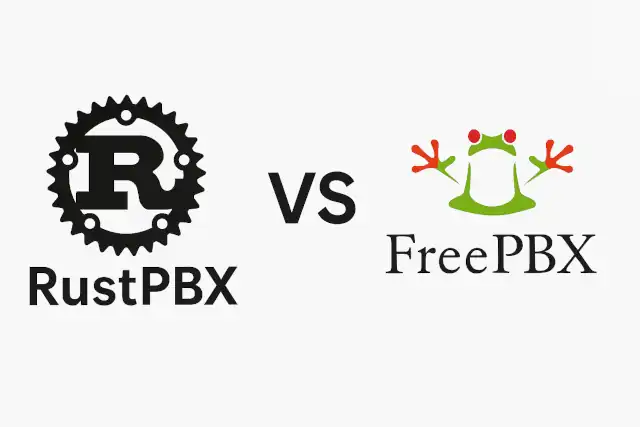
RustPBX vs. FreePBX: A Comprehensive Comparison and the Future of Open Source IP-PBX
RustPBX vs. FreePBX: A Comprehensive Comparison and the Future of Open Source IP-PBX
- Why Enterprise RAID Rebuilding Succeeds Where Consumer Arrays Fail?
- Linus Torvalds Rejects MMC Subsystem Updates for Linux 7.0: “Complete Garbage”
- The Man Who Maintained Sudo for 30 Years Now Struggles to Fund the Work That Powers Millions of Servers
- How Close Are Quantum Computers to Breaking RSA-2048?
- Why Windows 10 Users Are Flocking to Zorin OS 18 Instead of Linux Mint?
- How to Prevent Ransomware Infection Risks?
- What is the best alternative to Microsoft Office?
RustPBX vs. FreePBX: A Comprehensive Comparison and the Future of Open Source IP-PBX
Introduction
The world of Voice over IP (VoIP) and IP-PBX systems has been dominated for years by well-established platforms built on mature but aging foundations.
FreePBX, built atop the Asterisk telephony engine, has long been the gold standard for open-source business telephony.
Now, a new contender is quietly gaining attention in developer circles: RustPBX, a software-defined PBX built from the ground up in the Rust programming language.
This article takes a detailed look at both platforms, compares their strengths and limitations, and explores the pressing question: could RustPBX one day replace FreePBX?
What is FreePBX?
FreePBX is an open-source, web-based graphical user interface (GUI) that manages Asterisk, the widely used open-source telephony engine developed by Digium (now part of Sangoma Technologies). Described as the world’s most popular open-source IP PBX, FreePBX gives users the tools to build a phone system tailored to their needs. It is completely free to download and use, and its power comes from a global community of developers who ensure it remains a highly compatible and customizable platform.
FreePBX has been in active development for well over a decade and powers millions of phone systems globally — from small businesses to large enterprise call centers. It supports features like IVR (Interactive Voice Response), voicemail, call recording, conferencing, call queues, SIP trunking, and extensive module-based extensions through commercial add-ons.
What is RustPBX?
RustPBX is a high-performance, secure, software-defined PBX system implemented in Rust, designed to support AI-powered communication pipelines and modern voice applications. It features a full SIP stack with a complete SIP proxy server supporting registration, authentication, and call routing; a media proxy with advanced RTP/RTCP media proxying with NAT traversal support; and multi-transport support covering UDP, TCP, and WebSocket.
RustPBX positions itself as modern telephony simplified — built for reliability, speed, and ease of use. It provides an intuitive web console for all configurations, allowing users to manage extensions, trunks, and routes without touching complex config files, with hot-reloading to apply changes instantly.
RustPBX is a relatively young project (currently at version 0.3.x), open-sourced under the MIT license on GitHub, and is gaining traction particularly among developers building AI-driven voice applications.
Head-to-Head Comparison
1. Programming Language and Architecture
This is the most fundamental difference between the two platforms. FreePBX is built on Asterisk, which is written in C, with the FreePBX management layer written in PHP. The entire stack reflects design decisions made in the early 2000s. While stable and proven, C-based telephony engines are susceptible to memory management issues, and PHP frontends introduce their own security concerns.
RustPBX, by contrast, is written entirely in Rust — a systems programming language specifically designed to eliminate classes of memory-related bugs (buffer overflows, use-after-free vulnerabilities, data races) at compile time. This makes RustPBX inherently more secure and safer by design, without sacrificing performance.
2. Performance and Resource Efficiency
Asterisk/FreePBX can handle thousands of concurrent calls but requires significant tuning, particularly on commodity hardware. It has a reputation for heavy memory use as call volume scales.
RustPBX leverages Rust’s concurrency model and memory safety for a rock-solid SIP core that scales horizontally. Because Rust uses zero-cost abstractions and compiles directly to native machine code with no garbage collector, RustPBX can handle high concurrency with a much smaller memory footprint, making it well-suited for containerized and cloud-native deployments.
3. AI and Modern Voice Application Integration
This is where RustPBX diverges most dramatically from FreePBX. FreePBX was designed in an era before AI was mainstream, and while third-party integrations with AI services exist, they are bolted on rather than native.
RustPBX natively supports Speech-to-Text (ASR) with real-time speech recognition from multiple providers, Text-to-Speech (TTS) with emotion and speaker control, LLM integration via an OpenAI-compatible proxy for intelligent conversation handling, and Voice Activity Detection using WebRTC and Silero VAD. These capabilities make RustPBX a natural foundation for AI-powered contact centers, voice bots, and intelligent IVR systems — use cases that are increasingly central to modern business communications.
4. WebRTC Support
FreePBX supports WebRTC through additional modules and configuration, but setup can be complex and fragile.
RustPBX provides first-class support for browser-based telephony via WebSockets with integrated JSSIP/SIP.js support, meaning web-based softphones and browser calling work out of the box — a critical feature for remote and hybrid workforces.
5. Call Recording
RustPBX features SipFlow Recording — an advanced unified SIP+RTP recording system with superior I/O performance, offering two backends: local (file system + SQLite with date-based organization) and remote (distributed), using an open-write-close pattern to avoid file descriptor exhaustion. This is a more modern approach compared to Asterisk’s traditional recording mechanisms.
6. Ease of Use and Ecosystem Maturity
Here, FreePBX has a decisive advantage. It has a mature, feature-rich GUI that non-technical administrators can navigate, an enormous knowledge base, thousands of forum threads, a commercial support ecosystem, and a library of both free and commercial modules covering virtually every telephony need.
RustPBX, while it has a web console, is still young and primarily developer-oriented. Its community is small, documentation is growing, and there is far less third-party tooling and support available. For businesses that need plug-and-play telephony today, FreePBX remains the more practical choice.
7. Deployment
FreePBX is traditionally deployed as a standalone server (often via the FreePBX Distro ISO). While Docker deployment is possible, it is not the primary model.
RustPBX is designed with container-first deployment in mind, with official Docker images available and cross-compilation Docker images provided for x86_64 and aarch64 targets. This makes it a better fit for Kubernetes environments, cloud infrastructure, and microservices architectures.
8. Licensing and Vendor Lock-in
FreePBX is licensed under the GPL but is commercially backed by Sangoma. Many advanced features require paid modules, and there is some level of commercial lock-in through the Sangoma ecosystem.
RustPBX is released under the MIT license — one of the most permissive open-source licenses available — with no commercial modules or vendor tie-ins at this stage.
Feature Comparison Summary
| Feature | FreePBX | RustPBX |
|---|---|---|
| Core Language | C (Asterisk) + PHP | Rust |
| Maturity | 20+ years | 1–2 years |
| GUI | Rich, production-ready | Basic web console |
| AI/LLM Integration | Third-party only | Native |
| WebRTC | Via modules | First-class |
| Community | Very large | Small, growing |
| Docker/Cloud Native | Possible but complex | First-class |
| Memory Safety | Limited (C-based) | Guaranteed by Rust |
| License | GPL + commercial modules | MIT (fully open) |
| Deployment | Bare-metal / VM | Container / Cloud |
Will RustPBX Replace FreePBX?
This is the most interesting question, and the answer requires separating the short term from the long term.
In the short term — No. FreePBX has too many advantages in maturity, ecosystem, documentation, and community support. Tens of thousands of businesses rely on FreePBX today, and system administrators have years of accumulated expertise. RustPBX, currently at version 0.3.x with roughly 15,000 total downloads, is simply not yet ready to serve as a drop-in replacement for enterprise telephony environments that demand battle-tested reliability and 24/7 commercial support.
In the medium to long term — possibly, for specific use cases. The trajectory of technology strongly favors the characteristics RustPBX embodies: cloud-native deployment, AI integration, memory safety, and horizontal scalability. As businesses increasingly demand AI-powered contact centers, real-time voice analytics, and browser-based communications, platforms designed around these capabilities from the ground up will have a structural advantage over those retrofitting them.
RustPBX is not primarily trying to replace FreePBX in the traditional “office phone system” market. Rather, it appears positioned to capture the emerging market of AI-powered voice infrastructure — a space that barely existed when FreePBX was conceived. In this context, the two platforms may increasingly serve different markets rather than compete directly.
The broader analogy is instructive. Nginx did not “replace” Apache overnight — it carved out the high-performance, concurrent-connection segment of the web server market. Similarly, RustPBX may come to dominate the AI-voice-pipeline and developer-centric segment of the PBX market, while FreePBX continues to serve traditional enterprise telephony for years to come.
Conclusion
FreePBX and RustPBX represent two generations of thinking about business telephony. FreePBX is the reliable, mature workhorse of the VoIP industry — battle-tested, feature-rich, and backed by a massive global community. RustPBX is the lean, modern challenger — built on a safer programming foundation, designed for the cloud, and natively wired for the AI era.
For businesses running traditional phone systems today, FreePBX remains the sensible choice. For developers building the next generation of AI-powered voice applications, conversational agents, or cloud-native communication platforms, RustPBX is worth watching very closely. Whether it grows into a full FreePBX replacement or becomes the de facto standard for AI-driven VoIP infrastructure, RustPBX signals that the future of telephony will be written in Rust.
RustPBX Official Website