Speed Latency and Capacity: A Comprehensive Comparative Analysis of Wi-Fi 7 and Wi-Fi 6E
Speed Latency and Capacity: A Comprehensive Comparative Analysis of Wi-Fi 7 and Wi-Fi 6E
- Why Enterprise RAID Rebuilding Succeeds Where Consumer Arrays Fail?
- Linus Torvalds Rejects MMC Subsystem Updates for Linux 7.0: “Complete Garbage”
- The Man Who Maintained Sudo for 30 Years Now Struggles to Fund the Work That Powers Millions of Servers
- How Close Are Quantum Computers to Breaking RSA-2048?
- Why Windows 10 Users Are Flocking to Zorin OS 18 Instead of Linux Mint?
- How to Prevent Ransomware Infection Risks?
- What is the best alternative to Microsoft Office?
Speed Latency and Capacity: A Comprehensive Comparative Analysis of Wi-Fi 7 and Wi-Fi 6E
The evolution of wireless local area network (WLAN) technology has consistently been driven by the pursuit of higher performance and more reliable connectivity.
In recent years, with the initial deployment of Wi-Fi 6E and the official release of Wi-Fi 7, wireless connectivity standards in homes, enterprises, and industrial environments are undergoing a profound transformation.
Wi-Fi 6E, as an extended version of Wi-Fi 6, pioneered the introduction of the 6 GHz spectrum, while Wi-Fi 7 has built upon this foundation with multiple revolutionary technological innovations.
This article provides a comprehensive and professional comparative analysis of these two advanced Wi-Fi technologies across three core dimensions: speed, latency, and capacity, examining their differences in underlying technical principles, performance improvements, and real-world application scenarios.
Wi-Fi 6E: Expanding the Spectrum Frontier
Wi-Fi 6E, based on the IEEE 802.11ax standard, features its most significant and defining characteristic: access to the 6 GHz frequency band.
Before Wi-Fi 6E, traditional Wi-Fi networks were primarily concentrated in the congested 2.4 GHz and 5 GHz bands—the former suffering from low speeds and severe interference, while the latter has become increasingly crowded with growing numbers of users and devices.
The introduction of the 6 GHz band, often referred to as “greenfield” spectrum, represents nearly pristine and unutilized radio space. In the United States and many other countries, the 6 GHz band provides Wi-Fi 6E with up to 1,200 MHz of additional usable spectrum, enabling support for up to seven contiguous 160 MHz channels or three contiguous 320 MHz channels.
Regarding speed, Wi-Fi 6E’s physical layer peak rates are primarily determined by the channel bandwidth it employs. Since Wi-Fi 6E retains Wi-Fi 6’s modulation and coding scheme with a maximum of 1024-QAM, its single-stream peak rate reaches approximately 1.2 Gbps.
By supporting 160 MHz channel bandwidth, Wi-Fi 6E can deliver speeds significantly higher than traditional 5 GHz Wi-Fi for individual devices, with theoretical maximum rates reaching several Gbps.
This represents a substantial performance enhancement for high-bandwidth scenarios such as 4K/8K video streaming and large file transfers.
However, Wi-Fi 6E’s speed improvements rely more heavily on increased spectrum resources and 160 MHz channel availability rather than revolutionary technical efficiency gains.
Wi-Fi 7: A Quantum Leap in Wireless Technology
In stark contrast, Wi-Fi 7 (based on the IEEE 802.11be standard, also known as Extremely High Throughput or EHT) achieves breakthrough advances in both underlying technology and data rates.
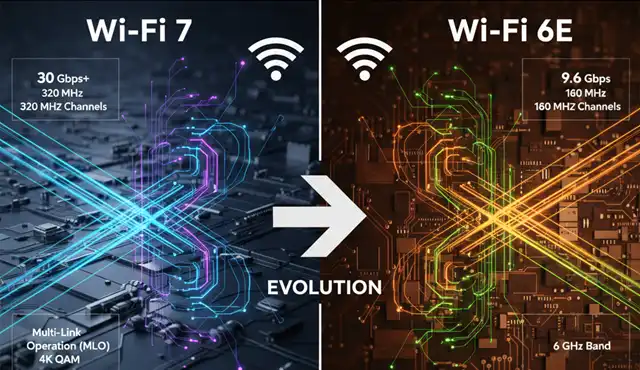
One of Wi-Fi 7’s most significant technological breakthroughs is the introduction of 320 MHz channel bandwidth, directly doubling available bandwidth and dramatically increasing theoretical peak rates.
More critically, Wi-Fi 7 elevates the maximum modulation order to 4096-QAM—compared to Wi-Fi 6E’s 1024-QAM, this increases the data carried per symbol by 20%, meaning that under identical channel bandwidth and spatial stream configurations, Wi-Fi 7’s raw data rate improves by approximately 20%.
Combining 320 MHz channels, 4096-QAM high-order modulation, and support for up to 16 spatial streams, Wi-Fi 7’s theoretical peak throughput can reach an astounding 46 Gbps—far exceeding Wi-Fi 6E’s maximum of approximately 9.6 Gbps.
This substantial speed differential enables Wi-Fi 7 to effortlessly handle future immersive virtual reality, ultra-high-definition collaboration, and cloud rendering applications that demand extreme bandwidth.
Latency Performance: From Improvement to Revolution
The differences in latency performance between these technologies are equally significant. Wi-Fi 6E’s latency improvements primarily stem from the cleanliness of the 6 GHz band. With minimal interference in this spectrum, devices can access the network without prolonged waiting, thereby reducing average access latency. Additionally, Wi-Fi 6E inherits Wi-Fi 6’s OFDMA (Orthogonal Frequency Division Multiple Access) technology, which divides channels into smaller Resource Units (RUs), allowing multiple users to simultaneously send and receive data on the same channel. This reduces contention and collisions inherent in traditional CSMA/CA mechanisms, effectively lowering average network latency and jitter.
While Wi-Fi 6E’s OFDMA helps reduce average latency, Wi-Fi 7 elevates latency optimization to an entirely new level through a groundbreaking feature: Multi-Link Operation (MLO). MLO represents one of Wi-Fi 7’s most revolutionary capabilities, allowing devices to simultaneously connect to multiple links across different frequency bands and channels on an access point. For example, a Wi-Fi 7 client device can concurrently utilize 2.4 GHz, 5 GHz, and 6 GHz links for data transmission.
MLO operates in several modes, with enhanced MLO being most impactful for latency—it enables load balancing or instantaneous switching between two links. When one link experiences momentary interference, the system can immediately redirect data flow to another link without the time-consuming reconnection or retransmission processes typical of traditional Wi-Fi.
This “zero-wait” seamless switching capability minimizes the impact of network jitter and packet loss, achieving extremely low deterministic latency—a critical characteristic for time-sensitive applications. Through redundancy and aggregation, MLO elevates latency stability and reliability to a new tier, capabilities that Wi-Fi 6E simply does not possess.
Capacity and Network Efficiency: Scaling for the Future
In terms of system capacity and network efficiency, Wi-Fi 6E’s primary contribution lies in frequency resource expansion. The abundant available channels in the 6 GHz band effectively alleviate channel congestion issues in high-density environments. In dense deployments, Wi-Fi 6E access points can utilize non-overlapping 160 MHz channels to avoid mutual interference, thereby improving overall network throughput and user capacity. Wi-Fi 6E continues to leverage Wi-Fi 6’s OFDMA and MU-MIMO (Multi-User Multiple Input Multiple Output) technologies, enabling more users to receive effective service simultaneously on the same channel.
Wi-Fi 7’s capacity improvements represent multidimensional efficiency optimizations. First, 320 MHz channels inherently provide greater capacity. Second, MLO not only reduces latency but also effectively increases aggregate capacity for both individual users and entire access points through cross-band link aggregation. For instance, a device can simultaneously aggregate two 160 MHz channels on 5 GHz and 6 GHz, achieving near-320 MHz capacity while more effectively utilizing spectrum resources that might otherwise remain idle.
Another significant efficiency enhancement comes from more refined Resource Unit (RU) utilization. Wi-Fi 7 introduces preamble puncturing technology, addressing interference issues within wide-bandwidth channels. In Wi-Fi 6E’s 160 MHz channels, if a small portion of sub-channels experiences interference, the entire 160 MHz channel becomes unusable. Wi-Fi 7’s preamble puncturing allows access points and clients to intelligently “skip” interfered sub-channels and use the remaining clean portions for data transmission. This feature dramatically improves spectrum utilization and robustness of wide-bandwidth channels, ensuring networks maintain high capacity and wide-bandwidth connections even in complex interference environments.
Furthermore, Wi-Fi 7 expands MU-MIMO spatial streams from Wi-Fi 6E’s 8 to 16, further enhancing an access point’s ability to simultaneously serve more users. In high-density scenarios, this delivers tremendous improvements in total system capacity. This doubling of spatial stream support means access points can more effectively allocate wireless resources, significantly enhancing overall network capacity and efficiency.
Technical Comparison Summary
| Feature | Wi-Fi 6E | Wi-Fi 7 |
|---|---|---|
| Standard | IEEE 802.11ax | IEEE 802.11be (EHT) |
| Maximum Channel Bandwidth | 160 MHz | 320 MHz |
| Modulation Scheme | 1024-QAM | 4096-QAM |
| Maximum Spatial Streams | 8 | 16 |
| Theoretical Peak Speed | ~9.6 Gbps | ~46 Gbps |
| Frequency Bands | 2.4 GHz, 5 GHz, 6 GHz | 2.4 GHz, 5 GHz, 6 GHz |
| Multi-Link Operation (MLO) | Not supported | Supported |
| Preamble Puncturing | Not supported | Supported |
| Primary Latency Reduction | Clean 6 GHz spectrum, OFDMA | MLO, enhanced OFDMA |
| Key Innovation | 6 GHz “greenfield” spectrum | 320 MHz channels, MLO, 4096-QAM |
Conclusion: From Evolution to Revolution
Wi-Fi 6E represents an important spectrum expansion of Wi-Fi 6, with its primary value lying in introducing the 6 GHz “greenfield” spectrum, resolving longstanding channel congestion issues, and significantly improving single-user peak rates and average access latency. It provides excellent experiences for current high-bandwidth applications and remains the mainstream high-end solution in today’s market.
Wi-Fi 7, however, constitutes a comprehensive technological revolution. Through 320 MHz ultra-wide channels, 4096-QAM high-order modulation, revolutionary MLO, and more flexible preamble puncturing technology, it achieves qualitative leaps in speed, latency, and capacity. Wi-Fi 7 not only delivers extreme speeds several times greater than Wi-Fi 6E, but more importantly, its MLO and preamble puncturing technologies bring deterministic low latency along with enhanced network robustness and spectrum efficiency.
As we look toward the future, Wi-Fi 7’s technical architecture has already established the foundation for ultra-high bandwidth, ultra-low latency immersive applications and Industrial Internet scenarios that will emerge over the next decade. While Wi-Fi 6E continues to serve current needs admirably, Wi-Fi 7 is positioned to enable the next generation of wireless connectivity, supporting applications we can only begin to imagine today.