The 40TB Barrier: Why Hard Drives Hit a Wall and What Comes Next
The 40TB Barrier: Why Hard Drives Hit a Wall and What Comes Next
- Why Enterprise RAID Rebuilding Succeeds Where Consumer Arrays Fail?
- Linus Torvalds Rejects MMC Subsystem Updates for Linux 7.0: “Complete Garbage”
- The Man Who Maintained Sudo for 30 Years Now Struggles to Fund the Work That Powers Millions of Servers
- How Close Are Quantum Computers to Breaking RSA-2048?
- Why Windows 10 Users Are Flocking to Zorin OS 18 Instead of Linux Mint?
- How to Prevent Ransomware Infection Risks?
- What is the best alternative to Microsoft Office?
The 40TB Barrier: Why Hard Drives Hit a Wall and What Comes Next
For decades, hard disk drives (HDDs) have followed a predictable trajectory: capacities doubled every couple of years, prices per terabyte plummeted, and storage seemed limitless.
But recently, that progress has slowed dramatically. While manufacturers have pushed capacities to around 30-32TB in consumer drives, breaking past 40TB has proven surprisingly difficult.
Understanding why reveals fundamental physics problems—and points toward fascinating alternatives beyond traditional HDDs and SSDs.
Seagate’s HAMR Technology Brings 60TB Hard Drives Within Reach
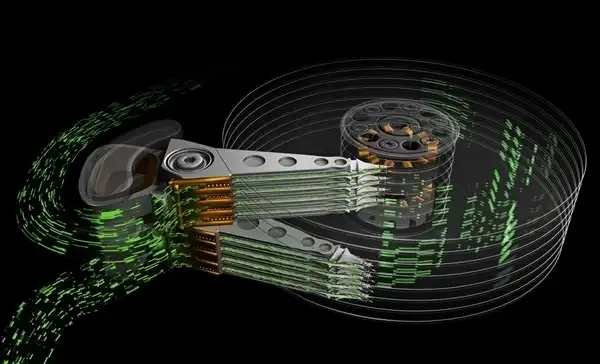
The Physics of Spinning Platters
Hard drives store data magnetically on rotating platters. To increase capacity, manufacturers must either pack more platters into the same physical space or increase the data density on each platter. Both approaches have hit hard limits.
The Superparamagnetic Effect
The primary villain is the superparamagnetic effect. As magnetic grains shrink to store more data in less space, they become thermally unstable. At a certain size—around 10-20 nanometers—random thermal energy can spontaneously flip bits, corrupting data. This isn’t a manufacturing problem; it’s a fundamental limit of physics.
To combat this, manufacturers developed perpendicular magnetic recording (PMR), where bits stand upright rather than lying flat. This helped, but only temporarily. The industry then moved to shingled magnetic recording (SMR), where tracks overlap like roof shingles, and heat-assisted magnetic recording (HAMR), which briefly heats the platter during writing to use more stable materials. Seagate’s HAMR drives have reached 32TB, but each technology adds complexity and cost.
Mechanical Constraints
Hard drives are precision instruments with read/write heads flying nanometers above platters spinning at 7,200 RPM. Adding more platters means:
- More weight, requiring stronger motors and bearings
- Greater vibration and heat generation
- Longer seek times as heads traverse more surfaces
- Increased failure risk—more moving parts mean more potential points of failure
The standard 3.5-inch form factor physically limits how many platters fit. Going beyond eight or nine platters becomes mechanically impractical.
The Economics Problem
Even if engineers overcome technical barriers, there’s an economic question: who needs 40TB+ single drives? Data centers increasingly prefer distributed storage systems with many smaller drives for redundancy and performance. The marginal benefit of larger single drives diminishes, making R&D investments harder to justify.
Toshiba Pioneers 12-Platter Hard Drive: 40TB Model Set for 2027 Launch
What Are the Physical Storage Alternatives Beyond HDD and SSD?
While HDDs struggle with density and SSDs remain expensive per terabyte, several promising alternative storage media exist for different use cases:
1. Tape Storage
Often dismissed as obsolete, magnetic tape remains the king of cold storage—data that’s rarely accessed but must be preserved.
Advantages:
- Incredibly cheap per terabyte (often 1/10th the cost of HDD)
- Modern LTO-9 tapes hold 18TB uncompressed, 45TB compressed
- 30-50 year shelf life without power
- Immune to ransomware (offline by nature)
Drawbacks:
- Sequential access only—retrieving specific files is slow
- Requires tape library infrastructure
- Not suitable for frequently accessed data
Major archives, film studios, and research institutions rely heavily on tape. Facebook stores petabytes of cold data on tape systems.
2. Optical Storage (Next-Generation)
Traditional DVDs and Blu-rays seem quaint, but new optical technologies show promise:
Holographic Storage: Companies like Microsoft (Project Silica) are developing glass-based holographic storage that encodes data in three dimensions using lasers. A single glass platter could theoretically hold hundreds of terabytes with millennia-long lifespans.
Multi-layer Optical Discs: Research prototypes have achieved hundreds of layers in optical media, potentially reaching 1PB per disc.
Advantages:
- Extremely long archival life
- No power needed for storage
- Resistant to electromagnetic interference and water damage
Drawbacks:
- Still largely experimental
- Slow write speeds
- Expensive specialized equipment
3. DNA Storage
This sounds like science fiction, but DNA storage is actively being researched by Microsoft, Twist Bioscience, and others.
The Concept: DNA stores genetic information at incredible density—one gram of DNA could theoretically store 215 petabytes. Researchers encode binary data into DNA base pairs (A, T, C, G), synthesize the strands, and later sequence them to read data back.
Advantages:
- Unmatched density (thousands of times better than any electronic medium)
- Millennia-long stability if stored properly
- Can be replicated easily through biological processes
Drawbacks:
- Extremely slow read/write speeds (hours to days)
- Currently costs thousands of dollars per megabyte
- High error rates requiring extensive error correction
- Decades away from commercial viability
4. Emerging Solid-State Alternatives
Beyond conventional NAND flash SSDs, several new storage technologies are in development:
Phase-Change Memory (PCM): Uses heat to switch materials between crystalline and amorphous states to store data. Faster than NAND flash with better endurance, though currently more expensive.
Resistive RAM (ReRAM): Stores data by changing the resistance of a material. Potentially faster and more durable than flash memory with lower power consumption.
Magnetoresistive RAM (MRAM): Uses magnetic storage elements, combining the speed of RAM with the non-volatility of flash storage.
Advantages:
- Faster read/write speeds than NAND flash
- Better endurance (more write cycles)
- Lower power consumption
- Non-volatile like SSDs
Drawbacks:
- Still in early commercialization stages
- Currently more expensive than conventional SSDs
- Limited capacity compared to mature technologies
Hard Drive Selection Guide: Surveillance vs Enterprise Storage for Small-Scale Deployments
The Future of Storage
The 40TB barrier for single hard drives isn’t necessarily a crisis—it’s a signal that storage is diversifying beyond the HDD/SSD duopoly. For consumers, 20-32TB drives are already more than sufficient for most uses. For organizations managing massive data archives, alternatives like tape provide cost-effective solutions for cold storage, while emerging technologies promise to fill specific niches.
Breakthrough technologies like DNA storage and holographic media remain years or decades from practicality, but they demonstrate that storage innovation hasn’t stalled—it’s just exploring fundamentally different approaches. The question isn’t whether we’ll surpass 40TB in traditional hard drives, but whether future storage needs will be met by entirely different physical media optimized for specific use cases: tape for archives, next-gen optical for long-term preservation, and exotic technologies like DNA for ultra-dense, ultra-stable storage.
The hard drive’s journey from megabytes to terabytes was remarkable. Its next chapter may not involve spinning platters at all, but rather a diverse ecosystem of storage media—each leveraging different physics, chemistry, or even biology—to meet humanity’s ever-growing data needs in ways we’re only beginning to imagine.