The Enduring Reign of Rotating Media: Why Tapes and HDDs Still Thrive in the SSD Era
The Enduring Reign of Rotating Media: Why Tapes and HDDs Still Thrive in the SSD Era
- Why Enterprise RAID Rebuilding Succeeds Where Consumer Arrays Fail?
- Linus Torvalds Rejects MMC Subsystem Updates for Linux 7.0: “Complete Garbage”
- The Man Who Maintained Sudo for 30 Years Now Struggles to Fund the Work That Powers Millions of Servers
- How Close Are Quantum Computers to Breaking RSA-2048?
- Why Windows 10 Users Are Flocking to Zorin OS 18 Instead of Linux Mint?
- How to Prevent Ransomware Infection Risks?
- What is the best alternative to Microsoft Office?
The Enduring Reign of Rotating Media: Why Tapes and HDDs Still Thrive in the SSD Era
In an age dominated by the lightning-fast performance of Solid State Drives (SSDs), it might seem counterintuitive that older storage technologies like Hard Disk Drives (HDDs) and especially magnetic tapes not only persist but continue to play a crucial role in the digital landscape.
While SSDs have revolutionized everyday computing with their speed and responsiveness, they haven’t rendered their predecessors obsolete.
The continued existence and even growth of HDDs and magnetic tapes boil down to a fundamental principle: the right tool for the right job, particularly when considering cost, capacity, and long-term data archival.
Why HDDs Won’t Be Replaced by SSDs: The Economics of Mass Storage
Hard Disk Drives (HDDs): The Workhorses of Mass Storage
Even with SSDs becoming increasingly affordable, HDDs remain the champions of cost-effective bulk storage. Here’s why they haven’t faded away:
-
Capacity King: For sheer storage capacity, HDDs still offer a significant advantage. A single enterprise-grade HDD can store tens of terabytes of data, far exceeding the typical capacity of an equivalently priced SSD. This makes them indispensable for data centers, cloud providers, and anyone needing to store massive amounts of information where access speed isn’t the absolute top priority.
-
Price Per Gigabyte: This is where HDDs truly shine. They offer a much lower cost per gigabyte compared to SSDs, making them the economical choice for storing large datasets, backups, and archival content that doesn’t require constant, rapid access.
-
Reliability for Certain Workloads: While SSDs have their own reliability advantages, modern HDDs are incredibly robust and have proven their long-term durability for specific workloads, especially in RAID configurations within servers where data redundancy is paramount.
HDDs are the backbone of cloud storage, large-scale video surveillance systems, and corporate data archives. They are the go-to solution for storing vast libraries of information that are accessed less frequently but still need to be readily available.
Glass Hard Drives Are Coming to Data Centers: 360TB Capacity with a 13.8 Billion-Year Lifespan
Magnetic Tapes: The Unsung Heroes of Long-Term Archival
The continued existence of magnetic tapes in the 21st century often surprises those unfamiliar with enterprise data management. Far from being a relic of the past, tape storage is thriving in specialized niches due to its unique advantages:
-
Unmatched Cost Per Gigabyte (and Terabyte!): For truly massive amounts of cold data (data that is rarely accessed but must be retained), magnetic tape offers the lowest cost per terabyte of any storage medium. This is a critical factor for organizations that generate petabytes or even exabytes of data.
-
Incredible Durability and Longevity: Tapes are designed for long-term archival, with a lifespan often measured in decades (30+ years) when stored correctly. They are less susceptible to environmental factors like power fluctuations and are inherently more robust for long-term, offline storage compared to spinning disks or even SSDs.
-
Offline Security (Air Gap): One of tape’s most compelling features is the “air gap” it provides. Once a tape cartridge is removed from the tape drive and stored offline, it is physically disconnected from the network. This makes tape archives immune to cyberattacks, ransomware, and other network-borne threats – a critical security advantage in today’s threat landscape.
-
Energy Efficiency: When stored offline, tape cartridges consume no power. This significantly reduces energy costs for long-term archives compared to always-on disk-based systems.
-
High Sequential Throughput: While random access on tape is slow, sequential read and write speeds can be very high, making them efficient for large, continuous data transfers, such as backing up entire databases or datasets.
Magnetic tapes are indispensable for industries with stringent regulatory compliance requirements (e.g., finance, healthcare), scientific research data, media and entertainment archives, and disaster recovery strategies. They serve as the ultimate last line of defense for critical data.
Hard Drive Selection Guide: Surveillance vs Enterprise Storage for Small-Scale Deployments
The Storage Hierarchy: A Symbiotic Relationship
Instead of viewing these technologies as competitors, it’s more accurate to see them as complementary components within a sophisticated storage hierarchy.
-
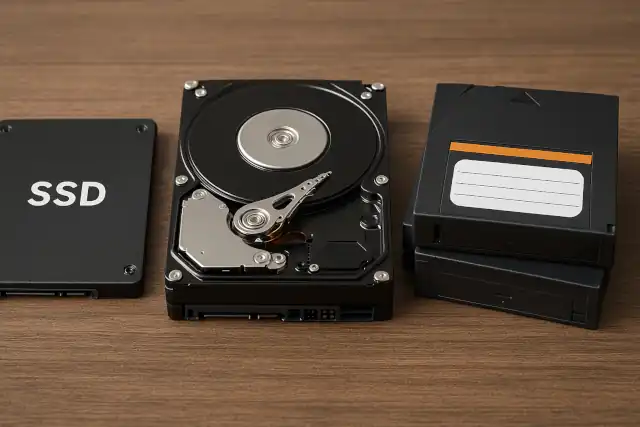
SSDs: Ideal for hot data – frequently accessed, performance-critical applications, operating systems, and active databases. They reside at the top of the hierarchy due to their speed.
-
HDDs: Perfect for warm data – large datasets, backups, and applications where capacity and cost are more important than instantaneous access. They offer a balance between performance and cost-effectiveness.
-
Magnetic Tapes: The ultimate solution for cold data – long-term archives, regulatory compliance, and disaster recovery. They sit at the bottom of the hierarchy, prioritizing cost, capacity, and security over speed.
In conclusion, while SSDs have dramatically improved the performance of active data, the vast and ever-growing ocean of information requires a diverse set of storage solutions.
Hard Disk Drives continue to provide economical, high-capacity storage for frequently accessed but less performance-sensitive data, forming the backbone of cloud infrastructure.
Magnetic tapes, with their unparalleled cost-effectiveness, longevity, and offline security, remain the unrivaled champions of long-term archival and disaster recovery.
In the complex world of data management, the enduring presence of HDDs and magnetic tapes alongside SSDs is not a sign of technological stagnation, but rather a testament to their continued relevance and indispensable roles in a sophisticated, multi-tiered storage strategy.