The Linux kernel will abandon “outdated graphics driver infrastructure” in the future
The Linux kernel will abandon “outdated graphics driver infrastructure” in the future
- Why Enterprise RAID Rebuilding Succeeds Where Consumer Arrays Fail?
- Linus Torvalds Rejects MMC Subsystem Updates for Linux 7.0: “Complete Garbage”
- The Man Who Maintained Sudo for 30 Years Now Struggles to Fund the Work That Powers Millions of Servers
- How Close Are Quantum Computers to Breaking RSA-2048?
- Why Windows 10 Users Are Flocking to Zorin OS 18 Instead of Linux Mint?
- How to Prevent Ransomware Infection Risks?
- What is the best alternative to Microsoft Office?
The Linux kernel will abandon “outdated graphics driver infrastructure” in the future, and users of old hardware can stay at the 6.6 LTS version
News on November 24 that SUSE engineer Thomas Zimmermann recently revealed on the developer mailing list that the Linux kernel will give up support for “outdated graphics driver infrastructure” in the future, and old users with 6.6 LTS version .
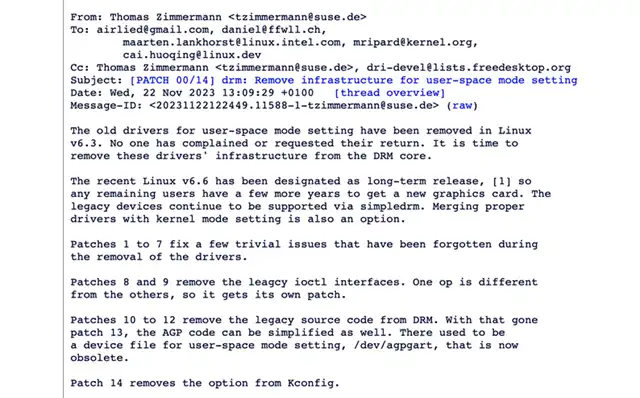
The old userspace mode settings drivers have been removed in Linux v6.3. There have been no complaints or requests to restore these drivers. It is time to remove the infrastructure for these drivers from the DRM core.
The recent Linux kernel v6.6 has been designated as a long-term support version, and users still using old hardware still have a few years to get new graphics cards, and simple drm still supports old hardware. Merging the appropriate driver with kernel mode settings is also an option.
Patches 1 to 7 fix some trivial issues that were forgotten during driver removal.
Patches 8 and 9 remove the legacy ioctl interface. One of the operations is different from the others, so it has its own patch.
Patches 10 to 12 remove legacy source code from DRM. With the removal of this part of the code, the AGP code in patch 13 can also be simplified. There was previously a device file for userspace mode settings, /dev/agpgart, which is now obsolete.
Patch 14 removes this option from Kconfig.
The Linux kernel has actually begun to gradually remove outdated GPU drivers. This can improve space usage and provide users with better performance and stability. In fact, in Linux kernel 6.3, the official has Removed drivers including ATI Rage 128, 3Dfx, S3 Savage, Intel 810, etc.
What is Linux kernel?
The Linux kernel is the core part of the Linux operating system. It’s the fundamental piece of software that sits between a computer’s hardware and applications.
Here’s what it does:
-
Hardware control: Manages CPU, memory, storage, network, and peripheral devices.
-
Resource management: Decides which processes (programs) get access to hardware resources and when.
-
Security and permissions: Enforces access control so that one program can’t freely interfere with another or with system hardware.
-
Abstraction: Provides a consistent interface for software, so applications don’t need to know the details of every hardware device.
-
Multitasking: Allows many programs to run at once by efficiently sharing resources.
In simple terms:
The Linux kernel is like the engine of a car. Applications are the passengers, the operating system tools (like Ubuntu, Fedora, Android) are the dashboard and controls, and the kernel is the engine that actually makes everything move by communicating with the hardware.