Why Are US Allies Also Abandoning American Software?
Why Are US Allies Also Abandoning American Software?
- Why Enterprise RAID Rebuilding Succeeds Where Consumer Arrays Fail?
- Linus Torvalds Rejects MMC Subsystem Updates for Linux 7.0: “Complete Garbage”
- The Man Who Maintained Sudo for 30 Years Now Struggles to Fund the Work That Powers Millions of Servers
- How Close Are Quantum Computers to Breaking RSA-2048?
- Why Windows 10 Users Are Flocking to Zorin OS 18 Instead of Linux Mint?
- How to Prevent Ransomware Infection Risks?
- What is the best alternative to Microsoft Office?
Why Are US Allies Also Abandoning American Software?
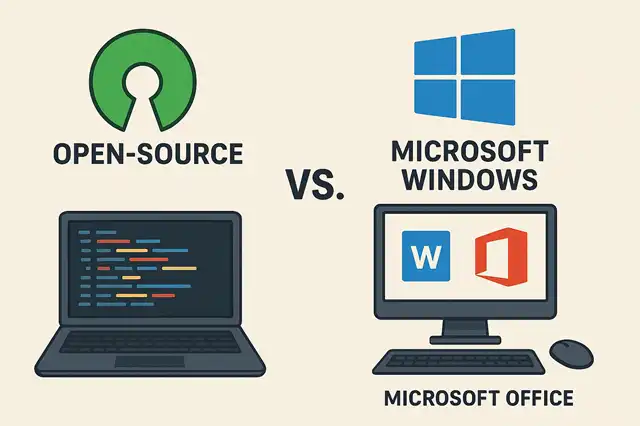
Countries Ditching Microsoft: The Global Movement Toward Open-Source Alternatives.
In an unprecedented shift in digital infrastructure, governments around the world including America’s closest allies—are increasingly replacing Microsoft Windows and MS Office with open-source alternatives like Linux and LibreOffice.
This movement, driven by concerns over digital sovereignty, security, cost, and geopolitical tensions, represents a fundamental rethinking of how nations manage their technological infrastructure.
Perhaps most striking is that this exodus isn’t limited to geopolitical rivals like China and Russia; even NATO allies and traditional U.S. partners are leading the charge away from American software giants.
Why German State Governments Are Abandoning Microsoft Office for Open-Source Solutions
Europe Leading the Charge
Denmark: The Boldest Move Yet
Denmark’s Ministry of Digital Affairs has announced one of the most ambitious transitions, planning to phase out Windows and Office 365 by November 2025 and replace them with Linux and LibreOffice.
This decision wasn’t primarily about cost savings but about digital sovereignty, with Denmark’s Minister for Digital Affairs Caroline Stage Olsen emphasizing that the country must never make itself so dependent on so few foreign suppliers that it can no longer act freely.
The ministry’s approach is cautious yet determined. Half of the staff began migrating to Linux and LibreOffice between June and August 2025, with a backup plan to revert to Microsoft if the transition proves too complicated.
This builds on earlier efforts by Denmark’s two largest cities, Copenhagen and Aarhus, which had already announced plans to limit their reliance on Microsoft software.
Germany: A State-Wide Transformation
Germany’s northern state of Schleswig-Holstein is undertaking one of the largest Linux migrations in European government history. The transition will affect around 30,000 public-sector employees, including civil servants, police, and judges, who will switch to Linux, LibreOffice, Open-Xchange, Nextcloud, and Thunderbird.
The state’s Digitalization Minister didn’t mince words about the motivation, declaring “We’re done with Teams!” and citing a desire to “take back control” of how the state’s data is stored and managed.
Austria’s Military Ditches Microsoft Office: A Neutral Nation’s Quest for Digital Sovereignty
France: Military-Grade Linux
France has been quietly advancing its own Linux agenda for years. The French gendarmerie now operates over 100,000 computers on a custom Ubuntu-based operating system called GendBuntu, demonstrating that large-scale Linux deployment in government is not only possible but practical. Additionally, the city of Lyon is transitioning to Linux and PostgreSQL.
Spain: An Early Pioneer
Spain has long been at the forefront of Linux adoption in government. In 2003, Spain was noted as the furthest along the road to Linux adoption, with the regional Andalusian Autonomous Government of Andalucía developing its own Linux distribution called Guadalinex in 2004.
In 2008, the city government of Barcelona announced it would migrate all desktop software from proprietary to free/open-source alternatives and would gradually migrate from proprietary operating systems to Linux.
Asia: Strategic Independence Through Open Source
China: The Kylin Revolution
China’s approach to replacing Windows represents perhaps the most comprehensive government-led effort globally. In February 2020, the Chinese government announced it would replace all PCs running Windows, with government services ordered to replace 30% of Windows PCs by the end of 2020, a further 50% in 2021, and the final 20% by the end of 2022.
The primary replacement is Kylin Linux, originally developed by the National University of Defense Technology of the People’s Liberation Army and launched over two decades ago in 2001. In 2013, Canonical reached an agreement with the Ministry of Industry and Information Technology to release an Ubuntu-based Linux operating system with features targeted at the Chinese market.
China has created an open platform called the OpenKylin project to accelerate the development of the homegrown operating system, with OpenKylin already used by 850,000 users. The system is designed to look and feel similar to Windows, making the transition easier for users familiar with Microsoft’s interface. The NeoShine office suite, developed by China Standard Software, offers alternatives to Excel, Word, and PowerPoint with interfaces strikingly similar to their Windows counterparts.
Does China Have Domestic Software Substitutes Amid US Export Ban Risks?
China Officially Replaces Microsoft Office with Domestic WPS Format in Government Documents
India: Defense-First Strategy
India has developed a multi-pronged approach to reducing dependence on foreign operating systems. In 2023, India’s Ministry of Defence announced it would use Ubuntu-based Linux distribution Maya OS on all Internet-connected computers. Maya OS is a secure Ubuntu-based system developed by the Defence Research and Development Organization (DRDO) to replace Windows on sensitive defence systems as part of a broader push for self-reliance in critical digital infrastructure.
Beyond defense, the Indian state of Tamil Nadu issued a directive in 2015 asking local government departments to switch to open-source software, and in 2020 planned to distribute 100,000 Linux laptops to students. The government has also developed BOSS GNU/Linux (Bharat Operating System Solutions), tailored to local needs with support for Indian languages.
India Calls for Replacing Microsoft Office with Indian Zoho Office
Russia: Security Through Sovereignty
Russia’s transition to Linux is driven primarily by security concerns. In 2018, Russia began adopting Astra Linux, an operating system certified to handle data classified as “special importance,” on their military computer systems. In October 2007, Russia announced all its school computers would run on Linux to avoid the cost of licensing currently unlicensed software.
Americas: Independence from North to South
Cuba: Breaking the Embargo Through Code
Cuba’s Linux adoption is intertwined with its broader struggle against U.S. economic sanctions. Students from the University of Information Science in Cuba launched their own Linux distribution called Nova to promote the replacement of Microsoft Windows on civilian and government computers, a project now supported by the Cuban Government. The transition involves organizational changes, development, and creating a legal framework, with the University of Information Science committing one department of 1,000 students dedicated to developing open-source programs.
Cuban officials view this as a matter of both technological sovereignty and national security, with concerns about Microsoft’s cooperation with U.S. authorities. The Linux user base in Cuba, though still modest, represents a growing movement toward software independence.
Why the Global Shift?
The motivations behind this worldwide movement are remarkably consistent across different countries and political systems:
1. Digital Sovereignty
Nations want control over their own data and systems without dependence on foreign corporations. This concern has intensified with growing awareness of data privacy issues and concerns about foreign surveillance.
2. Security and Transparency
Open-source systems allow governments to audit code for security vulnerabilities and potential backdoors. This transparency is impossible with proprietary software like Windows, where the source code remains hidden.
3. Cost Savings
While not always the primary driver, avoiding expensive licensing fees represents significant savings, especially for developing nations and large-scale deployments.
4. Geopolitical Tensions
Trade wars, sanctions, and international disputes have made nations wary of depending on software controlled by potentially adversarial governments. The U.S.-China tech rivalry has particularly accelerated this trend.
5. Vendor Independence
Being locked into a single vendor’s ecosystem limits flexibility and negotiating power. Open-source alternatives provide genuine choice and competition.
Challenges and Realities
Despite the momentum, these transitions face significant obstacles. Munich’s LiMux project, once celebrated as a success story, was reversed in 2017 due to user dissatisfaction and compatibility concerns, though the city later re-established a dedicated open-source program office in 2024.
The challenges include:
- User Training: Employees accustomed to Windows need retraining
- Software Compatibility: Some specialized applications only run on Windows
- Ecosystem Maturity: Windows and Office have decades of refinement and third-party support
- Initial Investment: Migration requires significant upfront planning and resources
- Political Will: Changes in leadership can derail multi-year transitions
The Future of Government Computing
The trend toward open-source government computing appears irreversible. As Windows 10 support ends and Microsoft pushes cloud-based subscription models that store data in U.S.-based datacenters, more governments are reconsidering their dependence on American tech giants.
The success of these transitions will likely depend on:
- Strong political commitment that survives electoral cycles
- Robust technical support and training programs
- Development of compatible alternatives for specialized software
- International cooperation in sharing best practices and code
- Gradual implementation that allows for course correction
As 2025 progresses, the “Year of Linux on the Desktop” may finally arrive—not in homes, but in government offices around the world. This shift represents not just a change in software, but a fundamental assertion of technological independence by nations seeking to control their digital destinies.
The question is no longer whether governments will move away from Microsoft, but how quickly and thoroughly they can execute these transitions while maintaining productivity and security. For countries watching these pioneers, their successes and failures will provide invaluable lessons for the next wave of digital sovereignty movements.
What is the best alternative to Microsoft Office?
Replacing Microsoft Outlook on Linux: The Best Email Clients Compared
The Best Free Adobe Acrobat Alternatives for Linux
The Most Windows-Friendly Linux Distributions for General Consumers: A Complete Guide