Why CAT7 Shielded Cables Are Unnecessary for Most Home and Office Networks?
Why CAT7 Shielded Cables Are Unnecessary for Most Home and Office Networks?
- Why Enterprise RAID Rebuilding Succeeds Where Consumer Arrays Fail?
- Linus Torvalds Rejects MMC Subsystem Updates for Linux 7.0: “Complete Garbage”
- The Man Who Maintained Sudo for 30 Years Now Struggles to Fund the Work That Powers Millions of Servers
- How Close Are Quantum Computers to Breaking RSA-2048?
- Why Windows 10 Users Are Flocking to Zorin OS 18 Instead of Linux Mint?
- How to Prevent Ransomware Infection Risks?
- What is the best alternative to Microsoft Office?
Why CAT7 Shielded Cables Are Unnecessary for Most Home and Office Networks?
Introduction
In the world of network cabling, the marketing appeal of “higher category” cables often leads consumers and IT professionals to believe that CAT7 shielded twisted pair (STP) cables are automatically superior to their unshielded counterparts.
However, for the vast majority of home and office networking scenarios, CAT7 shielded cables not only provide no meaningful benefit but can actually degrade network performance when improperly implemented.
This article examines why CAT7 shielded cables are generally unnecessary and explores the critical grounding requirements that, when ignored, can transform protective shielding into a performance liability.
Understanding Cable Categories and Shielding
Cable Category Overview
Network cables are categorized based on their ability to handle specific frequencies and data transmission rates:
- CAT5e: Supports up to 1 Gbps at 100 MHz
- CAT6: Supports up to 1 Gbps at 250 MHz (10 Gbps over short distances)
- CAT6A: Supports 10 Gbps at 500 MHz
- CAT7: Supports 10 Gbps at 600 MHz with individual pair shielding
Shielding Types
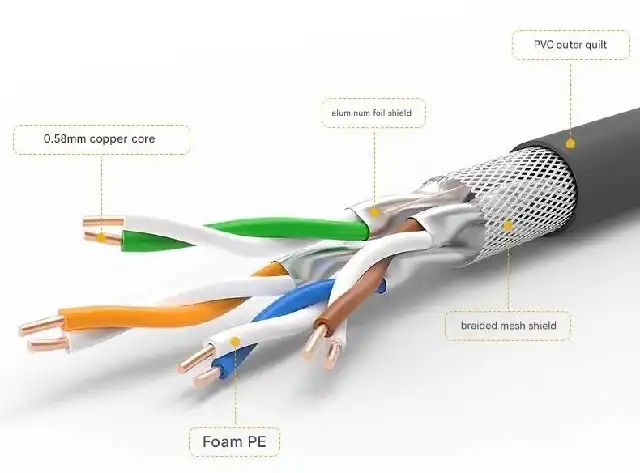
CAT7 cables typically employ multiple shielding layers:
- Individual pair shielding (typically foil)
- Overall cable shielding (braided metal or foil)
- This configuration is known as S/FTP (Screened/Foiled Twisted Pair)
Why Most Environments Don’t Need CAT7 Shielding
Electromagnetic Interference in Typical Installations
Modern unshielded twisted pair (UTP) cables like CAT5e and CAT6 are remarkably effective at rejecting electromagnetic interference (EMI) through their twisted pair geometry. The differential signaling used in Ethernet communication, combined with proper cable design, provides excellent noise immunity for typical office and residential environments.
Common sources of EMI in these environments include:
- Fluorescent lighting
- Wi-Fi routers and access points
- Microwave ovens
- Computer equipment
- Power cables
The interference levels from these sources rarely exceed the rejection capabilities of quality UTP cables, making additional shielding redundant.
Installation Complexity and Cost
CAT7 shielded cables introduce several practical challenges:
Higher Material Costs: Shielded cables cost significantly more than unshielded equivalents, often 2-3 times the price of CAT6 UTP.
Installation Complexity: Proper shielded cable installation requires specialized connectors, grounding hardware, and careful attention to maintaining shield continuity throughout the entire cable run.
Connector Limitations: Most standard RJ45 connectors and network equipment are designed for unshielded cables. Using shielded cables with unshielded connectors negates any potential EMI benefits.
Performance Requirements vs. Reality
Most home and office networks operate well within the performance envelope of CAT5e or CAT6 UTP cables:
- Internet connections rarely exceed 1 Gbps
- Local network traffic typically involves file sharing, printing, and web browsing
- Even demanding applications like 4K video streaming require only 25-50 Mbps per stream
The 10 Gbps capability of CAT7 is unnecessary for these applications, and the frequency response advantages are irrelevant when the connected equipment operates at much lower speeds.
The Antenna Effect: When Shielding Becomes a Liability
Fundamental Grounding Requirements
The effectiveness of cable shielding depends entirely on proper grounding implementation. The metal shielding must form a continuous path to ground at both ends of the cable run. This requires:
- Shielded connectors at both termination points
- Grounded network equipment or proper grounding hardware
- Continuous shield integrity throughout the cable length
- Proper bonding to building ground systems
The Antenna Phenomenon
When CAT7 shielded cables are not properly grounded, the metal shielding layer transforms from a protective barrier into an unintentional antenna. This occurs because:
- Impedance Mismatch: Ungrounded shielding creates impedance discontinuities that can reflect signals and introduce noise.
- Electromagnetic Coupling: The ungrounded metal shield can couple with external electromagnetic fields, potentially introducing more interference than it prevents.
- Signal Degradation: Rather than providing a return path for induced currents, an ungrounded shield can create additional signal paths that interfere with the intended differential signals in the twisted pairs.
Measured Performance Impact
Laboratory testing has demonstrated that improperly grounded CAT7 shielded cables can exhibit:
- Increased crosstalk between adjacent cables
- Higher bit error rates
- Reduced effective bandwidth
- Increased susceptibility to external EMI sources
In some cases, these performance degradations can make a poorly installed CAT7 shielded system perform worse than a properly installed CAT5e UTP system.
Proper Applications for Shielded Cables
Industrial and High-EMI Environments
Shielded cables do have legitimate applications in environments with significant electromagnetic interference:
- Manufacturing facilities with high-power machinery
- Medical facilities with imaging equipment
- Broadcasting and recording studios
- Data centers with high-density server installations
- Locations near radio transmission facilities
Critical Infrastructure
Some installations benefit from shielding as part of comprehensive EMI mitigation strategies:
- Financial trading floors
- Emergency communication systems
- Military and government facilities
- Scientific research installations
Best Practices for Network Cable Selection
Assessment Criteria
When selecting network cables, consider:
Environmental Factors: Evaluate actual EMI sources and levels in the installation environment.
Performance Requirements: Match cable specifications to actual bandwidth and distance requirements.
Installation Expertise: Ensure installers have experience with shielded cable systems if shielding is necessary.
Equipment Compatibility: Verify that all network equipment supports shielded cable implementations.
Recommended Approach for Most Installations
For typical home and office environments:
- Use CAT6 UTP for new installations requiring gigabit performance
- Consider CAT6A UTP only if 10 Gigabit performance is specifically required
- Invest in quality installation practices rather than premium cable categories
- Focus on proper cable management to minimize interference from power cables and other sources
Economic Considerations
Total Cost of Ownership
The true cost of CAT7 shielded installations extends beyond cable price:
- Specialized connectors and hardware
- Increased installation time and complexity
- Potential rework costs if grounding is inadequate
- Limited upgrade flexibility due to proprietary components
Performance vs. Investment
For most applications, the performance difference between properly installed CAT6 UTP and CAT7 STP is negligible, while the cost difference can be substantial. The return on investment for shielded cables in typical environments is generally negative.
Conclusion
While CAT7 shielded cables represent impressive engineering achievements, they are solutions in search of problems that don’t exist in most networking environments. The combination of unnecessary performance capabilities, installation complexity, and the risk of creating antenna effects through improper grounding makes them poor choices for typical home and office installations.
The networking industry’s focus should remain on proper installation practices, appropriate cable selection for actual requirements, and ensuring that grounding and shielding implementations meet professional standards when they are genuinely necessary. For the majority of users, high-quality CAT5e or CAT6 UTP cables, properly installed, will provide superior performance at a fraction of the cost and complexity of CAT7 shielded alternatives.
The key takeaway is that more expensive and technically advanced cables are not automatically better choices. Understanding the specific requirements of each installation environment and matching cable selection to those actual needs will result in better performance, lower costs, and more reliable network infrastructure.