Why Chinese Companies Are Stockpiling DDR5 Memory?
Why Chinese Companies Are Stockpiling DDR5 Memory?
- Why Enterprise RAID Rebuilding Succeeds Where Consumer Arrays Fail?
- Linus Torvalds Rejects MMC Subsystem Updates for Linux 7.0: “Complete Garbage”
- The Man Who Maintained Sudo for 30 Years Now Struggles to Fund the Work That Powers Millions of Servers
- How Close Are Quantum Computers to Breaking RSA-2048?
- Why Windows 10 Users Are Flocking to Zorin OS 18 Instead of Linux Mint?
- How to Prevent Ransomware Infection Risks?
- What is the best alternative to Microsoft Office?
Why Chinese Companies Are Stockpiling DDR5 Memory: Technical Innovation Meets Supply Chain Strategy
The Rising Demand for DDR5 in China
China’s semiconductor industry is experiencing an unprecedented surge in DDR5 memory purchases, driven by a combination of technological necessity and supply chain adaptation.
This phenomenon represents more than routine procurement—it’s a strategic response to export restrictions that have cut off access to high-bandwidth memory (HBM), the preferred memory technology for AI and high-performance computing applications.
Why China Is Phasing Out Foreign AI Chips Despite Their Higher Compute Power?
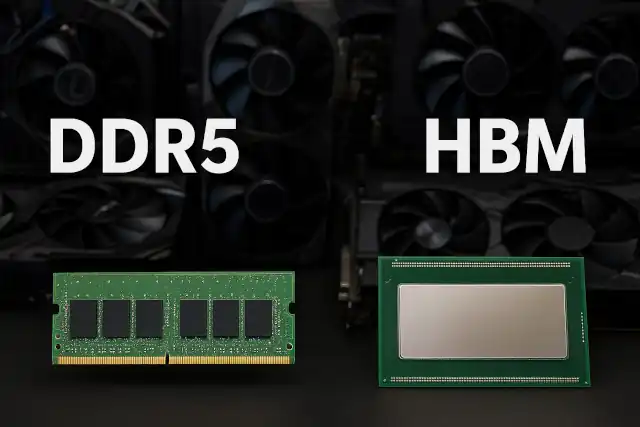
Understanding the Technical Landscape: DDR5 vs HBM
To understand why Chinese companies are turning to DDR5, it’s essential to understand the fundamental differences between DDR5 and HBM technologies.
Architecture and Design Philosophy
DDR5 (Double Data Rate 5) is the latest generation of standard system memory, designed as a general-purpose solution. It uses a traditional planar design where memory chips sit on printed circuit boards (PCBs) connected to processors via relatively narrow data buses. DDR5 offers approximately 33.6 GB/s bandwidth per module with a 64-bit interface, though this can be doubled with dual-channel configurations.
HBM (High-Bandwidth Memory), by contrast, employs a radically different 3D-stacked architecture. HBM chips are stacked vertically on the same package as the CPU or GPU, connected through thousands of Through-Silicon Vias (TSVs) that provide ultra-wide data interfaces of 1024 bits or more. This design allows HBM to achieve dramatically higher bandwidth at lower clock speeds.
Bandwidth Performance Comparison
The bandwidth differences between these technologies are substantial:
- HBM2E can achieve up to 410 GB/s per stack
- HBM3 delivers up to 819 GB/s per stack
- DDR5 provides roughly 33-67 GB/s per module, depending on speed grade
- GDDR6 and HBM outperform DDR5 by approximately 10x in bandwidth
A typical CPU with four DDR5 channels might achieve around 152 GB/s total bandwidth, which is far below what a couple of HBM stacks can deliver (over 500 GB/s).
How HBM Achieves Superior Performance
The key to HBM’s performance advantage lies in its design approach. HBM achieves high throughput by using a very wide bus (1024+ bits) at lower clock speeds, whereas DDR uses a narrower bus (64-bit for DDR5) at high speed.
For example, HBM3 achieves 6.4 Gbps per pin while GDDR6X requires up to 23 Gbps per pin to match comparable performance. Because the memory dies are stacked directly adjacent to the processor with minimal signal travel distance, HBM can operate efficiently at these lower frequencies.
Power Efficiency
HBM consumes significantly less power than DDR due to its 3D design and shorter signal paths. HBM3 operates at just 2.5 picojoules per bit—a 68% improvement over GDDR6X which consumes 4.2 pJ/bit. This makes HBM ideal for data centers where power consumption and heat generation are critical concerns.
Latency Characteristics
HBM3 achieves an average random-access latency of 120 nanoseconds, outperforming DDR5 which averages 160 nanoseconds under similar memory patterns. The physical proximity of HBM to the processor provides inherent latency advantages.
Cost and Capacity Trade-offs
The major advantages of DDR5 are cost and capacity scalability. DDR5 can scale to much larger capacities—you could have 128 GB DDR5 DIMMs, whereas HBM stacks are of smaller capacity. HBM is considerably more expensive than DDR5 due to its complex 3D stacking manufacturing process.
HBM’s high cost stems from the complex technology and materials involved, with the stacking process using TSVs being more involved than making normal DRAM chips, plus lower yields and the need for silicon interposers.
How China’s Financial Controls Are Winning the Ransomware War
China’s Strategic Response: Using DDR5 to Bridge the Gap
Given these technical differences, why are Chinese companies purchasing massive quantities of DDR5 when it’s clearly inferior to HBM for AI applications? The answer lies in necessity and innovation.
Export Restrictions Drive Alternative Solutions
In December 2024, the U.S. adopted country-wide restrictions on the export of advanced HBM to China, effectively cutting off access to this critical technology. This has forced Chinese technology companies to develop alternative approaches to maintain their AI development programs and data center operations.
According to the provided information, Zheng Bingrui, Director of China’s Economic and Financial Research Institute, explains: “Because China cannot use foreign-manufactured GPUs, they are increasing the use of domestically-produced AI chips. Since they cannot import not only GPUs but also cutting-edge HBM, China is replacing HBM with DDR5 memory, equipping domestic chips with DDR5.”
Technical Innovation: DDR5 as an HBM Substitute
The most innovative aspect of China’s response is the strategic use of DDR5 memory as a substitute for HBM in AI chips. Huawei’s Ascend 910B chip, unveiled at a September technology conference, demonstrates this approach. According to the provided information, the Ascend 910B uses only DDR5 memory without HBM but achieves performance comparable to NVIDIA’s A100 chip.
This represents a significant engineering achievement. While DDR5 offers approximately 10x less bandwidth than HBM, Chinese engineers have apparently optimized chip architectures and algorithms to work effectively within these bandwidth constraints. The trade-off involves:
- Lower peak bandwidth but sufficient for many AI training and inference tasks
- Higher capacity potential compared to HBM stacks
- Lower cost per gigabyte of memory
- Established supply chains with multiple manufacturers
Domestic Production Capacity
China’s leading DRAM manufacturer, CXMT (ChangXin Memory Technologies), is rapidly gaining market share and is projected to capture 15% of the global DRAM market by 2025. The company has achieved an 80% yield rate for DDR5 production and aims to reach 90% by the end of 2025.
CXMT has also begun developing HBM capabilities. According to the provided information, “CXMT’s goal is HBM. The company recently began supplying HBM3 samples to Huawei,” indicating that while DDR5 serves as a current solution, China is simultaneously working toward domestic HBM production.
Government Policy Support
The Chinese government has accelerated the transition to domestic components by ordering the removal of all foreign chips from data centers where installation completion rates are below 30%. This policy creates enormous domestic demand for Chinese-made alternatives, including both processors and DDR5 memory.
China has also leveraged its ability to produce advanced semiconductors using deep ultraviolet (DUV) equipment rather than the more advanced extreme ultraviolet (EUV) systems blocked by export restrictions. By producing 7-nanometer chips domestically and pairing them with DDR5 memory, Chinese manufacturers have created a complete domestic technology stack.
China’s “Nvidia Rival” Cambricon Sees 1300% Revenue Surge Benefiting from US and China’s bans
Market Implications
Pricing Dynamics
CXMT and other Chinese manufacturers have been selling DDR5 and DDR4 memory at significantly discounted prices, with some DDR4 products offered at 50% discounts. This aggressive pricing puts pressure on established players like Samsung, SK Hynix, and Micron.
Production Transition
CXMT is phasing out DDR4 production to focus on DDR5 and HBM development, with DDR5 expected to comprise more than 60% of the company’s output by late 2025. This rapid transition reflects both market demand and government directives prioritizing AI and cloud infrastructure.
Stockpiling Activity
Beyond substitution strategies, Chinese companies engaged in significant stockpiling when news of potential HBM export restrictions leaked in August 2024. According to reports, Huawei accumulated approximately 11.7 million HBM units before restrictions were enforced, providing a temporary buffer while domestic alternatives are developed.
Technical Limitations and Future Outlook
Performance Constraints
While DDR5-equipped AI chips can achieve competitive results in certain tasks, they face inherent limitations:
- Bandwidth bottlenecks: For the most demanding AI training workloads requiring rapid access to large datasets, DDR5’s bandwidth limitations become apparent
- Scalability challenges: Systems requiring extreme memory bandwidth (500+ GB/s) cannot effectively use DDR5 as a complete HBM replacement
- Energy efficiency: While DDR5 is efficient, it cannot match HBM’s power-per-bit performance in high-density computing environments
The Path to Domestic HBM
China’s long-term strategy clearly involves developing domestic HBM capabilities. CXMT has already begun customer sampling for HBM2, with low-volume production expected by mid-2025. However, the company remains several years behind industry leaders like SK Hynix and Samsung in HBM technology.
Chinese memory manufacturers are approximately six years behind the leading edge in advanced memory technology. Closing this gap will require continued investment, talent acquisition, and technological breakthroughs in complex areas like TSV manufacturing, 3D stacking, and thermal management.
Why China Is Confident in Banning Nvidia GPUs: Can Domestic Alternatives Really Replace Them?
Conclusion
China’s massive DDR5 purchasing represents a pragmatic, multi-layered response to technology export restrictions. By combining:
- Domestic DDR5 production scaling
- Innovative chip architectures optimized for DDR5
- Strategic stockpiling of restricted components
- Parallel development of HBM capabilities
- Government policies driving domestic adoption
Chinese companies have created a pathway to maintain AI development momentum despite losing access to optimal memory technologies. DDR5 serves as a practical bridge solution—offering acceptable performance at lower cost and with domestic supply chains—while the industry works toward HBM self-sufficiency.
The technical comparison reveals that DDR5 is fundamentally unsuited as a long-term HBM replacement for cutting-edge AI applications. However, for many real-world workloads and with appropriate system optimization, it provides sufficient capability to keep China’s AI industry advancing. The DDR5 surge is not just about buying memory—it’s about buying time and maintaining momentum in the global technology competition while building the foundation for complete semiconductor independence.