Why openSUSE Is One of the Safest Linux Distributions
Why openSUSE Is One of the Safest Linux Distributions
- Why Enterprise RAID Rebuilding Succeeds Where Consumer Arrays Fail?
- Linus Torvalds Rejects MMC Subsystem Updates for Linux 7.0: “Complete Garbage”
- The Man Who Maintained Sudo for 30 Years Now Struggles to Fund the Work That Powers Millions of Servers
- How Close Are Quantum Computers to Breaking RSA-2048?
- Why Windows 10 Users Are Flocking to Zorin OS 18 Instead of Linux Mint?
- How to Prevent Ransomware Infection Risks?
- What is the best alternative to Microsoft Office?
Why openSUSE Is One of the Safest Linux Distributions
When choosing a Linux distribution, security is often the deciding factor — especially for professionals, developers, and enterprise users.
Among the many available options, openSUSE stands out as one of the most secure and trusted Linux distributions in the world. Its robust architecture, enterprise-grade security mechanisms, and impeccable security record make it a top choice for users who value stability and protection.
Anatomy of a Ransomware Attack: The Askul and Asahi Cyber Incidents In Japan
1. Built on Enterprise-Grade Security
openSUSE shares its foundation with SUSE Linux Enterprise (SLE) — a commercial system trusted by major corporations, governments, and data centers around the globe.
This close relationship ensures that openSUSE inherits the same rigorous security testing, hardened configurations, and patching processes that power mission-critical systems.
At the heart of openSUSE’s defense is AppArmor, a mandatory access control framework that limits what applications can do, even if they’re compromised.
It works like a virtual security fence, isolating potential threats and preventing them from damaging the rest of the system.
Together with technologies like Address Space Layout Randomization (ASLR), stack protection, and sandboxing, openSUSE delivers security on multiple layers — from the kernel to user applications.
2. Secure and Transparent Software Sources
All openSUSE software is cryptographically signed and verified using GPG keys, ensuring that only authentic and untampered packages can be installed.
The openSUSE Build Service (OBS), which publicly builds and tests all packages, provides complete transparency — anyone can inspect the source code, verify dependencies, or even rebuild the software themselves.
This transparency and community validation make it virtually impossible for malicious code to sneak into official repositories without being detected.
How to Prevent Ransomware Infection Risks
3. Rapid Patching and Reliable Updates
openSUSE offers two main branches — Leap and Tumbleweed — both benefiting from active maintenance and fast patch cycles.
-
Leap emphasizes enterprise-grade stability, inheriting security fixes directly from SUSE Linux Enterprise.
-
Tumbleweed provides rolling updates but with strict quality control and automated testing.
The built-in package manager zypper, along with YaST Online Update, makes it simple to keep the system current and secure.
For users who demand even stronger protection, MicroOS, a derivative of openSUSE, uses transactional updates and system rollbacks to ensure that updates never break or compromise the system.
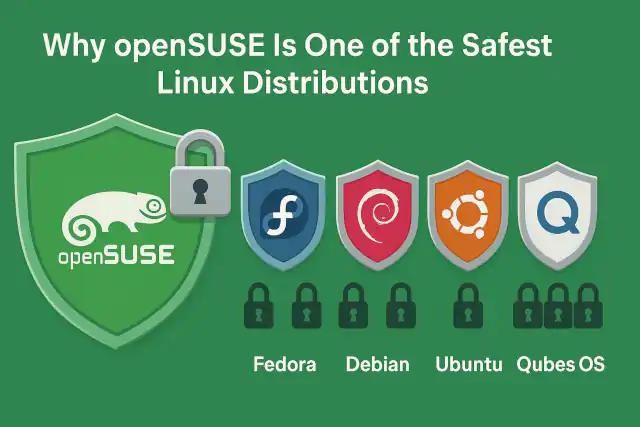
4. Comparison: openSUSE vs Other Secure Linux Distributions
| Distribution | Security Tools | Security Level | Notes |
|---|---|---|---|
| openSUSE | AppArmor, GPG-signing, YaST, OBS | 🔒🔒🔒🔒 | Enterprise-grade, transparent, extremely safe |
| Fedora | SELinux, Firewalld | 🔒🔒🔒🔒 | Cutting-edge, fast updates |
| Debian | Manual hardening, apt-secure | 🔒🔒🔒 | Conservative, stable |
| Ubuntu | AppArmor, auto-updates | 🔒🔒🔒 | User-friendly, strong default security |
| Qubes OS | VM isolation | 🔒🔒🔒🔒🔒 | Exceptional isolation, but complex to use |
While Fedora and Qubes OS also offer strong security, openSUSE provides a rare balance of usability, transparency, and enterprise-grade hardening without sacrificing performance or stability.
5. Security Record: Has openSUSE Ever Been Hacked?
In its long history, openSUSE has never suffered a major security breach or virus infection.
There are no known cases of its package repositories or system infrastructure being successfully compromised.
Some related events have occurred in the broader Linux world, but openSUSE remained unaffected or responded immediately:
-
2011: Linux kernel.org was hacked — openSUSE’s servers were not impacted.
-
2014: The OpenSSL “Heartbleed” vulnerability — patched within 24 hours on openSUSE.
-
2017: The openSUSE user forum (not the OS itself) experienced a database leak — passwords were hashed, and no operating systems were affected.
-
2020: A SaltStack exploit affected some Linux management systems — openSUSE issued fixes quickly, with no reported real-world infections.
Every incident reinforced openSUSE’s commitment to rapid response and transparency. Its Security Team works closely with SUSE engineers and the open-source community to ensure patches are released promptly and publicly documented.
10 Dangerous Ports You Should Close Immediately!
6. Why openSUSE Rarely Gets Infected
Unlike Windows systems, which are frequent targets for malware, openSUSE’s architecture makes infection extremely difficult.
System-wide changes require administrator (root) privileges, package sources are verified, and AppArmor confines application behavior. Even if a single app is compromised, the damage remains isolated.
For an openSUSE system that:
-
installs software only from official repositories,
-
stays up to date using
zypper up, and -
keeps AppArmor and the firewall enabled,
the risk of cyber infection or hacker compromise is extraordinarily low.
Conclusion
openSUSE’s flawless security record, enterprise foundation, and modern defense technologies make it one of the safest Linux distributions in existence.
It combines the reliability of commercial-grade software with the transparency of open source, offering strong protection against modern cyber threats — without sacrificing usability.
In short, if your priorities are security, transparency, and long-term stability, openSUSE is not just a good choice — it’s one of the best.
openSUSE Official Website