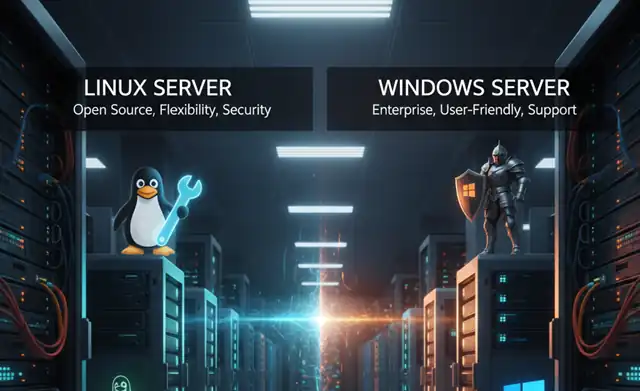
Why servers with Linux OS are much more than Windows server?
Why servers with Linux OS are much more than Windows server?
- Why Enterprise RAID Rebuilding Succeeds Where Consumer Arrays Fail?
- Linus Torvalds Rejects MMC Subsystem Updates for Linux 7.0: “Complete Garbage”
- The Man Who Maintained Sudo for 30 Years Now Struggles to Fund the Work That Powers Millions of Servers
- How Close Are Quantum Computers to Breaking RSA-2048?
- Why Windows 10 Users Are Flocking to Zorin OS 18 Instead of Linux Mint?
- How to Prevent Ransomware Infection Risks?
- What is the best alternative to Microsoft Office?
Why servers with Linux OS are much more than Windows server? 10 Critical Advantages
As of 2025, Linux continues to strengthen its position in the server market, with recent data showing Linux powers approximately 55-63% of web servers globally, significantly outpacing Windows Server’s 12-14% market share.
Major technology companies including Google, Amazon, Facebook, and Twitter rely on Linux-based server infrastructure for their critical operations.
The Linux operating system segment is projected to lead the server OS market with the highest compound annual growth rate through 2032, driven by increased cloud adoption and enterprise digital transformation initiatives.
Why is it difficult for viruses to “infect” Linux OS?
Here are ten compelling reasons why organizations should choose Linux for their server infrastructure:
1. Open Source
Linux’s foremost advantage is its completely free and open-source nature. This openness provides several critical benefits:
- Full access to view, modify, and recreate the kernel code
- Ability to develop custom programs and integrate them into the operating system
- Complete customization to meet specific organizational requirements
- No vendor lock-in or licensing restrictions
Unlike proprietary systems, Linux offers organizations complete control over their server environment without recurring licensing costs.
2. Stability and Uptime
Linux systems are renowned for exceptional stability, capable of running continuously for years without significant issues. Many Linux administrators report never experiencing system crashes in production environments.
A key advantage is that most configuration changes can be applied without system restarts, ensuring minimal downtime. In contrast, Windows Server typically requires restarts for configuration changes, leading to more frequent service interruptions and reduced uptime.
Linux excels at multitasking, handling diverse workloads simultaneously while maintaining rock-solid performance, making it ideal for mission-critical applications.
3. Security
Linux evolved from the UNIX multi-user operating system and inherits robust security architecture. Key security advantages include:
- Privilege-based access control: Only administrators or specifically authorized users can access the Linux kernel
- Rapid vulnerability patching: The global developer community identifies and patches vulnerabilities quickly through transparent code review
- Lower attack surface: Linux servers face fewer attacks than Windows systems, which remain prime targets for malware and viruses
- Built-in security features: Kernel-level defenses including SELinux, AppArmor, UEFI Secure Boot, and packet-filtering firewalls
While Linux is not immune to cyber threats—with increasing sophisticated attacks in recent years—its open-source nature enables faster security response compared to closed-source operating systems.
4. Hardware Efficiency
Linux demonstrates superior hardware efficiency compared to Windows Server:
- Minimal hardware requirements: Runs efficiently on older or lower-specification hardware
- No forced upgrades: Doesn’t require frequent hardware upgrades to maintain performance
- Architecture flexibility: Performs excellently across different system architectures and processors
- Resource optimization: Lower memory and CPU overhead leaves more resources for applications
This efficiency translates to significant cost savings, allowing organizations to extend hardware lifecycles and reduce infrastructure expenses.
Why Linux Doesn’t Need Antivirus Software (But Windows Does)
5. Flexibility and Control
Linux offers unparalleled flexibility for server management:
- Interface options: Choose between GUI interfaces or terminal-only management
- Comprehensive toolsets: Wide selection of utilities for user management, service configuration, networking, application installation, and performance monitoring
- Powerful shell environment: Advanced scripting capabilities for automation and system interaction
- Complete control: Full access to all system components and configurations
This flexibility enables administrators to tailor server environments precisely to organizational needs.
6. Total Cost of Ownership (TCO)
Linux provides substantial cost advantages on TCO:
- Zero licensing fees: Completely free for unlimited servers
- Enterprise distributions: Commercial Linux distributions cost significantly less than Windows Server licenses
- Reduced maintenance costs: Lower overhead for system updates and patches
- Hardware savings: Ability to use existing or less expensive hardware
For organizations managing multiple servers, these savings compound dramatically, making Linux an economically superior choice.
7. Freedom from Vendor Lock-in
Linux liberates organizations from commercial vendor constraints:
- No forced products or services: Choose solutions based on technical merit, not vendor requirements
- Industry validation: Technology giants like Amazon and Google choose Linux for this independence
- Community-driven development: Features and improvements driven by user needs, not vendor profit motives
- Ecosystem diversity: Wide choice of distributions, tools, and support options
Why Enterprise Firewalls and Antivirus Software Fail to Stop Ransomware Attacks?
8. Rich Open Source Application Ecosystem
Linux provides access to thousands of open-source applications:
- Extensive software repository: Vast collection of free, enterprise-grade applications
- Windows compatibility: Ability to run Windows applications using compatibility layers
- Active development: Continuous innovation and improvement by global developer community
- No additional licensing: Most applications free to use and distribute
9. Live Configuration Changes
Unlike Windows Server, Linux enables system modifications without service interruption:
- Dynamic updates: Apply most configuration changes without reboots
- No version lock-in: Continuous updates without purchasing new versions
- Reduced downtime: Maintain service availability during maintenance
- Agile operations: Respond quickly to changing requirements
10. Robust Community Support
The Linux community provides exceptional support resources:
- Global network: Active worldwide community of developers and administrators
- Rapid response: Questions posted on forums typically receive immediate answers
- Enterprise options: Commercial support available for enterprise Linux distributions
- Extensive documentation: Comprehensive guides, tutorials, and best practices readily available
Hackers Can Disable Microsoft Defender on Windows 10/11 by Registering Fake Antivirus Software
Conclusion
As of 2025, Linux’s dominance in server infrastructure continues to grow, powered by its open-source foundation, superior security architecture, exceptional stability, and significant cost advantages.
With 96.3% of the top one million web servers running Linux and projected market growth through 2032, the platform has proven itself as the enterprise-grade choice for modern server infrastructure.
Whether deploying cloud services, managing data centers, or running enterprise applications, Linux provides the flexibility, performance, and reliability organizations need to succeed in today’s digital landscape.