Windows 10’s End of Support Creates Opening for China’s Domestic Linux-Based Operating Systems
Windows 10’s End of Support Creates Opening for China’s Domestic Linux-Based Operating Systems
- Why Enterprise RAID Rebuilding Succeeds Where Consumer Arrays Fail?
- Linus Torvalds Rejects MMC Subsystem Updates for Linux 7.0: “Complete Garbage”
- The Man Who Maintained Sudo for 30 Years Now Struggles to Fund the Work That Powers Millions of Servers
- How Close Are Quantum Computers to Breaking RSA-2048?
- Why Windows 10 Users Are Flocking to Zorin OS 18 Instead of Linux Mint?
- How to Prevent Ransomware Infection Risks?
- What is the best alternative to Microsoft Office?
Windows 10’s End of Support Creates Opening for China’s Domestic Linux-Based Operating Systems
As Microsoft prepares to end support for Windows 10 in October 2025, China sees a strategic opportunity to accelerate its transition away from foreign technology dependence.
The shift toward domestically developed, Linux-based operating systems has been gaining momentum as part of China’s broader technology self-sufficiency initiative.
The Window of Opportunity
Windows 10’s impending end-of-life presents significant challenges for organizations worldwide, but for China, it represents a chance to reduce reliance on American technology. Government agencies, state-owned enterprises, and critical infrastructure operators have been gradually migrating to domestic alternatives, and the Windows 10 support deadline adds urgency to these efforts.
The Chinese government has been promoting this transition through procurement policies that favor domestic software, security concerns about foreign-developed systems, and substantial investments in local operating system development.
Major Chinese Domestic Operating Systems
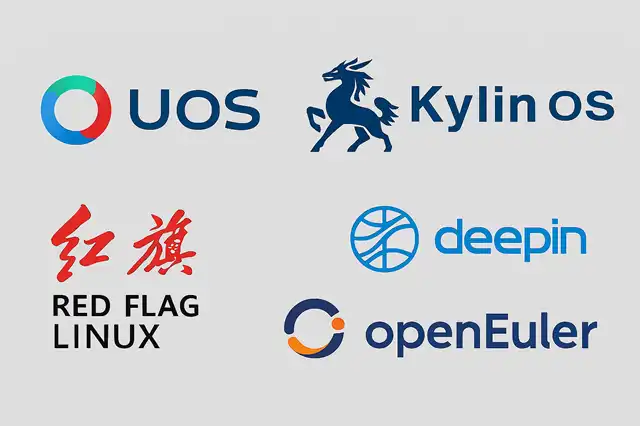
Several Linux-based operating systems have emerged as credible alternatives in the Chinese market:
UOS (Unity Operating System) – Developed by UnionTech, UOS is built on Debian Linux. It has become one of the most prominent domestic options, featuring a polished interface and extensive hardware compatibility. The system is widely deployed in government offices and state-owned enterprises.
Kylin OS – Based on Ubuntu Linux, Kylin is developed by the National University of Defense Technology and commercialized by China Standard Software. It comes in several variants, including NeoKylin for servers and UKUI (Ubuntu Kylin User Interface) for desktops.
Deepin OS – Originally developed as a Debian-based distribution, Deepin has gained international recognition for its elegant user interface. While it has a global user base, it serves as the foundation for several domestic variants and has been incorporated into government procurement lists.
Red Flag Linux – One of China’s earliest domestic operating systems, based on Red Hat/Fedora. Though it faced financial difficulties in the past, recent versions have seen renewed development and deployment.
OpenKylin – A newer community-driven distribution that aims to create an independent Chinese Linux ecosystem, not directly derived from Ubuntu or Debian, though it shares common Linux foundations.
openEuler – positioned as an enterprise-focused, server-oriented distribution based on CentOS/RHEL, developed by Huawei and now maintained by the OpenAtom Foundation. It’s particularly important for cloud computing and data center infrastructure.
HarmonyOS is presented as a unique case – while it started with Linux kernel compatibility, HarmonyOS NEXT represents Huawei’s ambitious attempt to create a truly independent operating system that works seamlessly across all device types (phones, tablets, PCs, IoT devices). It’s notable for being less traditionally “Linux-based” than the others, representing a more radical departure from Western technology stacks.
Ecosystem Development and Maturity
The ecosystem surrounding Chinese domestic operating systems has expanded significantly in recent years, though challenges remain:
Application Availability: Major Chinese software developers, including WPS Office, Kingsoft, Tencent, and Alibaba, have released native versions of their applications for domestic OS platforms. Banking software, government service applications, and popular Chinese productivity tools are increasingly compatible.
Hardware Support: Chinese hardware manufacturers like Loongson, Phytium, and Zhaoxin have optimized their processors for domestic operating systems. Major PC manufacturers including Lenovo, Huawei, and Tongfang have released pre-installed systems.
Developer Community: The domestic OS ecosystem has attracted growing developer interest, with improving documentation, development tools, and support resources available in Chinese.
However, gaps persist. International software compatibility remains limited, gaming support lags behind Windows, and specialized professional software often lacks native versions. The transition requires significant user retraining and workflow adaptation.
Security Considerations
Security represents both a motivation for and a concern about China’s domestic operating systems:
Advantages:
- Source code transparency allows for domestic security audits
- Reduced exposure to potential foreign surveillance or backdoors
- Customization for specific Chinese security requirements and standards
- Integration with domestic encryption and security frameworks
Challenges:
- Smaller user base means potentially fewer eyes identifying vulnerabilities
- Limited third-party security research compared to mainstream systems
- Questions about update frequency and long-term security maintenance
- Concerns among international observers about potential government access
The Chinese government emphasizes that domestic control over operating system code is essential for national security, particularly for critical infrastructure and sensitive operations.
Can They Replace Microsoft Office?
The question of replacing Microsoft Office is perhaps the most practical concern for organizations considering migration:
WPS Office has emerged as the leading alternative, offering strong compatibility with Microsoft Office formats. Developed by Kingsoft, it includes word processing, spreadsheet, and presentation software with interfaces familiar to Office users. WPS Office runs natively on all major Chinese operating systems and claims over 500 million users globally.
LibreOffice and Chinese-localized variants provide open-source alternatives with decent format compatibility, though some advanced features and formatting may not translate perfectly.
For many government and business workflows in China, these alternatives have proven sufficient. However, organizations with complex Excel macros, extensive Office customization, or international collaboration requirements may face compatibility challenges.
The Path Forward
China’s transition from Windows to domestic operating systems represents an ambitious technological and political project. While the end of Windows 10 support creates urgency, the migration faces practical challenges including application compatibility, user familiarity, and ecosystem maturity.
For government operations and standardized business environments, the transition appears increasingly feasible. For users requiring specialized software, international collaboration tools, or cutting-edge applications, the domestic ecosystem still has gaps to fill.
The success of this initiative will depend not just on technical capability, but on continued investment in ecosystem development, user education, and the patience to allow these platforms to mature. As Windows 10 support ends, China will test whether its domestic alternatives are ready to serve as comprehensive replacements for hundreds of millions of users.