Zoom Phone: A Cloud-First Challenger to Cisco in the VoIP Landscape
Zoom Phone: A Cloud-First Challenger to Cisco in the VoIP Landscape
- Why Enterprise RAID Rebuilding Succeeds Where Consumer Arrays Fail?
- Linus Torvalds Rejects MMC Subsystem Updates for Linux 7.0: “Complete Garbage”
- The Man Who Maintained Sudo for 30 Years Now Struggles to Fund the Work That Powers Millions of Servers
- How Close Are Quantum Computers to Breaking RSA-2048?
- Why Windows 10 Users Are Flocking to Zorin OS 18 Instead of Linux Mint?
- How to Prevent Ransomware Infection Risks?
- What is the best alternative to Microsoft Office?
Zoom Phone: A Cloud-First Challenger to Cisco in the VoIP Landscape
The enterprise voice market has shifted decisively to the cloud, transforming traditional PBX (Private Branch Exchange) systems into unified communications as a service (UCaaS) platforms.
Zoom Phone, built upon the success of the Zoom Meetings platform, has rapidly emerged as a powerful, cloud-first competitor to established giants like Cisco, which offers its comprehensive Cisco Unified Communications Manager (CUCM) and Webex Calling solutions.
Technological Foundations: Protocols and Codecs
Zoom Phone leverages industry-standard Voice over IP (VoIP) protocols while integrating proprietary optimizations for superior call quality and security.
VoIP Protocols
| Protocol | Purpose | Details |
| SIP (Session Initiation Protocol) | Call Signaling | Used for establishing, managing, and terminating voice calls. |
| TLS 1.2+ | Signaling Security | Encrypts the SIP signaling layer (SIP over TLS), typically using AES 256-bit encryption. |
| RTP (Real-time Transport Protocol) | Media Transport | Transmits the actual voice data stream. |
| SRTP (Secure Real-time Transport Protocol) | Media Security | Encrypts the RTP media stream (call content) using AES 128-bit or 256-bit algorithms. |
| RFC 2833 | DTMF Tones | Used for reliable transmission of touch-tones (e.g., pressing “1” for a menu option). |
Supported Audio Codecs
Zoom prioritizes high-definition (HD) audio and bandwidth efficiency.
- Primary Codecs (for App Users): Opus and SILK are the preferred codecs, offering excellent audio quality and dynamic adaptation to network conditions.
- SIP Device Codecs: For calls involving IP desk phones or Session Border Controllers (SBCs), Zoom Phone supports a wider range of standard codecs, including:
- G.711 (μ-law / A-law): Standard, uncompressed legacy codec.
- G.722: Wideband (HD) codec.
- G.729: Low-bandwidth codec, crucial for network connections with limited bandwidth.
Deployment and Hardware Compatibility
Zoom Phone offers a streamlined deployment model tailored for the modern, agile enterprise.
Softphone and Application Support
The core philosophy of Zoom Phone is “One App for Everything.” The dedicated softphone application is the primary way users interact with the system.
- Supported Applications:
- Zoom Workplace App (Desktop/Mobile): The mandatory client for all users, integrating voice calling, video conferencing, chat, and other collaborative features.
- No Third-Party Softphone Support: Users cannot register a generic third-party SIP softphone (like Bria or Zoiper) for full functionality, as the platform’s security and advanced features rely on the native Zoom app integration.
IP Desk Phone Support
Zoom Phone provides strong support for physical IP phones through two channels:
- Certified Devices: The recommended option, featuring Zero Touch Provisioning (ZTP) and full support for advanced features. Key partners include Poly, Yealink, and select Cisco Multi-Platform Phones.
- Generic SIP Devices: Allows organizations to register nearly any standard SIP-compatible phone manually. However, this is limited to basic call features and lacks the enhanced usability and deep integration of certified devices.
Competition: Zoom Phone vs. Cisco VoIP
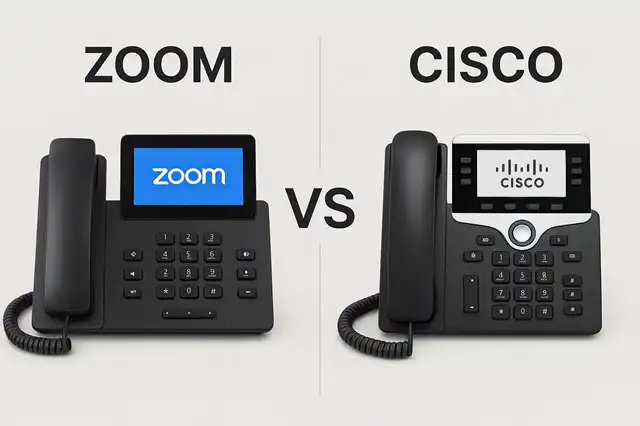
Zoom Phone and Cisco’s solutions (primarily CUCM and Webex Calling) compete across several key differentiators:
| Feature | Zoom Phone (Cloud-First UCaaS) | Cisco (CUCM/Webex Calling) |
| Core Focus | Video-centric unified platform and user experience. | Network-centric reliability and deep voice infrastructure control. |
| Deployment Model | Pure Cloud (Cloud PBX) with fast, simple deployment. | On-Premises/Hybrid (CUCM) or Cloud (Webex Calling). |
| Ease of Use | Extremely high. Intuitive interface, minimal IT overhead. | Moderate to Complex. Requires specialized IT expertise, particularly for CUCM. |
| Hardware | Relies on certified third-party hardware. | Offers a complete portfolio of first-party (Cisco) phones and room systems. |
| Target Market | Mid-market, agile enterprises, and companies prioritizing simplicity and speed. | Large enterprises, those with existing Cisco network infrastructure, and industries with strict compliance/control requirements. |
Zoom’s Competitive Strategy
Zoom Phone competes with Cisco by focusing on three key advantages:
- Seamless Integration and User Experience: By bundling meetings, chat, and phone services into a single, cohesive app, Zoom eliminates the complexity of managing multiple platforms, which significantly reduces the learning curve and IT support burden.
- Agility and Innovation: As a pure cloud player, Zoom can deploy new features rapidly, particularly those involving AI (AI Companion) and advanced cloud-PBX functionality, often outpacing the development cycle of legacy-heavy systems like CUCM.
- Cost-Effectiveness and Scalability: The cloud-only model typically offers a lower Total Cost of Ownership (TCO) than traditional on-premises or hybrid solutions, making it an attractive, scalable choice for growing businesses.
In essence, while Cisco appeals to organizations prioritizing deep control and network heritage, Zoom Phone wins by offering superior simplicity, rapid innovation, and a modern, video-first user experience.