Traditional Passwords Won’t Be Replaced Even Passkey Favored
Traditional Passwords Won’t Re Replaced Even Passkey Favored
- 60% of MD5 Password Hashes Can Be Cracked in Under an Hour with a Single GPU
- Dirty Frag: Root Access on Every Major Linux Distribution — No Patch, No Warning
- Ubuntu 26.04 LTS (Resolute Raccoon): The Most Ambitious Ubuntu LTS in a Decade
- Proton Mail: Data Transferred to FBI Again!
- How Close Are Quantum Computers to Breaking RSA-2048?
- How to Prevent Ransomware Infection Risks?
- What is the best alternative to Microsoft Office?
Traditional Passwords Won’t Re Replaced Even Passkey Favored
Bitwarden: Most Developers Favor Passkey, but They Won’t Replace Traditional Passwords.
News on October 24 – Bitwarden, the open-source password manager, has released a developer survey report that interviewed over 600 developers, primarily focusing on topics related to authentication, AI, and network security.
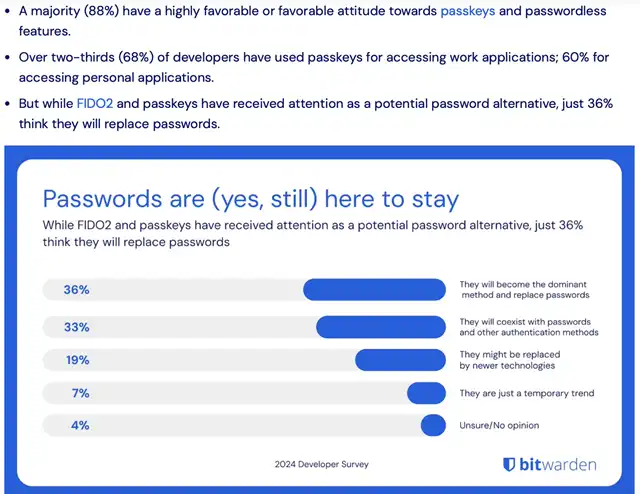
According to the report, the majority of developers (88%) have a favorable view of Passkeys and “passwordless features.” Among them, more than two-thirds (68%) of developers use Passkeys to access work applications, while 60% use them for personal applications.
Passkeys: A combination of keys used for login authentication, where the public key is registered with websites or apps, and the private key is stored on the user’s device. Once registered, users can utilize various biometric features on their devices, such as fingerprint or iris recognition, as well as a PIN code, to log in to various web services.
Apart from eliminating the need to remember passwords, the primary advantage of Passkeys is security. Because the public and private keys are stored separately, user login credentials are kept in both the cloud and locally, making it more challenging for hackers to obtain user password information.
However, the report also indicates that although developers acknowledge the value of Passkey features, they won’t replace traditional passwords. Only 36% of developers believe that Passkeys will replace passwords.
It’s worth noting that several major companies like Microsoft (GitHub), Google, and Apple have shown significant interest in Passkeys, with some of their products gradually incorporating Passkey functionality.
Tell me more about Passkey security
Passkey security is a concept related to modern authentication methods that aim to enhance security and user convenience compared to traditional password-based systems.
Passkeys are designed to reduce the reliance on passwords and offer a more secure and user-friendly way to authenticate users.
Some key aspects of Passkey security:
-
Biometric Authentication: Passkeys often leverage biometric authentication methods such as fingerprint recognition, facial recognition, iris scanning, or even voice recognition. These biometric identifiers are unique to each individual, making it difficult for unauthorized users to gain access.
-
Two-Factor or Multi-Factor Authentication (2FA/MFA): Passkeys can be combined with other factors of authentication to enhance security. For example, users may need to provide a fingerprint scan along with a PIN or a hardware token to access their accounts.
-
Public and Private Key Pair: Passkeys typically consist of a pair of cryptographic keys: a public key and a private key. The public key is stored on the server or service provider’s side, while the private key remains on the user’s device. This separation of keys enhances security because even if the server is compromised, an attacker cannot easily access a user’s account without the private key.
-
Eliminating Passwords: Passkey systems aim to eliminate the need for traditional passwords. Users rely on biometrics or other forms of authentication, reducing the risk of password-related security issues such as weak passwords, password reuse, and phishing attacks.
-
Enhanced Security: Passkeys are generally considered more secure than traditional passwords. They provide a strong barrier against brute-force attacks and credential theft because the private key is typically stored securely on the user’s device and not on remote servers.
-
Convenience: Passkeys offer a convenient way for users to access their accounts. They don’t need to remember complex passwords or worry about changing them regularly. Biometric authentication is quick and user-friendly.
-
Passwordless Authentication: Passkey systems are often associated with the idea of “passwordless authentication.” This means that users don’t need to enter a traditional password during the authentication process. Instead, they use their biometric data or other authentication methods.
-
Secure Storage: The private key of a Passkey is usually stored in a secure enclave on the user’s device, making it difficult for malware or attackers to access it.
-
Resistance to Phishing: Passkey systems are less susceptible to phishing attacks because even if a user is tricked into providing their public key (e.g., through a fake website), the attacker would still need the user’s private key to gain access.
Passkey security is part of a broader trend in enhancing online security and user authentication.
While it offers numerous benefits, it’s important to note that the implementation and security of Passkey systems can vary, and not all services and platforms have adopted them.
Users should also remain cautious about the privacy and security implications associated with biometric data storage.