Windows 11 Now Natively Supports 11 File Archive Formats
Windows 11 Now Natively Supports 11 File Archive Formats, Including 7-Zip and RAR
- 60% of MD5 Password Hashes Can Be Cracked in Under an Hour with a Single GPU
- Dirty Frag: Root Access on Every Major Linux Distribution — No Patch, No Warning
- Ubuntu 26.04 LTS (Resolute Raccoon): The Most Ambitious Ubuntu LTS in a Decade
- Proton Mail: Data Transferred to FBI Again!
- How Close Are Quantum Computers to Breaking RSA-2048?
- How to Prevent Ransomware Infection Risks?
- What is the best alternative to Microsoft Office?
Windows 11 Now Natively Supports 11 File Archive Formats, Including 7-Zip and RAR
Back in May of this year, Microsoft announced its plans to natively introduce support for compression file formats like RAR and 7-Zip in the Windows 11 operating system.
Fast forward to today, the company has added support for 11 new file archive formats through the optional KB5031455 preview cumulative update released this month.
Windows 11 22H2 now natively supports nearly a dozen additional archive formats.
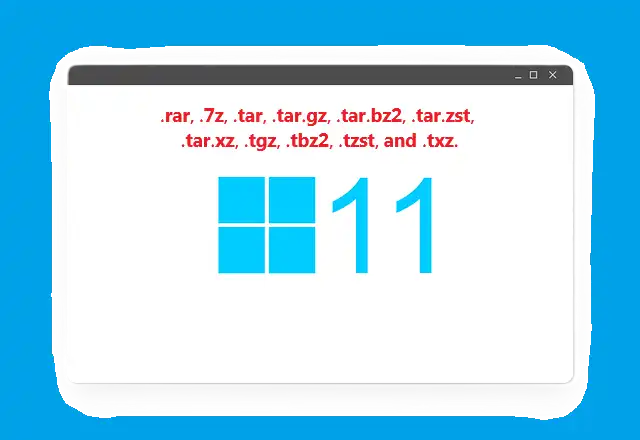
The updated list of archive types supported in Windows 11 now includes: .rar, .7z, .tar, .tar.gz, .tar.bz2, .tar.zst, .tar.xz, .tgz, .tbz2, .tzst, and .txz.
However, it’s important to note that password-encrypted files are not supported at this time, and Microsoft has not disclosed further details. They may consider adding support for other formats such as LZH and XAR in the future.
“We have added native support for other archive formats using the open-source libarchive project, including tar, 7-Zip, RAR, gz, and many others. Now, you can enjoy enhanced archive functionality during compression on Windows.”
Libarchive is an open-source C library designed to provide read and write support for various compression formats. It supports many common compression formats and offers advanced features like encryption, digital signatures, and multi-volume support. A significant advantage of libarchive is its cross-platform support, as it can run on various operating systems, including Linux, Windows, macOS, and more. It also offers bindings in multiple programming languages like Python, Ruby, Perl, making it convenient for developers to use it in their preferred programming language.
Since KB5031455 is an optional update, Windows users will need to manually install it. This new feature will also be rolled out to all Windows 11 users through a cumulative update planned for the “Patch Tuesday” release in November.