Linux Kernel Developers Debate Priority-Based Shutdown Support
Linux Kernel Developers Debate Priority-Based Shutdown Support
- 60% of MD5 Password Hashes Can Be Cracked in Under an Hour with a Single GPU
- Dirty Frag: Root Access on Every Major Linux Distribution — No Patch, No Warning
- Ubuntu 26.04 LTS (Resolute Raccoon): The Most Ambitious Ubuntu LTS in a Decade
- Proton Mail: Data Transferred to FBI Again!
- How Close Are Quantum Computers to Breaking RSA-2048?
- How to Prevent Ransomware Infection Risks?
- What is the best alternative to Microsoft Office?
Linux Kernel Developers Debate Priority-Based Shutdown Support
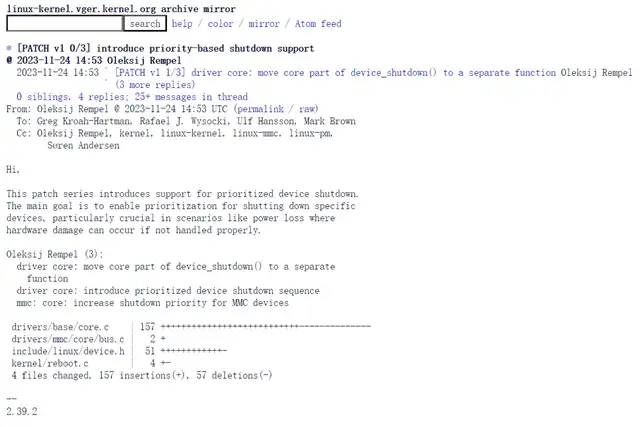
Oleksij Rempel, a developer at Pengutronix, an embedded Linux consulting company, released a series of patches last Friday proposing priority-based shutdown support for drivers/hardware in the Linux kernel.
The primary objective is to provide the ability to prioritize the shutdown of specific devices in the mainline Linux kernel. This is particularly crucial in events like power loss, where improper handling could result in hardware damage.
The focus of these patches is on correctly shutting down critical devices during unexpected or immediate shutdown events, such as power or voltage drops, or complete power loss. As part of the patch series, Oleksij Rempel also suggests setting (e)MMC storage devices to a higher priority during shutdown to help ensure data integrity and prevent corruption.
Oleksij Rempel’s proposal sparked intense debates among Linux kernel developers, leading to a polarization of opinions. Greg Kroah-Hartman was among the first to question this priority-based shutdown support. He pointed out that such an approach could lead to a priority tug-of-war between drivers and subsystems:
“Every driver and subsystem thinks they are the most important!”
In essence, this could pose numerous problems in the long run. What makes certain hardware so special that it cannot be shut down in the existing order and must be given “priority”? What is the purpose of this, and which devices necessitate such treatment?
The discussion on whether the mainline Linux kernel should have this functionality to effectively address hardware design issues has been extensive. Interestingly, some outer layers of the Linux kernel used in the automotive industry already offer this priority shutdown support. Oleksij Rempel summarized the need as follows:
“It prevents hardware damage. In typical automotive undervoltage tests, you can usually reproduce X damaged eMMC or NAND within Y undervoltage cycles (I don’t have exact numbers right now). Even though the quantities seen in artificial testing are not huge (sometimes one damaged device in a month of testing), the field return rate is high enough to make us care about a software solution to this issue.”
Greg responded with a touch of sarcasm, asking, “So, the hardware is relying on software to prevent the same hardware from being damaged? Hardware designers surely aren’t that crazy, right?”
The tech website Phoronix commented that from a higher-level perspective, if devices/drivers have valid reasons to prioritize preparing for shutdown—such as preventing data loss or gaining other significant advantages—priority-based shutdown support seems reasonable. However, in practice, if multiple drivers claim “priority” during the shutdown process, and there are other obstacles to ensuring a reliable design that effectively addresses real-world issues, the specific implementation could face challenges.
Opinions on this approach are currently divided, and whether a solution can be designed that is both acceptable to the mainline and meets the specific requirements of the automotive and broader embedded/industrial fields remains to be seen.