Ham Radio Community Challenges Satellite Company’s “Emergency Use” Claims
Ham Radio Community Challenges Satellite Company’s “Emergency Use” Claims
- 60% of MD5 Password Hashes Can Be Cracked in Under an Hour with a Single GPU
- Dirty Frag: Root Access on Every Major Linux Distribution — No Patch, No Warning
- Ubuntu 26.04 LTS (Resolute Raccoon): The Most Ambitious Ubuntu LTS in a Decade
- Proton Mail: Data Transferred to FBI Again!
- How Close Are Quantum Computers to Breaking RSA-2048?
- How to Prevent Ransomware Infection Risks?
- What is the best alternative to Microsoft Office?
Ham Radio Community Challenges Satellite Company’s “Emergency Use” Claims.
AST SpaceMobile Faces Growing Opposition Over Amateur Radio Spectrum Use.
AST SpaceMobile’s attempts to justify its use of amateur radio spectrum bands have failed to ease concerns within the ham radio community, as operators worldwide mobilize to monitor and challenge the company’s satellite operations.
“AST is once again obscuring the truth,” German amateur radio operator Mario Lorenz wrote in a letter to the Federal Communications Commission (FCC) on Friday, escalating a dispute that has drawn international attention to spectrum allocation policies.
The Spectrum Conflict
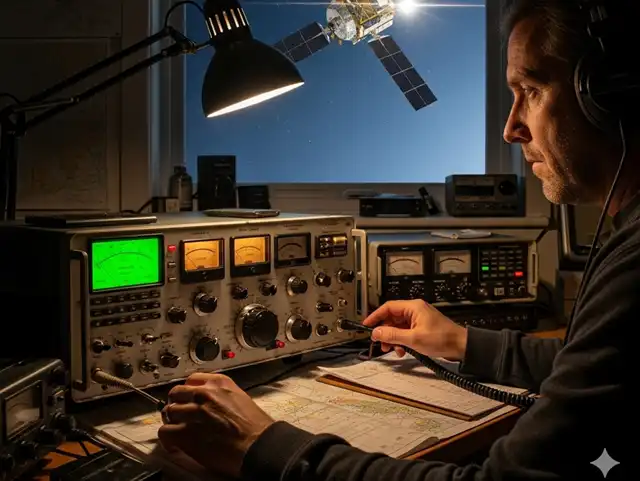
At the heart of the controversy is the 430-440 MHz frequency band. AST SpaceMobile wants to use this spectrum outside the United States to control and track its constellation of 248 satellites, designed to provide cellular connectivity directly to smartphones worldwide. However, these frequencies have long been allocated to amateur radio operations globally, raising concerns about widespread interference.
According to International Telecommunication Union (ITU) allocations, this 10 MHz bandwidth is designated for “secondary service” or “amateur satellite service” in most regions worldwide, supporting activities including moonbounce communications, satellite telemetry, emergency drills, and educational experiments.
Company lawyers assured the FCC this week that the frequency band would only be activated briefly when “other frequencies are unavailable,” using extremely low power with “negligible interference risk.”
Challenging the “Emergency Use” Narrative
The amateur radio community disputes AST’s emergency-use justification. AMSAT-Deutschland submitted formal correspondence to the FCC on Friday stating: “We have continuously monitored regular downlink signals from AST satellites on 430-440 MHz. The claim of ‘limited and exceptional’ use is either a misguided statement or deliberate fabrication.”
The organization provided waterfall charts showing that BlueWalker-3 consistently occupied frequencies near 435 MHz with bandwidth up to 1 MHz—far exceeding what would be needed for an “emergency beacon”—until a global amateur radio monitoring campaign began on July 23.
Ironically, AMSAT-Deutschland is itself a nonprofit organization promoting amateur satellite development and typically supports commercial space innovation. Yet their letter bluntly reminded the FCC: “We appreciate AST’s ambitious vision, but innovation must never come at the expense of internationally recognized amateur radio services with deep community involvement.”
Precedent Concerns
The organization fears that FCC approval for AST would set a precedent allowing commercial companies to claim “emergency” use of amateur frequencies at will. This could lead to other operators following suit, ultimately transforming the 430-440 MHz band into a de facto commercial control frequency range.
“What is called ‘special purpose’ today could become routine tomorrow, leaving amateur earth stations, campus satellite ground stations, and emergency communication teams worldwide without clean spectrum,” the letter warned.
AMSAT-Deutschland also questioned AST’s technical maturity, noting that SpaceX operates over 6,000 Starlink satellites using officially allocated S-band and Ku-band frequencies for tracking, telemetry and control (TT&C). Amazon’s Project Kuiper and Europe’s OneWeb similarly operate without requesting amateur UHF spectrum. “Why can’t AST do the same? This raises questions about whether their RF architecture and link budgets have been adequately verified.”
Technical Analysis Disputes
Mario Lorenz further dissected AST’s third-party interference analysis in his Friday submission, pointing out that the report only calculated scenarios where “amateur satellite uplinks are suppressed,” while deliberately ignoring more common situations where ground-based amateur stations—especially narrowband moonbounce, meteor scatter, and WSJT weak-signal experiments—could be overwhelmed by satellite downlink noise.
“AST is once again trying to evade responsibility by submitting only half the homework,” Lorenz wrote.
The Bulgarian Amateur Radio Union warned in last month’s comments that even interference levels below ITU-R recommended thresholds could be problematic. AST satellites use burst-mode high-gain antennas that create rapidly scanning “energy lobes” on the ground, potentially overlapping with amateur satellite control sub-audio frequencies or meteor scatter experiment windows. “Even a brief pulse could cause link error rates to spike, destroying data integrity and potentially causing amateur satellites to lose control,” constituting “harmful interference” under FCC regulation 47 CFR §2.1.
Industry Response and Global Monitoring
Facing mounting criticism, AST has yet to provide further media response, only submitting a two-page technical memorandum to the FCC last week reiterating that “interference probability is extremely low.”
However, the amateur radio community has committed to continued monitoring. AMSAT-Deutschland, AMSAT-NA, the UK’s RSGB, Japan’s JARL, and other organizations have launched a “Global UHF Watch” campaign, encouraging operators to conduct wideband recordings, waterfall screenshots, and orbital comparisons near 435 MHz. Any captured persistent downlink signals will be packaged and submitted to national regulatory authorities.
“We must show decision-makers that amateur frequencies are not unguarded ‘vacant lots,’ but provide critical daily support for global research, emergency response, and talent development,” AMSAT-Deutschland emphasized. “If the FCC transfers interference risk to other countries, it sets a dangerous precedent for global spectrum management.”
Regulatory Timeline and Broader Implications
The story is far from over. The FCC currently lists AST’s control frequency application as “accepting comments,” with the next reply deadline set for mid-September. Regardless of the outcome, this battle over 430-440 MHz has brought the “commercial satellites vs. amateur services” conflict into public view for the first time.
When innovation vision meets historically established spectrum rights, which should regulatory agencies prioritize? The world’s 3 million licensed amateur radio operators are watching the FCC’s next move closely.
The dispute highlights fundamental questions about spectrum allocation in an era of rapidly expanding commercial satellite constellations, where traditional users find themselves competing with well-funded commercial ventures for increasingly scarce radio frequencies. The outcome may establish important precedents for how regulators balance innovation with protection of existing spectrum rights globally.