Will the U.S. Sanction BYD Like It Did Huawei?
Will the U.S. Sanction BYD Like It Did Huawei?
- 60% of MD5 Password Hashes Can Be Cracked in Under an Hour with a Single GPU
- Dirty Frag: Root Access on Every Major Linux Distribution — No Patch, No Warning
- Ubuntu 26.04 LTS (Resolute Raccoon): The Most Ambitious Ubuntu LTS in a Decade
- Proton Mail: Data Transferred to FBI Again!
- How Close Are Quantum Computers to Breaking RSA-2048?
- How to Prevent Ransomware Infection Risks?
- What is the best alternative to Microsoft Office?
Will the U.S. Sanction BYD Like It Did Huawei?
Tesla’s European Collapse Signals Shifting EV Power Dynamics
Tesla is experiencing an unprecedented collapse in Europe, raising questions about whether the United States might resort to sanctions against Chinese EV giant BYD as competition intensifies.
The Numbers Tell a Stark Story
According to data from ACEA (European Automobile Manufacturers Association), Tesla sold just 6,600 vehicles in the European Union in July 2024, a staggering 42.4% year-over-year decline.
More significantly, Tesla’s sales have now fallen below those of BYD, despite the Chinese automaker facing punitive tariffs across Europe.
The decline represents a catastrophic erosion from Tesla’s peak. Compared to November 2023, when Tesla sold 31,810 units, current sales have plummeted approximately 80%. Spain saw the steepest collapse, with sales dropping 75%.
This isn’t just a European phenomenon. In August 2024, Tesla’s share of the U.S. new energy vehicle market fell below 40% for the first time since 2017, hitting 38%.
In China, Tesla has managed to maintain monthly sales of 30,000-40,000 units, merely holding its ground while the broader EV market grows at 20% year-over-year.
Competition Intensifies from All Sides
Tesla faces mounting pressure from three distinct competitive fronts in Europe:
German manufacturers are directly challenging Tesla’s dominance. Volkswagen’s ID.7 outsold the Model 3 in the first half of 2024, with 36,565 units compared to 27,084. The ID.7 offers more interior space, with dimensions of 4,961mm x 1,862mm x 1,537mm and a 2,965mm wheelbase, versus the Model 3’s 4,720mm x 1,850mm x 1,442mm with a 2,875mm wheelbase.
French and Korean automakers are attacking from below with smaller, more affordable options like the Kia EV3, Renault 5, and Megane E-Tech, filling the gap left by Tesla’s delayed Model 2 or Model Q.
Chinese manufacturers, particularly BYD, are establishing themselves as credible alternatives. The BYD Seal directly competes with the Model 3, offering comparable features despite the tariff disadvantages. BYD sold 9,698 units in the EU in July, surpassing Tesla.
Product Stagnation vs. Brand Erosion
Tesla retains certain technical advantages. The Model 3’s energy consumption remains below 14 kWh per 100km, superior to the ID.7’s 14-16 kWh. Tesla’s Supercharger network continues to provide a competitive edge, with even Volkswagen owners utilizing Tesla charging infrastructure.
However, Tesla hasn’t launched a significant mass-market vehicle since the Model Y in 2021. The Model 3 dates back to 2017. While CEO Elon Musk focuses on artificial intelligence and robotics, defining Tesla as an “AI robotics company,” the core automotive business has suffered from neglect.
The Musk Factor
Industry analysts point to brand image as the critical factor behind Tesla’s European decline. Musk’s increasingly controversial political activities have alienated European consumers. His direct involvement in UK protests, public commentary on German elections, and prominent political positioning have transformed Tesla’s brand identity.
From being viewed as a technology leader, Tesla has been rebranded in European minds as a “right-wing flagship.” A T-Online survey of 100,000 Germans found that 94% would not purchase a Tesla, with only 3% considering it.
Anti-Musk organizations have emerged across Europe, with campaigns like “Everyone Hates Elon” in the UK calling for X account deletions and Tesla boycotts. Tesla stores, charging stations, and vehicles have faced vandalism and arson attacks in both Europe and the United States.
The Huawei Parallel
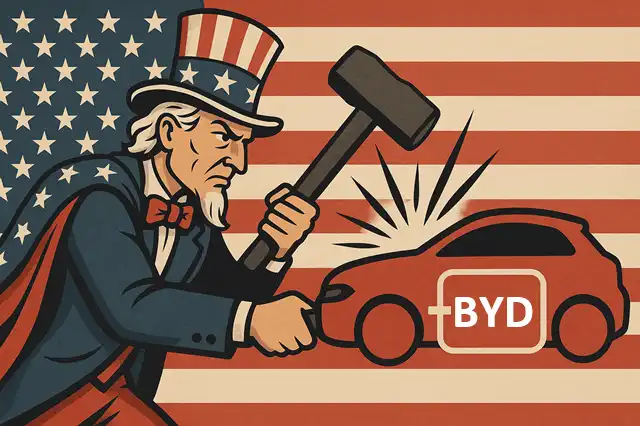
This raises the uncomfortable question: as Chinese EV manufacturers like BYD gain market share despite existing tariffs, will the United States consider more aggressive measures similar to those deployed against Huawei?
BYD’s success in Europe, even with punitive tariffs, demonstrates the competitiveness of Chinese EV technology. In China’s domestic market, where Tesla competes on equal footing, the American manufacturer struggles to maintain relevance against rapidly innovating local competitors.
The automotive industry differs significantly from telecommunications, but the geopolitical parallels are evident. If Chinese EVs begin dominating Western markets despite tariff barriers, political pressure for more comprehensive restrictions could intensify.
An Uncertain Future
Tesla’s European crisis illustrates how quickly dominant market positions can erode when product development stagnates and brand identity becomes toxic. Whether through continued self-inflicted damage or external competitive pressure, Tesla’s path forward appears increasingly uncertain.
For BYD and other Chinese manufacturers, the question remains whether their technological and manufacturing advantages will overcome political barriers, or whether they too will face the kind of comprehensive restrictions that crippled Huawei’s global ambitions.
As one observer noted: people bought Teslas partly because the brand seemed least likely to fail. In Europe today, that assumption no longer holds.