Why Does Zigbee Beat Wi-Fi for Smart Home Sensors?
Why Does Zigbee Beat Wi-Fi for Smart Home Sensors?
- 60% of MD5 Password Hashes Can Be Cracked in Under an Hour with a Single GPU
- Dirty Frag: Root Access on Every Major Linux Distribution — No Patch, No Warning
- Ubuntu 26.04 LTS (Resolute Raccoon): The Most Ambitious Ubuntu LTS in a Decade
- Proton Mail: Data Transferred to FBI Again!
- How Close Are Quantum Computers to Breaking RSA-2048?
- How to Prevent Ransomware Infection Risks?
- What is the best alternative to Microsoft Office?
Why Does Zigbee Beat Wi-Fi for Smart Home Sensors?
As smart home technology continues to transform our living spaces, an invisible network of communication protocols works tirelessly behind the scenes.
While Wi-Fi dominates our smartphones and laptops, a quieter technology called Zigbee has become the backbone for countless smart home sensors, switches, and controllers.
Understanding why manufacturers often choose Zigbee over the seemingly ubiquitous Wi-Fi reveals fundamental insights into the architecture of modern smart homes.
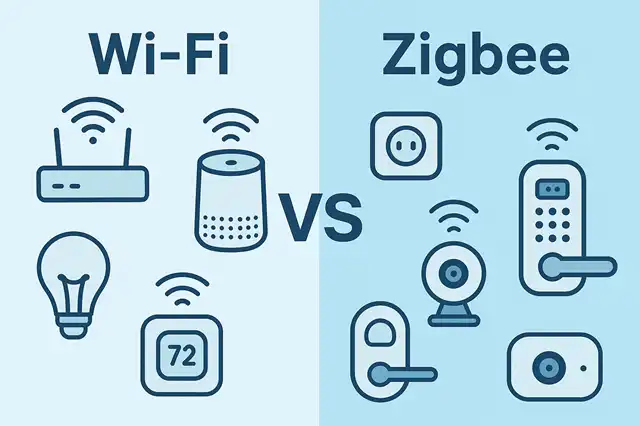
Two Technologies, Two Philosophies
Wi-Fi and Zigbee represent fundamentally different approaches to wireless communication, each optimized for distinct purposes.
Wi-Fi, based on the IEEE 802.11 standard family, was designed to provide high-speed internet access to computers and mobile devices. Operating on 2.4GHz and 5GHz frequencies, it delivers the substantial bandwidth needed for streaming 4K video, video conferencing, and downloading large files.
Wi-Fi networks typically form a star topology, with a router at the center connecting all devices directly to the internet.
Zigbee, in contrast, follows a “small but powerful” philosophy. Built on the IEEE 802.15.4 standard, it prioritizes low power consumption, modest data rates, and minimal cost.
While it shares the 2.4GHz frequency band with Wi-Fi, Zigbee employs a completely different networking approach.
The technology organizes devices into three categories: coordinators that manage the network, routers that relay signals, and end devices—typically sensors and controllers—that spend most of their time in sleep mode, waking only when needed.
The Mesh Network Advantage
Perhaps Zigbee’s most significant advantage lies in its mesh networking capability. Unlike Wi-Fi’s hub-and-spoke model, Zigbee creates a mesh topology where each router device can serve as a “stepping stone” for others. When you place a Zigbee light bulb in your hallway, it doesn’t just control lighting—it also extends the network, allowing a sensor in a distant bedroom to communicate with the coordinator through multiple hops.
This mesh architecture delivers two critical benefits. First, it dramatically extends coverage range. A Zigbee network can blanket an entire home, including challenging areas like basements and garages, without requiring additional infrastructure. Second, it provides remarkable reliability through self-healing capabilities. If one communication path fails, the network automatically reroutes data through alternative nodes, maintaining connectivity even when individual devices malfunction or lose power.
The Power Consumption Dilemma
The most compelling reason for choosing Zigbee over Wi-Fi in many smart home applications boils down to a simple reality: batteries. Consider a smart door sensor that needs to detect when a window opens. Wi-Fi’s high-speed communication requires substantial power, meaning such a sensor would need frequent battery changes—perhaps every few weeks. The same sensor using Zigbee can operate for years on a single battery, thanks to its ability to remain dormant most of the time and transmit only tiny packets of data when triggered.
This power efficiency becomes crucial when deploying dozens of sensors throughout a home. Wi-Fi-based sensors would create an unsustainable maintenance burden, requiring constant battery replacements. Zigbee’s ultra-low power consumption makes truly wireless, install-anywhere devices practical for everyday use.
Network Scalability and Management
Smart homes often contain dozens or even hundreds of connected devices. Each Wi-Fi device requires its own IP address and maintains a direct connection to the router, placing significant strain on network resources. Routers have finite capacity for simultaneous connections, and as devices multiply, performance can degrade, leading to congestion and dropped connections.
Zigbee networks elegantly sidestep this limitation. The coordinator manages all Zigbee devices while presenting only a single point of connection to the Wi-Fi network. A home might have fifty Zigbee sensors and switches, but from the router’s perspective, it’s just one device. This dramatically reduces network overhead and prevents the router from becoming overwhelmed.
Complementary Roles, Not Competition
Understanding these differences reveals why modern smart homes typically employ both technologies rather than choosing one over the other. Wi-Fi excels at connecting bandwidth-hungry devices that require constant internet access: smart TVs, security cameras, video doorbells, and smart speakers. These devices usually plug into wall power, so Wi-Fi’s higher energy consumption isn’t a concern.
Zigbee dominates the realm of sensors and simple controllers: motion detectors, door/window sensors, smart light switches, temperature sensors, and smart locks. These devices transmit small amounts of data infrequently, making Zigbee’s lower speeds perfectly adequate while benefiting enormously from its power efficiency and mesh networking.
In a typical smart home architecture, the Wi-Fi router serves as the backbone, connecting to the internet and managing high-bandwidth devices. A Zigbee coordinator (often integrated into a smart home hub) connects to this Wi-Fi network and manages a separate Zigbee mesh populated by sensors and controllers. The coordinator acts as a translator between the two networks, enabling Zigbee devices to trigger actions on Wi-Fi devices and vice versa.
Security and Interoperability Considerations
Both technologies offer robust security features, though with different approaches. Wi-Fi networks employ mature encryption standards like WPA2 and WPA3, providing strong protection for data transmission. Zigbee incorporates 128-bit AES encryption directly into the protocol, ensuring secure communication between devices.
Interoperability presents different challenges for each technology. Wi-Fi benefits from near-universal standardization—any certified Wi-Fi device should work with any Wi-Fi router. Zigbee, while based on unified standards, has historically suffered from fragmentation as manufacturers implemented different application-layer protocols. Recent initiatives like the Matter standard (formerly Project CHIP) aim to address these compatibility issues by providing a common application layer across multiple wireless protocols, including both Zigbee and Wi-Fi.
The Future: Coexistence and Evolution
The smart home of today—and likely tomorrow—is not a question of Zigbee versus Wi-Fi, but rather Zigbee and Wi-Fi working in concert. Each technology occupies the niche where its strengths shine brightest. Wi-Fi handles heavy lifting for multimedia and internet-connected devices, while Zigbee creates an efficient, self-healing network for the numerous small sensors and controllers that make homes truly intelligent.
As smart home adoption accelerates, this multi-protocol approach seems not just practical but necessary. The convenience of battery-powered, maintenance-free sensors depends on Zigbee’s efficiency, while the rich functionality of smart displays and cameras requires Wi-Fi’s bandwidth. Together, they create a layered, resilient ecosystem that delivers the seamless, responsive experience users expect from modern smart homes.
For homeowners building their smart home systems, the lesson is clear: don’t think in terms of choosing one technology over another. Instead, embrace the strengths of both, using Wi-Fi where power and bandwidth are available, and Zigbee where ultra-low power consumption and extensive coverage matter most. This complementary approach transforms a house into a truly intelligent home.