Why Enterprise Data Centers Still Rely Heavily on Hard Disk Drives Despite SSD Advancements?
Why Enterprise Data Centers Still Rely Heavily on Hard Disk Drives Despite SSD Advancements?
- 60% of MD5 Password Hashes Can Be Cracked in Under an Hour with a Single GPU
- Dirty Frag: Root Access on Every Major Linux Distribution — No Patch, No Warning
- Ubuntu 26.04 LTS (Resolute Raccoon): The Most Ambitious Ubuntu LTS in a Decade
- Proton Mail: Data Transferred to FBI Again!
- How Close Are Quantum Computers to Breaking RSA-2048?
- How to Prevent Ransomware Infection Risks?
- What is the best alternative to Microsoft Office?
Why Enterprise Data Centers Still Rely Heavily on Hard Disk Drives Despite SSD Advancements
While solid-state drives (SSDs) have revolutionized consumer computing with their blazing speeds and declining prices, a surprising reality persists in the world of enterprise data storage: hard disk drives (HDDs) remain indispensable.
In fact, approximately 80% of hyperscale enterprise data currently resides on mechanical hard drives rather than flash storage. This isn’t due to technological inertia—it’s a strategic choice driven by economics, capacity innovations, and the unique demands of massive-scale data management.
The Three-Tier Storage Architecture
Hyperscale enterprises—the tech giants operating sprawling data centers that power cloud services, social media platforms, and search engines—employ a sophisticated three-tier storage strategy.
This hierarchy consists of NAND flash-based SSDs at the top tier, HDDs in the middle, and magnetic tape at the bottom. Each tier serves a distinct purpose based on data access patterns and cost considerations.
The logic is straightforward: storing all data on SSDs would be prohibitively expensive. Instead, these organizations dynamically migrate data between tiers according to its “temperature”—how frequently it’s accessed.
Hot data requiring rapid access lives on SSDs, warm data moves to HDDs, and cold archival data descends to tape storage. This approach optimizes total cost of ownership (TCO) while maintaining performance where it matters most.
The Economics of Scale
The cost differential between SSDs and HDDs becomes staggering at hyperscale. When managing exabytes of information, even small per-gigabyte price differences multiply into hundreds of millions of dollars. HDDs offer dramatically lower cost per terabyte, making them the economically rational choice for the vast majority of enterprise data that doesn’t require millisecond access times.
Beyond initial purchase costs, HDDs provide advantages in power efficiency at scale. Modern high-capacity drives consolidate more data into fewer physical units, reducing the overall energy footprint of data centers—a critical consideration as sustainability pressures mount.
The Capacity Revolution
Perhaps the most compelling reason for HDDs’ continued dominance is their remarkable capacity growth trajectory. Western Digital’s progression illustrates this trend: three years ago, their largest drives topped out at 18TB. Today, that figure has reached 32TB—nearly doubling capacity in just three years.
The roadmap ahead is even more ambitious. Western Digital plans to introduce 36TB HDDs by mid-2026, followed by 44TB models by late 2027. This relentless capacity scaling directly addresses TCO concerns while simultaneously improving energy efficiency per terabyte stored.
Technological Innovation: From ePMR to HAMR
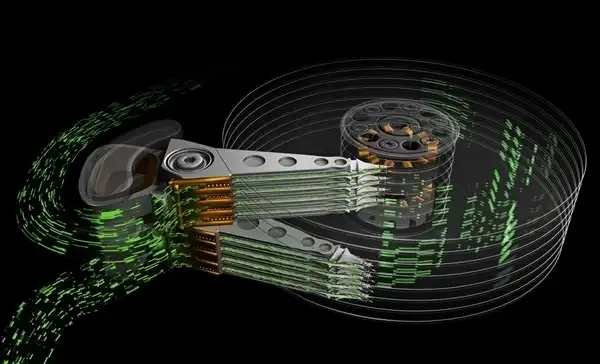
Achieving these capacity milestones requires fundamental technological advances. Western Digital has historically relied on ePMR (energy-assisted perpendicular magnetic recording) to pack data densely onto platters. However, for the 44TB drives launching in 2027, the company is transitioning to HAMR (heat-assisted magnetic recording).
HAMR represents a breakthrough approach: it uses laser beams to momentarily heat the magnetic disk medium during the write process. This heating allows data to be recorded on materials with higher magnetic stability, enabling far greater areal densities. According to industry projections, HAMR technology could eventually enable individual drives reaching 100TB capacity—a transformative milestone that would further cement HDDs’ role in enterprise infrastructure.
Meeting Hyperscale Demands
Capacity alone doesn’t satisfy hyperscale operators—they also require massive deployment scale. These organizations don’t purchase storage in hundreds or thousands of units; they operate on a scale where quarterly shipments reach into the millions of drives.
Western Digital is building systems capable of shipping one million units per quarter while simultaneously increasing capacity and maintaining stringent reliability and quality standards. This combination of volume manufacturing capability, capacity growth, and proven dependability creates a value proposition that SSDs cannot currently match for the majority of enterprise storage needs.
The Future of Enterprise Storage
The continuing success of HDDs doesn’t diminish SSDs’ importance—rather, it highlights how different storage technologies complement each other in modern data centers. SSDs excel at delivering performance for active workloads, while HDDs provide economical capacity for the massive volumes of less-frequently accessed data that still require preservation.
As data generation accelerates globally, the strategic use of HDDs in multi-tier architectures allows enterprises to manage exponential growth sustainably. The technology’s ability to scale capacity while controlling costs ensures that mechanical hard drives will remain a cornerstone of enterprise infrastructure for years to come—even as solid-state storage continues its impressive evolution.