Will Solid-State Batteries Replace Current Lithium-Ion Technology in Electric Vehicles?
Will Solid-State Batteries Replace Current Lithium-Ion Technology in Electric Vehicles?
- 60% of MD5 Password Hashes Can Be Cracked in Under an Hour with a Single GPU
- Dirty Frag: Root Access on Every Major Linux Distribution — No Patch, No Warning
- Ubuntu 26.04 LTS (Resolute Raccoon): The Most Ambitious Ubuntu LTS in a Decade
- Proton Mail: Data Transferred to FBI Again!
- How Close Are Quantum Computers to Breaking RSA-2048?
- How to Prevent Ransomware Infection Risks?
- What is the best alternative to Microsoft Office?
Will Solid-State Batteries Replace Current Lithium-Ion Technology in Electric Vehicles?
Introduction
The electric vehicle (EV) industry currently relies on two dominant battery chemistries: ternary lithium-ion batteries (NMC and NCA) and lithium iron phosphate (LFP) batteries.
However, solid-state battery (SSB) technology has emerged as a potential revolutionary successor, promising superior performance metrics across multiple dimensions.
This article examines whether solid-state batteries will eventually replace current lithium-ion technologies, drawing on recent scientific research and industry developments.
The Promise of Solid-State Technology
Superior Energy Density
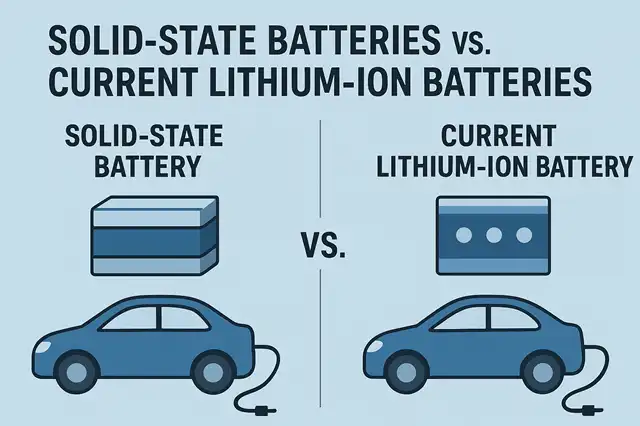
One of the most compelling advantages of solid-state batteries lies in their significantly higher energy density compared to conventional lithium-ion batteries.
According to research published in Advanced Functional Materials (2024), typical lithium-ion batteries achieve gravimetric energy densities of 150–250 Wh/kg, which researchers note “is not ideal for large-scale grid and transportation applications.” In contrast, solid-state batteries demonstrate substantially higher potential.
Recent developments have shown impressive progress in this domain. Research by Mercedes-Benz and Factorial has achieved 450 Wh/kg in solid-state battery prototypes, representing approximately an 80% improvement over conventional lithium-ion batteries.
These batteries are reportedly 33% smaller and 40% lighter than comparable lithium-ion alternatives. Furthermore, thin-film solid-state batteries have demonstrated energy densities ranging from 300-800 Wh/kg, while bulk-type configurations achieve 250-500 Wh/kg.
Honda’s research projections suggest their solid-state cells could be 50% smaller, 35% lighter, and potentially 25% cheaper than current lithium-ion batteries, with driving ranges exceeding 620 miles—a transformative increase over current EV capabilities.
Enhanced Safety Profile
Safety represents a critical differentiator for solid-state technology. Traditional lithium-ion batteries utilize liquid or gel electrolytes containing flammable organic solvents, which pose thermal runaway and fire risks. Solid-state batteries eliminate these flammable liquid electrolytes, replacing them with solid electrolyte materials that are nearly impervious to fire.
Materials Chemistry Frontiers (2024) highlighted that all-solid-state batteries have “gained significant attention as next-generation battery systems owing to their potential for overcoming the limitations of conventional lithium-ion batteries in terms of stability and high energy density.” This enhanced safety profile could prove decisive in consumer acceptance and regulatory approval for widespread EV adoption.
Extended Service Life and Performance Characteristics
Research published in MDPI’s Batteries journal (2024) emphasizes that solid-state batteries offer “superior safety, higher energy density, longer service life, temperature resistance, design flexibility, and environmental sustainability” compared to conventional technologies. The solid electrolyte interface demonstrates greater stability over charge-discharge cycles, potentially reducing degradation rates that plague current lithium-ion batteries.
Significant Challenges to Commercialization
Despite their theoretical advantages, solid-state batteries face substantial technical and economic hurdles that may delay or prevent complete market displacement of current technologies.
Manufacturing Complexity and Cost
The PNAS review (December 2024) acknowledges that solid-state batteries must “surmount technical and financial hurdles” before achieving market viability. Current manufacturing processes for solid-state batteries are significantly more complex and expensive than established lithium-ion production lines, which benefit from decades of optimization and economies of scale.
While Honda projects potential cost reductions of 25%, this remains speculative until mass production is achieved. The established infrastructure for NMC, NCA, and LFP battery production represents billions of dollars in sunk costs that manufacturers will be reluctant to abandon prematurely.
Ionic Conductivity Limitations
A critical technical challenge involves achieving adequate ionic conductivity in solid electrolytes. ScienceDaily reporting on 2024 research notes that all-solid-state lithium-ion batteries “face challenges like lower conductivity and insufficient electrode” performance. Solid electrolytes typically exhibit lower ionic conductivity than liquid electrolytes at room temperature, requiring elevated operating temperatures or sophisticated material engineering to overcome this limitation.
The electrode-electrolyte interface presents particular difficulties. Maintaining intimate contact between solid components throughout battery cycling, while managing volume changes during charge and discharge, represents an ongoing materials science challenge.
Timeline Uncertainties
Commercial deployment timelines remain highly uncertain despite optimistic manufacturer projections. Toyota targets 2027-2028 for commercial launch, while Honda and other manufacturers aim for deployment before 2030. However, these timelines have historically been subject to repeated delays as technical challenges emerge during scale-up efforts.
The Likely Transition Pathway
Rather than complete replacement, the evidence suggests a more nuanced transition scenario involving market segmentation and gradual adoption.
Semi-Solid-State as an Intermediate Step
CNBC reporting from October 2024 highlights growing interest in “semi-solid-state” batteries as an intermediate technology. These hybrid systems retain some liquid electrolyte while incorporating solid-state components, offering improved performance over current lithium-ion batteries while being more readily manufacturable than pure solid-state designs. This transitional technology may dominate the near-term market (2025-2030) before fully solid-state batteries achieve cost-effective mass production.
Market Segmentation
Different battery chemistries serve distinct market segments based on performance requirements and cost constraints. LFP batteries dominate cost-sensitive applications due to their lower material costs and adequate performance for standard-range vehicles. NMC batteries serve premium segments requiring maximum energy density. Solid-state batteries will likely initially target ultra-premium and performance applications where cost is secondary to range and charging speed.
Complementary Coexistence
The Journal of the American Chemical Society (2024) recognizes solid-state batteries as “high-energy-density alternatives to conventional lithium-ion batteries,” suggesting complementary rather than exclusive positioning. Multiple battery technologies have historically coexisted in the market, optimized for specific applications. The massive scale of global EV production likely necessitates multiple battery technologies serving different market segments simultaneously.
Conclusion
The evidence suggests that solid-state batteries will not completely replace current ternary lithium-ion and lithium iron phosphate batteries in the foreseeable future, but rather will gradually capture market share in specific applications while existing technologies continue serving other segments.
Solid-state technology offers genuine and substantial advantages in energy density, safety, and potentially lifespan. However, significant technical challenges in manufacturing scalability, ionic conductivity, interface engineering, and cost reduction must be resolved before mass-market penetration is achievable. The most likely scenario involves:
- Near-term (2025-2028): Continued dominance of NMC, NCA, and LFP batteries, with semi-solid-state batteries emerging in premium applications
- Medium-term (2028-2035): Gradual solid-state adoption in performance and premium vehicles, while LFP remains dominant in cost-sensitive segments
- Long-term (2035+): Potential majority market share for solid-state in new vehicle production, with legacy lithium-ion production continuing for replacement batteries and cost-sensitive applications
Complete displacement of current lithium-ion technologies appears unlikely before 2035, and even then, market segmentation may sustain multiple battery chemistries serving different applications.
The transition will be evolutionary rather than revolutionary, driven by technological maturation, manufacturing scale-up, and economic competitiveness rather than simple technical superiority.
Why Tesla Still Prefers Ternary Lithium-Ion Batteries Over Solid-State Technology
Toyota Accelerates Solid-State Battery Development: All-Solid-State EVs Targeted for 2027-2028
Will Solid-State Batteries Replace Current Lithium-Ion Technology in Electric Vehicles?
References
- Advanced Functional Materials (2024). “Solid-State Electrolytes for Lithium Metal Batteries: State-of-the-Art and Perspectives”
- Materials Chemistry Frontiers, Royal Society of Chemistry (2024). “Recent advances in all-solid-state batteries for commercialization”
- MDPI Batteries (2024). “Advancements and Challenges in Solid-State Battery Technology: An In-Depth Review of Solid Electrolytes and Anode Innovations”
- Proceedings of the National Academy of Sciences (December 2024). “Solid-state batteries could revolutionize EVs and more—if they can surmount technical and financial hurdles”
- Journal of the American Chemical Society (2024). “Recent Advances in Solid-State Batteries”
- Various industry reports from Honda, Toyota, Mercedes-Benz/Factorial, and market analysis publications (2024-2025)