Why DDR4 Memory and HDD Prices Are Soaring in 2025
Why DDR4 Memory and HDD Prices Are Soaring in 2025
- 60% of MD5 Password Hashes Can Be Cracked in Under an Hour with a Single GPU
- Dirty Frag: Root Access on Every Major Linux Distribution — No Patch, No Warning
- Ubuntu 26.04 LTS (Resolute Raccoon): The Most Ambitious Ubuntu LTS in a Decade
- Proton Mail: Data Transferred to FBI Again!
- How Close Are Quantum Computers to Breaking RSA-2048?
- How to Prevent Ransomware Infection Risks?
- What is the best alternative to Microsoft Office?
The Unseen Hand of AI: Why DDR4 Memory and HDD Prices Are Soaring in 2025
The year 2025 has brought an unexpected crunch for PC builders and data centers alike: significant and sustained price increases for both DDR4 memory and Hard Disk Drives (HDDs).
While seemingly disparate components, their shared upward trajectory can largely be attributed to a single, dominant force reshaping the tech landscape: the insatiable demands of Artificial Intelligence (AI) infrastructure.
Let’s delve into the distinct, yet interconnected, reasons behind these rising costs.
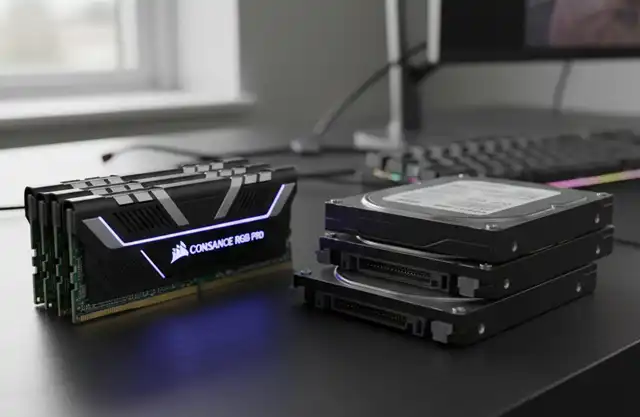
The Twilight of DDR4: A Planned Obsolescence Meets Unexpected Demand
For years, the industry has been preparing for the transition from DDR4 to its faster successor, DDR5. However, 2025 marks a pivotal moment where this planned evolution is colliding head-on with market realities, driving DDR4 prices sky-high.
1. The Great Production Pivot: All Hail HBM and DDR5
The primary driver of DDR4’s price surge is a deliberate, strategic shift by major memory manufacturers like Samsung, SK Hynix, and Micron. These giants are aggressively reallocating their production lines away from DDR4. Why? Because the future, and crucially, the highest profit margins, lie in two areas:
-
DDR5: The newer standard offers significant performance advantages for modern CPUs, making it the preferred choice for new consumer and server platforms.
-
High-Bandwidth Memory (HBM): This specialized, ultra-fast memory is the lifeblood of AI accelerators (GPUs designed for AI tasks). With the AI boom showing no signs of slowing, HBM production has become an absolute priority for memory fabs.
This pivot means new DDR4 wafer starts have been drastically reduced or halted entirely. What little DDR4 is still produced often comes from older, less efficient lines, further driving up costs.
2. Scarcity Breeds High Prices: The Lasting Legacy of Older Platforms
While the tech world moves to DDR5, millions of existing PCs and servers still rely on DDR4. Gamers with AMD AM4 builds, businesses with older Intel Xeon servers, and countless everyday users upgrading their systems suddenly find themselves in a challenging position. With minimal new stock entering the market, and a vast installed base still needing replacements or upgrades, the available supply of DDR4 is rapidly dwindling.
This scarcity has led to:
-
Soaring Spot Prices: DDR4 modules on the spot market have seen price increases exceeding 40% in some quarters of 2025.
-
DDR4 More Expensive than DDR5: In a bizarre market inversion, the cost-per-gigabyte of older DDR4 memory has, in some cases, surpassed that of the newer, more performant DDR5 due to extreme scarcity.
3. Projected Continued Escalation:
Analysts predict that DDR4 contract and spot prices will continue their double-digit gains throughout the remainder of 2025 and well into 2026. Unless there’s an unforeseen technological breakthrough or a dramatic collapse in demand for older platforms, the price of DDR4 will likely only continue its upward climb as remaining stock is depleted.
The Storage Powerhouse: AI’s Voracious Appetite for HDDs
While NVMe SSDs dominate the headlines for speed, HDDs remain the undisputed champion for massive, cost-effective storage, particularly in the terabyte and petabyte scale required by data centers. And it’s here that AI’s influence is most acutely felt, pushing HDD prices ever higher.
1. The AI Data Deluge: Training Models Requires Mountains of Data
Training sophisticated AI models, especially large language models and advanced image recognition systems, requires astronomical amounts of data. This includes vast datasets of text, images, videos, and sensor readings. This data isn’t just processed; it needs to be stored, accessed, and archived, often for extended periods.
Hyperscale cloud service providers (CSPs) – the backbone of modern AI development – are therefore in a frantic race to expand their storage infrastructure. They are snapping up every high-capacity HDD they can get their hands on, creating unprecedented demand for:
-
Nearline HDDs: Typically 16TB, 20TB, 24TB, and increasingly, 32TB and beyond. These drives offer the best balance of capacity and performance for cloud storage.
2. Supply Lag and Technological Hurdles:
HDD manufacturers like Western Digital and Seagate are struggling to keep pace with this sudden explosion in demand. Producing these ultra-high-capacity drives is a complex endeavor, involving:
-
Advanced Technologies: Newer drives often incorporate cutting-edge technologies like HAMR (Heat-Assisted Magnetic Recording) or MAMR (Microwave-Assisted Magnetic Recording) to achieve higher platters densities. These technologies are costly to research, develop, and integrate into mass production.
-
Extended Lead Times: The sheer volume of orders from CSPs has stretched manufacturing lead times. Reports indicate that for the largest capacity drives, lead times can now extend to nearly a year, creating a significant bottleneck and validating higher prices.
3. Rising Average Sales Prices (ASPs):
With demand outstripping supply, and the underlying production costs of advanced drives increasing, manufacturers have a clear rationale for hiking prices. Western Digital, for instance, has publicly announced “immediate, gradual price increases” across its HDD product line. This has translated into a noticeable rise in the Average Sales Price (ASP) of HDDs, with double-digit increases observed in the first half of 2025.
Conclusion: A New Era of Component Economics
The price hikes for DDR4 memory and HDDs in 2025 are not isolated incidents but symptoms of a larger paradigm shift.
The relentless growth of AI is not only driving demand for specialized hardware like GPUs and HBM but is also exerting immense pressure on more traditional components.
As AI continues its ascent, influencing everything from cloud computing to edge devices, the tech industry will likely witness continued volatility in component pricing.
For consumers and businesses, this means a new calculus for upgrades and infrastructure planning, where the “unseen hand” of AI now directly impacts the cost of fundamental computing resources.