Will China Bullet Trains Replace Boeing 737s?
Will China Bullet Trains Replace Boeing 737s? China’s CR450 High-Speed Train Reaches 453 km/h
- 60% of MD5 Password Hashes Can Be Cracked in Under an Hour with a Single GPU
- Dirty Frag: Root Access on Every Major Linux Distribution — No Patch, No Warning
- Ubuntu 26.04 LTS (Resolute Raccoon): The Most Ambitious Ubuntu LTS in a Decade
- Proton Mail: Data Transferred to FBI Again!
- How Close Are Quantum Computers to Breaking RSA-2048?
- How to Prevent Ransomware Infection Risks?
- What is the best alternative to Microsoft Office?
Will China Bullet Trains Replace Boeing 737s? China’s CR450 High-Speed Train Reaches 453 km/h
China has successfully tested the world’s fastest high-speed train, reaching speeds of 453 kilometers per hour, raising questions about whether ultra-fast rail could eventually replace regional aircraft like the Boeing 737 on short-haul routes.
The CR450 “Fuxing” (Renaissance) train completed its trial run on October 20, 2025, on the high-speed railway connecting Shanghai, Chongqing, and Chengdu, according to China Central Television (CCTV).
The new generation train, developed by state-owned China Railway Rolling Stock Corporation (CRRC) under the leadership of China Railway, represents a significant leap in rail technology.
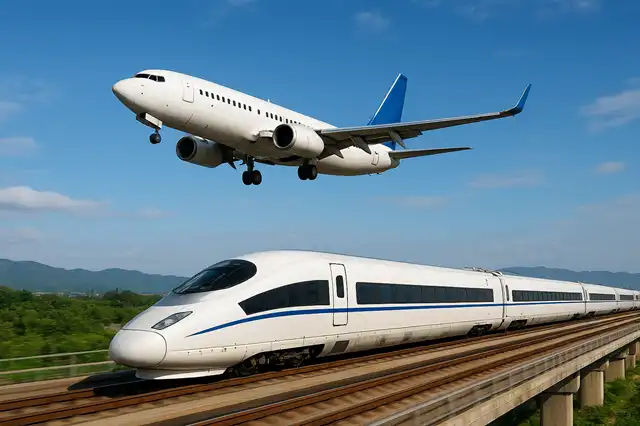
Technical Breakthrough
The CR450 outpaces current commercial high-speed trains by more than 100 kilometers per hour. While Shanghai’s maglev train currently holds the record for operational speed at 460 km/h, the CR450 is the fastest conventional wheel-based electric multiple unit in the world. By comparison, China’s existing CR400 series operates at 350 km/h, France’s TGV and Japan’s Shinkansen reach 320 km/h, and South Korea’s KTX reaches 305 km/h.
The train’s performance improvements stem from innovative engineering solutions. The streamlined body features an extended nose—increased from 12.5 to 15 meters—and a 20-centimeter reduction in height, cutting wind resistance by 22%. The train weighs 50 tons less than previous models and can accelerate from standstill to 350 km/h in just 100 seconds.
Perhaps most impressively, interior noise at 400 km/h measures only 68 decibels—equivalent to a conventional passenger car traveling at 70 km/h. This achievement comes from a new permanent magnet synchronous traction motor (PMSM), which operates 3% more efficiently than the asynchronous motors used in the CR400, reducing energy consumption.
Commercial Viability and the Aviation Question
China Railway Academy of Sciences announced plans to conduct comprehensive near-commercial-operation tests on the Chengdu-Chongqing mid-line railway next year. If successful, commercial operations could begin in 2026 after the train completes 600,000 kilometers of testing.
The potential impact on regional aviation depends on several factors. At 400+ km/h, high-speed rail becomes competitive with short-haul flights on routes up to 1,000-1,200 kilometers when accounting for airport security, boarding times, and urban transit connections. Aircraft like the Boeing 737 typically cruise at 850 km/h but require significantly more time for ground operations.
China’s aggressive infrastructure expansion under its 14th Five-Year Plan (2021-2025) has created a comprehensive transportation network exceeding 6 million kilometers. According to financial news outlet Cailian Press, over 80% of China’s county-level administrative regions are now connected to high-speed networks, with more than 90% of the population and economic activity located within these corridors.
Industry Implications
CCTV characterized the CR450’s successful trial as “an important milestone in China’s high-speed rail technology evolving from ‘Made in China’ to ‘Created in China.'”
However, complete replacement of regional aircraft remains unlikely. Aviation maintains advantages for distances beyond 1,200 kilometers and for routes requiring flexibility or serving areas without rail infrastructure. The more probable outcome is market segmentation, where ultra-high-speed rail dominates dense corridors between major cities, while aircraft continue serving longer routes, secondary markets, and international connections.
For aircraft manufacturers like Boeing, the expansion of 400+ km/h rail networks in China—and potentially other markets developing similar technology—may pressure demand for single-aisle jets on certain domestic routes, particularly as environmental concerns and energy efficiency gain prominence in transportation policy.
The CR450’s development signals that the competition between rail and air travel is entering a new phase, with implications extending far beyond China’s borders as other nations watch this technological race closely.