Does China Have Domestic Software Substitutes Amid US Export Ban Risks?
Does China Have Domestic Software Substitutes Amid US Export Ban Risks?
- 60% of MD5 Password Hashes Can Be Cracked in Under an Hour with a Single GPU
- Dirty Frag: Root Access on Every Major Linux Distribution — No Patch, No Warning
- Ubuntu 26.04 LTS (Resolute Raccoon): The Most Ambitious Ubuntu LTS in a Decade
- Proton Mail: Data Transferred to FBI Again!
- How Close Are Quantum Computers to Breaking RSA-2048?
- How to Prevent Ransomware Infection Risks?
- What is the best alternative to Microsoft Office?
Does China Have Domestic Software Substitutes Amid US Export Ban Risks?
Amid escalating U.S.-China trade and technology tensions, Beijing is rapidly pursuing domestic software innovations to offset potential losses caused by Washington’s expanded export curbs on “critical” software.
Following U.S. President Donald Trump’s 2025 decision to consider halting exports of technologies built with American software, China has responded with an accelerated self-reliance strategy across chip design, industrial manufacturing, enterprise management, and artificial intelligence sectors.
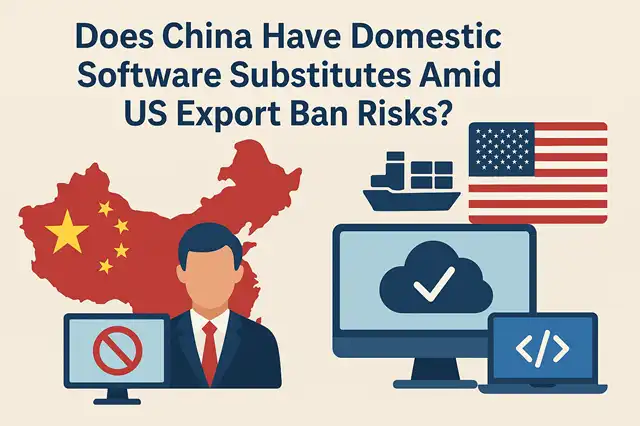
China Accelerates Domestic Software Substitution Amid Potential U.S. Export Restrictions
In response to the potential risk of the United States halting software exports, China has been advancing domestic alternatives across several key technology sectors.
Although the overall maturity of these substitutes still lags behind global leaders, their replaceability is improving rapidly and is expected to see significant progress within the next five years.
Semiconductor Design Software (EDA)
Key directions for domestic substitution include:
-
Empyrean Technology : Achieved mass application in both digital circuit and analog IC design. The company has launched a free domestic EDA trial program to mitigate the risk of supply disruption.
-
Xpeedic, GigaDesign, and Huawei EDA Joint Lab: Achieved 100% functional equivalence in 14nm process verification, with yield monitoring reaching international standards.
-
Market Outlook: The domestic EDA market share, which stood at around 15% in 2023, is projected to reach 35% by 2030, driven primarily by growth in AI chip and automotive electronics sectors.
Industrial Design and Manufacturing Software
China’s self-developed industrial software is advancing rapidly:
-
ZWSoft (ZW3D): Its 3D modeling precision has surpassed certain versions of SolidWorks and is now widely used in aerospace manufacturing.
-
PERA SIM (ANSYS alternative): Developed by PERA Global, its fluid simulation performance rivals ANSYS, helping automakers reduce simulation costs by up to 80%.
-
Huawei, Dongfang Electric, and Sany Heavy Industry: Have built industrial internet platforms using self-developed MOM and SCADA systems, enabling autonomous control of manufacturing processes.
Operating Systems and Office Software
-
Operating Systems: Kylin, UnionTech UOS, Huawei EulerOS, and OpenAnolis are all Linux-based and compatible with both x86 and domestic CPUs (Loongson, Kunpeng, Zhaoxin, etc.). These systems are now fully deployed in government and defense sectors.
-
Office Software: Kingsoft WPS Office and Yozo Office have become domestic replacements for Microsoft Office, fully compatible with its ecosystem, and are widely adopted in government and education institutions.
Enterprise Management Systems (ERP / Database)
-
ERP: Yonyou NC Cloud, Kingdee Cloud Galaxy, and Dingjie ERP have been successfully implemented in manufacturing and financial industries, supporting cloud-native and microservice architectures.
-
Databases: OceanBase, DM Database, Huawei GaussDB, Kingbase, and GBase have demonstrated full replacement capability for Oracle and SQL Server, and are already in extensive use within finance and government systems.
Artificial Intelligence and Large Model Frameworks
-
PaddlePaddle : Led by Baidu, it is currently China’s most mature open-source AI framework, supporting large-scale models and domestic GPUs.
-
MindSpore by Huawei: Optimized for the Ascend chip architecture, enhancing AI inference and training efficiency.
-
DeepSeek: A rising domestic AI framework emphasizing independent compatibility and security.
Conclusion
China’s domestic software ecosystem has begun to take shape — from EDA to operating systems, from ERP to AI frameworks, each field now features strong domestic players.
Although short-term challenges remain in achieving full compatibility with international ecosystems, in the medium to long term (2025–2030), full technological autonomy in areas such as design simulation, AI frameworks, and databases appears increasingly achievable.
| Sector | U.S. Software Affected | Chinese Alternatives | Status and Capabilities |
|---|---|---|---|
| Semiconductor Design (EDA) | Synopsys, Cadence, Siemens EDA | Empyrean, Primarius, Huawei EDA | Chinese EDA tools now cover analog and digital IC design at 14nm nodes; projected market share could reach 35% by 2030 . |
| Industrial & Manufacturing Software | AutoCAD, SolidWorks, ANSYS, MATLAB | ZW3D (ZWSOFT), PERA SIM (Ansys alternative), NineRiver Smart Manufacturing | Increasing presence in automotive and aerospace design; adoption in national projects under “Made in China 2025” . |
| Operating Systems | Microsoft Windows/macOS | Kylin OS, UnionTech UOS, Euler OS | Based on Linux, adapted for domestic CPUs (Loongson, Kunpeng); deployed in government and military networks . |
| Office & Productivity | Microsoft Office, Adobe Suite | WPS Office, Yozo Office | Proven compatibility with Office formats; widely used in public institutions and schools . |
| Enterprise & Database Systems | Oracle, SAP, VMware, AWS | Kingdee Cloud, UFIDA NC Cloud, OceanBase, GaussDB, DM Database | State-owned enterprises shifting to cloud-native domestic ERP and database platforms . |
| Artificial Intelligence | TensorFlow, PyTorch, NVIDIA CUDA | PaddlePaddle (Baidu), MindSpore (Huawei), DeepSeek | AI frameworks optimized for Chinese GPUs; DeepSeek emerging as a secure, interoperable alternative . |
What is the best alternative to Microsoft Office?
Replacing Microsoft Outlook on Linux: The Best Email Clients Compared
Why German State Governments Are Abandoning Microsoft Office for Open-Source Solutions