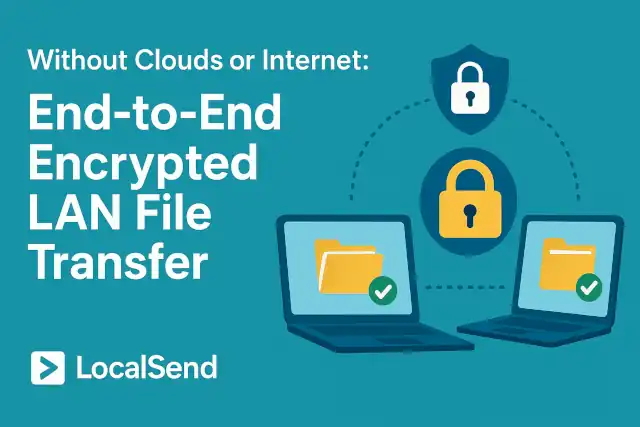
Without Clouds or Internet: End-to-End Encrypted LAN File Transfer with LocalSend
Without Clouds or Internet: End-to-End Encrypted LAN File Transfer with LocalSend
- 60% of MD5 Password Hashes Can Be Cracked in Under an Hour with a Single GPU
- Dirty Frag: Root Access on Every Major Linux Distribution — No Patch, No Warning
- Ubuntu 26.04 LTS (Resolute Raccoon): The Most Ambitious Ubuntu LTS in a Decade
- Proton Mail: Data Transferred to FBI Again!
- How Close Are Quantum Computers to Breaking RSA-2048?
- How to Prevent Ransomware Infection Risks?
- What is the best alternative to Microsoft Office?
Without Clouds or Internet: End-to-End Encrypted LAN File Transfer with LocalSend
Is LocalSend Safe? A Comprehensive Look at Its Security
In an era of cloud storage and internet-dependent services, LocalSend has emerged as a popular, offline alternative for local file sharing. But a critical question remains: is it truly safe to use?
The short answer is yes, LocalSend is widely considered a highly secure application, primarily due to its core design principles. However, understanding the specifics of its security model and the associated best practices is key to using it safely.
How Do Hackers Gain Administrator Access in Under an Hour?
The Pillars of LocalSend’s Security
LocalSend’s strong security reputation is built on several foundational features:
-
End-to-End Encryption
This is the cornerstone of its security. When you send a file, it is encrypted on your device before transmission over the local network. Only the intended recipient’s device possesses the key to decrypt it. Even if a malicious actor on the same Wi-Fi network were to intercept the data packets, they would see only encrypted, unreadable gibberish, not your actual files. -
No Internet or Cloud Servers
LocalSend operates entirely on your local area network (LAN), using Wi-Fi or a device-created hotspot. Your files are never uploaded to any third-party cloud server. This eliminates risks associated with data breaches at a cloud provider, internet-based surveillance, or interception during transit over the public internet. Your data stays strictly between your devices. -
Open-Source Transparency
LocalSend is an open-source project, meaning its complete source code is publicly available on GitHub. This allows security researchers and developers worldwide to continuously inspect the code for backdoors, vulnerabilities, or poor security practices. This transparency builds significant trust, as any potential issues can be identified and reported by the community quickly. -
Manual Verification and Consent
Unlike some services that auto-accept files, LocalSend requires explicit action from the receiver. The recipient must manually tap “Receive” for every transfer. Furthermore, for initial connections, the app may display a verification token or QR code that both parties must confirm. This process effectively prevents “man-in-the-middle” attacks and ensures you are connecting to the correct device. -
Anonymity and No Registration
The app does not require you to create an account, log in, or provide any personal information. It doesn’t collect your data or track your activity, enhancing your privacy.
Why Enterprises Must Implement Zero Trust Security?
Potential Risks and Essential Best Practices
While LocalSend’s design is robust, no software is 100% immune to risk. Users should be aware of the following and adopt these safe habits:
-
The Security of Your Local Network
-
Risk: LocalSend’s safety is contingent on the security of the LAN you’re using. On an unsecured public Wi-Fi network (e.g., at a cafe or airport), while your file content is encrypted, an attacker could still see that LocalSend traffic is occurring and might attempt to spoof a device.
-
Precaution: Use LocalSend on trusted, password-protected networks like your home or office. For the highest security, create a private network by having one device set up a hotspot for the other to join.
-
-
Device-Level Security
-
Risk: If your device is already compromised by malware or a virus, LocalSend cannot protect your files from being accessed or stolen before sending or after receiving.
-
Precaution: Maintain good device security by using reliable antivirus software and keeping your operating system updated.
-
-
The “Visible to Everyone” Setting
-
Risk: When this setting is enabled, your device appears to all other LocalSend users on the same network. In a public setting, this could expose you to unsolicited or malicious file transfer requests.
-
Precaution: In public or untrusted networks, disable the “Visible to Everyone” option. Only enable it when you need to transfer files and disable it afterward.
-
-
Software Source
-
Risk: Downloading the app from unofficial third-party websites or app stores carries the risk of installing a tampered version containing malware.
-
Precaution: Always download LocalSend from official sources: the Apple App Store, Google Play Store, Microsoft Store, or the official GitHub repository.
-
How to Defend Against Large-Scale DDoS Attacks: A Comprehensive Strategy
Final Verdict
LocalSend is an exceptionally secure tool for local file transmission, whose security model is superior to many proprietary alternatives.
Its combination of end-to-end encryption, local-only transfers, and open-source transparency makes it an excellent choice for privacy-conscious users.
For typical use cases in trusted environments like homes and offices, it can be used with high confidence. By following basic security hygiene:
- Downloading from official sources
- Using it on secure networks
- Being mindful of connection requests
You can leverage LocalSend’s convenience while minimizing potential risks. It successfully provides a secure, fast, and private way to share files without the internet.
Official Download Link