LiFi Promised Gigabit Speeds a Decade Ago—So Why Are We Still Using WiFi?
LiFi Promised Gigabit Speeds a Decade Ago—So Why Are We Still Using WiFi?
- 60% of MD5 Password Hashes Can Be Cracked in Under an Hour with a Single GPU
- Dirty Frag: Root Access on Every Major Linux Distribution — No Patch, No Warning
- Ubuntu 26.04 LTS (Resolute Raccoon): The Most Ambitious Ubuntu LTS in a Decade
- Proton Mail: Data Transferred to FBI Again!
- How Close Are Quantum Computers to Breaking RSA-2048?
- How to Prevent Ransomware Infection Risks?
- What is the best alternative to Microsoft Office?
LiFi Promised Gigabit Speeds a Decade Ago—So Why Are We Still Using WiFi?
What Are The Promise of Light-Speed Data and the Reality of Technical Barriers?
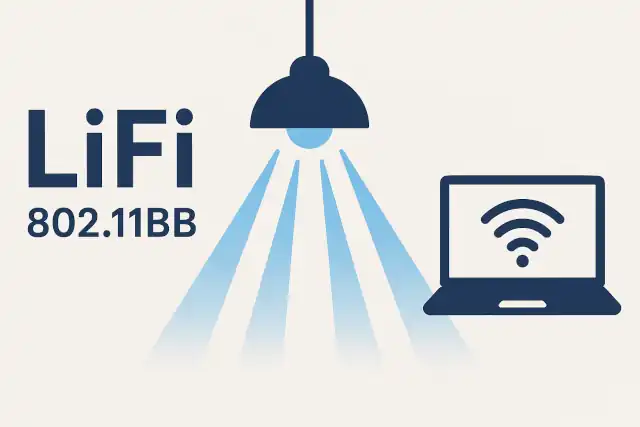
Light Fidelity (LiFi) technology has captivated researchers and industry observers for over a decade with its tantalizing promise: wireless data transmission at speeds potentially 100 times faster than WiFi, using nothing more than LED light bulbs.
Yet despite numerous laboratory demonstrations achieving multi-gigabit speeds, LiFi remains largely confined to pilot projects and niche applications.
What technical challenges have prevented this seemingly revolutionary technology from reaching mainstream adoption?
Li-Fi wireless transmission standard 802.11bb officially released
The Fundamental Obstacle: Line-of-Sight Dependency
The most significant challenge plaguing LiFi is its inherent requirement for direct line-of-sight between transmitter and receiver. Unlike radio waves that can penetrate walls and diffract around obstacles, light waves operate at much higher frequencies and behave more like particles. When a person walks between a LiFi-enabled light fixture and a receiving device, the connection drops instantly. This limitation creates a user experience fundamentally incompatible with modern expectations of seamless connectivity.
In practical environments—offices with moving personnel, homes with furniture and walls, or public spaces with crowds—maintaining continuous line-of-sight proves nearly impossible. While researchers have experimented with multiple access points and beam-steering technologies to create overlapping coverage zones, these solutions dramatically increase system complexity and installation costs.
Why Li-Fi Can’t Replace 5G and Wi-Fi?
Limited Uplink Capabilities
LiFi systems face an asymmetric communication problem. While LED lights can transmit data downstream to devices relatively easily, the reverse channel—from device back to the access point—presents significant engineering challenges. Mobile devices cannot use high-intensity visible light for uplink transmission without blinding users or draining batteries rapidly.
Current solutions typically employ infrared LEDs for the uplink channel, but these have limited range and power output constraints due to eye safety regulations. This creates a bottleneck where download speeds may reach gigabits per second, but upload speeds lag far behind, limiting applications like video conferencing or cloud synchronization that require robust bidirectional communication.
How Hackers Can Steal Your Data Through Fake Free WiFi?
Interference from Ambient Light
LiFi receivers must distinguish between data-carrying light signals and ambient lighting from sunlight, conventional lamps, or screens. Sunlight, in particular, contains orders of magnitude more optical power than a modulated LED signal. While sophisticated filtering and signal processing techniques can mitigate this interference indoors, outdoor deployment becomes virtually impossible during daylight hours.
Even indoors, fluorescent lights with electronic ballasts and LED lighting from non-LiFi sources create noise that degrades signal quality. This ambient light pollution requires receivers to employ complex photodetectors with narrow field-of-view and advanced algorithms, increasing both component costs and power consumption.
TP-Link Successfully Completes First Wi-Fi 8 Hardware Trial: A Leap Forward in Wireless Reliability
Mobility and Handover Challenges
Modern wireless networks must support seamless handover as users move between coverage areas. In WiFi networks, handover protocols have been refined over decades. LiFi systems must manage handovers between light fixtures while maintaining the stringent line-of-sight requirement, creating a coordination problem that’s exponentially more complex.
As a user moves through a building, the system must predict which light fixture will provide the next connection and execute handovers in milliseconds to prevent dropped connections. The small coverage area of each LiFi cell—typically just a few square meters—means handovers occur far more frequently than in WiFi networks, placing enormous demands on network architecture and processing capabilities.
Wi-Fi 8 Could Arrive Next Year as Industry Shifts Focus from Speed to Reliability
Infrastructure and Standardization Gaps
Unlike WiFi, which benefits from decades of standardization through IEEE 802.11 protocols, LiFi lacks comprehensive, universally adopted standards. The IEEE 802.15.7 standard for optical wireless communications exists but hasn’t achieved the market penetration necessary to drive mass manufacturing and interoperability.
Deploying LiFi requires specialized LED drivers capable of high-frequency modulation (typically MHz to GHz range) while maintaining flicker-free illumination. Retrofitting existing lighting infrastructure is expensive and technically complex. New buildings would need to be designed with LiFi in mind, integrating both lighting and communication planning from the architectural phase—a chicken-and-egg problem that slows adoption.
Limited Device Ecosystem
Perhaps the most pragmatic barrier is the absence of LiFi-compatible receivers in consumer devices. Smartphones, laptops, and tablets universally include WiFi and cellular radios, but none incorporate the photodetectors and signal processing hardware required for LiFi. Adding these components would increase manufacturing costs, device thickness, and power consumption—a tough sell when WiFi already meets most users’ needs.
Without devices in users’ hands, there’s little incentive to deploy LiFi infrastructure. Without infrastructure, manufacturers won’t invest in LiFi-capable devices. This circular dependency has proven difficult to break, even with demonstration projects showing impressive technical capabilities.
Power Consumption Trade-offs
While LiFi proponents highlight the efficiency of using existing lighting infrastructure for dual purposes, the reality is more nuanced. Maintaining the high-frequency modulation necessary for multi-gigabit transmission requires sophisticated LED driver circuits that consume more power than standard lighting drivers. Additionally, the photodetectors and signal processing electronics in receiving devices draw continuous power, potentially reducing battery life in mobile devices.
The Path Forward
Despite these challenges, LiFi isn’t dead. Niche applications where its limitations become advantages continue to emerge: secure communications in environments where radio frequency leakage is problematic, hospital settings where RF interference concerns exist, or underwater communications where radio waves fail entirely.
Research continues on hybrid systems that combine LiFi with WiFi or 5G networks, using LiFi for high-bandwidth downlinks in stationary settings while relying on RF technologies for mobility and uplink. Advances in avalanche photodiodes, optical concentrators, and machine learning-based signal processing may eventually address some technical barriers.
However, for LiFi to transition from laboratory curiosity to everyday utility, it must overcome not just individual technical challenges but the compounding effect of multiple simultaneous limitations. Until a compelling use case emerges that justifies the substantial infrastructure investment despite these constraints, LiFi will likely remain a promising technology still waiting for its moment.