Why Enterprises Should Replace VPN with Warpgate?
Why Enterprises Should Replace VPN with Warpgate: A Modern Approach to Secure Remote Access
- 60% of MD5 Password Hashes Can Be Cracked in Under an Hour with a Single GPU
- Dirty Frag: Root Access on Every Major Linux Distribution — No Patch, No Warning
- Ubuntu 26.04 LTS (Resolute Raccoon): The Most Ambitious Ubuntu LTS in a Decade
- Proton Mail: Data Transferred to FBI Again!
- How Close Are Quantum Computers to Breaking RSA-2048?
- How to Prevent Ransomware Infection Risks?
- What is the best alternative to Microsoft Office?
Why Enterprises Should Replace VPN with Warpgate: A Modern Approach to Secure Remote Access
Introduction
As remote work becomes the new normal, providing efficient and secure access to internal enterprise resources has become a critical security priority.
Traditional VPNs and bastion hosts have long been the cornerstone of remote access management in enterprise security architectures.
However, with the evolution of cloud computing, zero-trust architecture, and increasingly sophisticated attack methods, the inherent design flaws of these legacy solutions are becoming increasingly apparent—particularly in terms of security, manageability, and user experience.
Why VPN Security Should Be Every Enterprise’s Top Priority
The Problems with Traditional VPN
Traditional VPNs operate on a “network-as-perimeter” assumption. Once a user passes authentication, they gain network access privileges equivalent to internal employees, including access to internal network segments and IP addresses. This broad access creates several critical vulnerabilities:
- Excessive Network Access: Authenticated users receive blanket access to the internal network, making internal hosts potential targets for attackers who can leverage compromised credentials to turn machines into botnets or launch lateral movement attacks.
- Complex Configuration: Many VPN solutions require complicated setup procedures and client software installation, creating friction for users and administrative overhead for IT teams.
- Performance Bottlenecks: All traffic must route through VPN gateways, which easily become performance bottlenecks, especially for international access scenarios.
- Limited Visibility: VPNs provide minimal granular visibility into what resources users are actually accessing once connected to the network.
Why Enterprises Are Replacing VPNs with Zscaler Private Access?
The Limitations of Traditional Bastion Hosts
While bastion hosts offer some advantages over VPNs, they face their own set of challenges:
- Limited Protocol Coverage: Often restricted to SSH/RDP protocols
- Poor Scalability: Difficult to scale horizontally in distributed environments
- Suboptimal User Experience: Require multiple authentication steps and lack modern UI/UX
- Cloud-Native Incompatibility: Not designed for containerized or cloud-native environments
Anatomy of a Ransomware Attack: The Askul and Asahi Cyber Incidents In Japan
Introducing Warpgate: A Modern Alternative
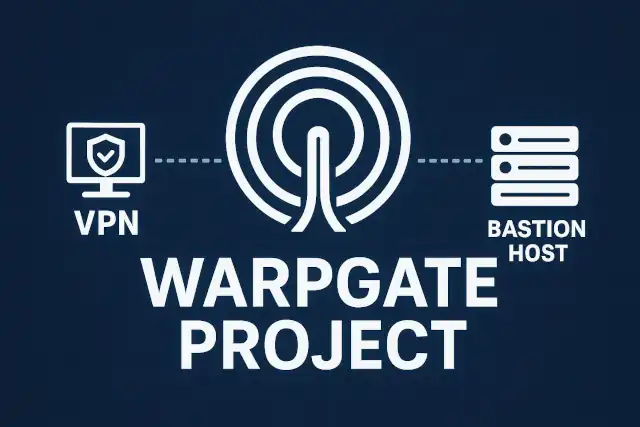
Warpgate is an open-source, cloud-native bastion host that embraces zero-trust principles and modern security paradigms. Unlike traditional VPNs that grant network-level access, Warpgate provides application-level access control, ensuring users can only access specific resources they’re authorized to use.
Core Security Features of Warpgate
1. Zero-Trust Access Control
Warpgate implements granular, identity-based access control. Users don’t get network access; instead, they receive permission to specific services (SSH, HTTP, MySQL, etc.), eliminating the lateral movement risks inherent in VPN architectures.
2. Multi-Protocol Support
Unlike traditional bastion hosts, Warpgate supports multiple protocols including:
- SSH
- HTTP/HTTPS
- MySQL and PostgreSQL databases
- This extensibility makes it suitable for diverse enterprise environments
3. Session Recording and Auditing
All sessions are recorded and can be replayed for compliance and forensic purposes. This provides complete visibility into what actions users perform on remote systems.
4. Multi-Factor Authentication (MFA)
Built-in support for modern authentication mechanisms including:
- TOTP (Time-based One-Time Passwords)
- SSO integration
- Public key authentication
5. Web-Based Access
No client software installation required—users can access resources directly through their web browser, significantly improving user experience and reducing deployment complexity.
6. Fine-Grained Role-Based Access Control (RBAC)
Administrators can define precise roles and permissions, ensuring principle of least privilege is enforced across the organization.
7. TLS Encryption
All connections are encrypted end-to-end using modern TLS protocols, protecting data in transit from interception.
Why EDR is Critical for Enterprises to Prevent Ransomware Attacks?
How to Deploy and Use Warpgate
Deployment Options
1. Docker Deployment (Recommended for Quick Start)
docker run -d \
  --name warpgate \
  -p 8888:8888 \
  -p 2222:2222 \
  -v /opt/warpgate:/data \
  ghcr.io/warp-tech/warpgate:latest
2. Binary Deployment
# Download the latest release
wget https://github.com/warp-tech/warpgate/releases/download/latest/warpgate-linux-x64

# Make it executable
chmod +x warpgate-linux-x64

# Run with configuration file
./warpgate-linux-x64 --config /etc/warpgate/config.yaml
3. Kubernetes Deployment
For cloud-native environments, deploy Warpgate as a Kubernetes service with load balancing and high availability configurations.
Basic Configuration
Create a config.yaml file:
http:
  listen: 0.0.0.0:8888
  certificate: /data/tls.crt
  key: /data/tls.key

ssh:
  listen: 0.0.0.0:2222
  keys: /data/ssh-keys

database:
  path: /data/warpgate.db

targets:
  - name: production-server
    host: 10.0.1.100
    port: 22
    protocol: ssh

  - name: internal-web-app
    host: 10.0.2.50
    port: 443
    protocol: https
User Access Workflow
- Administrator Setup: Configure targets (servers, databases, web apps) in Warpgate
- User Assignment: Assign users to specific targets with appropriate permissions
- User Access: Users navigate to Warpgate’s web interface, authenticate, and select their authorized target
- Connection: Warpgate proxies the connection, recording the session and enforcing policies
Comparison: Warpgate vs. Traditional Solutions
| Feature | Traditional VPN | Traditional Bastion Host | Warpgate |
|---|---|---|---|
| Access Model | Network-level | Host-level | Application-level (Zero-Trust) |
| Client Installation | Required | Sometimes required | Not required (Web-based) |
| Protocol Support | All network protocols | SSH/RDP only | SSH, HTTP, MySQL, PostgreSQL, extensible |
| Session Recording | Limited or none | SSH/RDP only | Full session recording for all protocols |
| Granular Access Control | Network-based (coarse) | Host-based (moderate) | Service-based (fine-grained) |
| Performance | Gateway bottleneck | Direct connection | Optimized proxy with minimal overhead |
| MFA Support | Varies by vendor | Limited | Native TOTP, SSO integration |
| Cloud-Native | Not designed for it | Poor support | Kubernetes-ready, containerized |
| Scalability | Vertical scaling | Limited | Horizontal scaling |
| User Experience | Complex setup, client issues | Multiple authentication steps | Single web interface, seamless access |
| Lateral Movement Risk | High (full network access) | Moderate | Minimal (zero-trust model) |
| Compliance & Audit | Difficult | Session logs only | Complete session replay and audit trails |
| Deployment Complexity | High | Moderate | Low (Docker, K8s support) |
| Cost | License + infrastructure | License + infrastructure | Open-source, infrastructure only |
Conclusion
As enterprises embrace cloud-native architectures and zero-trust security models, traditional VPNs and bastion hosts increasingly fall short of modern security requirements. Warpgate represents a paradigm shift—moving from network-centric to identity-centric access control, eliminating the implicit trust that makes legacy solutions vulnerable.
By providing granular, application-level access control, comprehensive auditing, multi-protocol support, and seamless user experience, Warpgate addresses the core weaknesses of traditional remote access solutions. For enterprises looking to modernize their security posture while improving operational efficiency, Warpgate offers a compelling open-source alternative that aligns with contemporary security best practices.
The transition from VPN to Warpgate isn’t just a technology upgrade—it’s a strategic move toward a more secure, manageable, and user-friendly remote access infrastructure that’s fit for the modern enterprise.
Warpgate Project Link